$SOL
Alpenglow is getting most of the attention for one headline: Solana wants finality around 150ms instead of roughly 12.8 seconds.
But there’s a detail I think the market could easily misread.
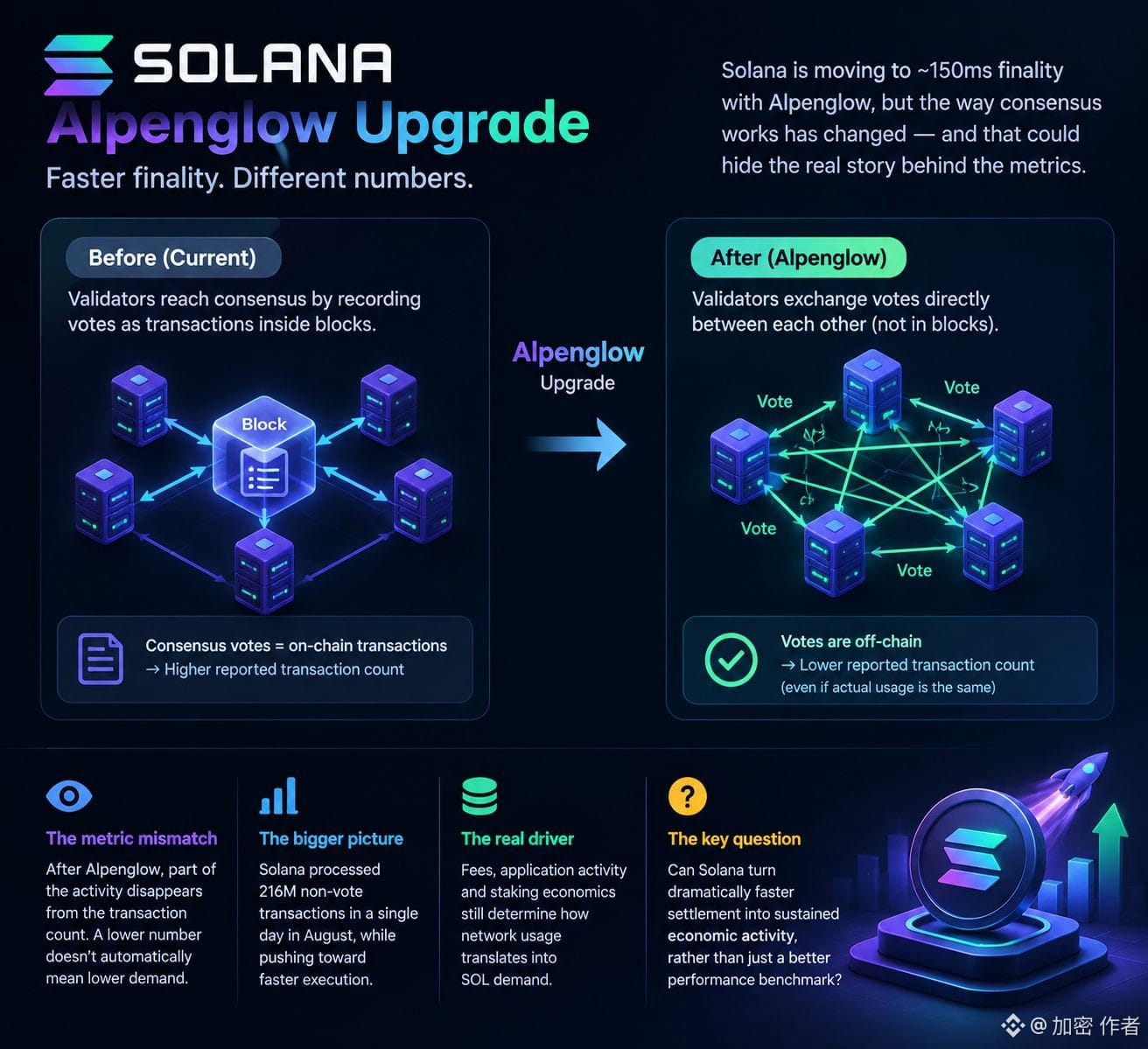
The upgrade changes how validators reach consensus, with votes sent directly between validators instead of being recorded as transactions inside blocks. That means Solana’s reported transaction count can fall even if actual user activity stays the same.
That creates an unusual metric problem.
For years, transaction count has been used as a rough proxy for network demand. After Alpenglow, part of that activity disappears from the denominator because consensus overhead is no longer represented the same way.
So a lower “transactions” number wouldn’t automatically mean lower usage.
The more interesting question is what happens to the economics underneath it.
Solana already processed 216M non-vote transactions in a single day in August, while the network continues pushing toward faster execution. But faster finality does not automatically mean proportionally more SOL demand. Fees, application activity, and staking economics still determine how network usage translates into token demand.
That’s the tension I’ll be watching: can Solana turn dramatically faster settlement into sustained economic activity, rather than simply a better performance benchmark?
$BR
$PYTH
Alpenglow is getting most of the attention for one headline: Solana wants finality around 150ms instead of roughly 12.8 seconds.
But there’s a detail I think the market could easily misread.
The upgrade changes how validators reach consensus, with votes sent directly between validators instead of being recorded as transactions inside blocks. That means Solana’s reported transaction count can fall even if actual user activity stays the same.
That creates an unusual metric problem.
For years, transaction count has been used as a rough proxy for network demand. After Alpenglow, part of that activity disappears from the denominator because consensus overhead is no longer represented the same way.
So a lower “transactions” number wouldn’t automatically mean lower usage.
The more interesting question is what happens to the economics underneath it.
Solana already processed 216M non-vote transactions in a single day in August, while the network continues pushing toward faster execution. But faster finality does not automatically mean proportionally more SOL demand. Fees, application activity, and staking economics still determine how network usage translates into token demand.
That’s the tension I’ll be watching: can Solana turn dramatically faster settlement into sustained economic activity, rather than simply a better performance benchmark?
$BR
$PYTH