

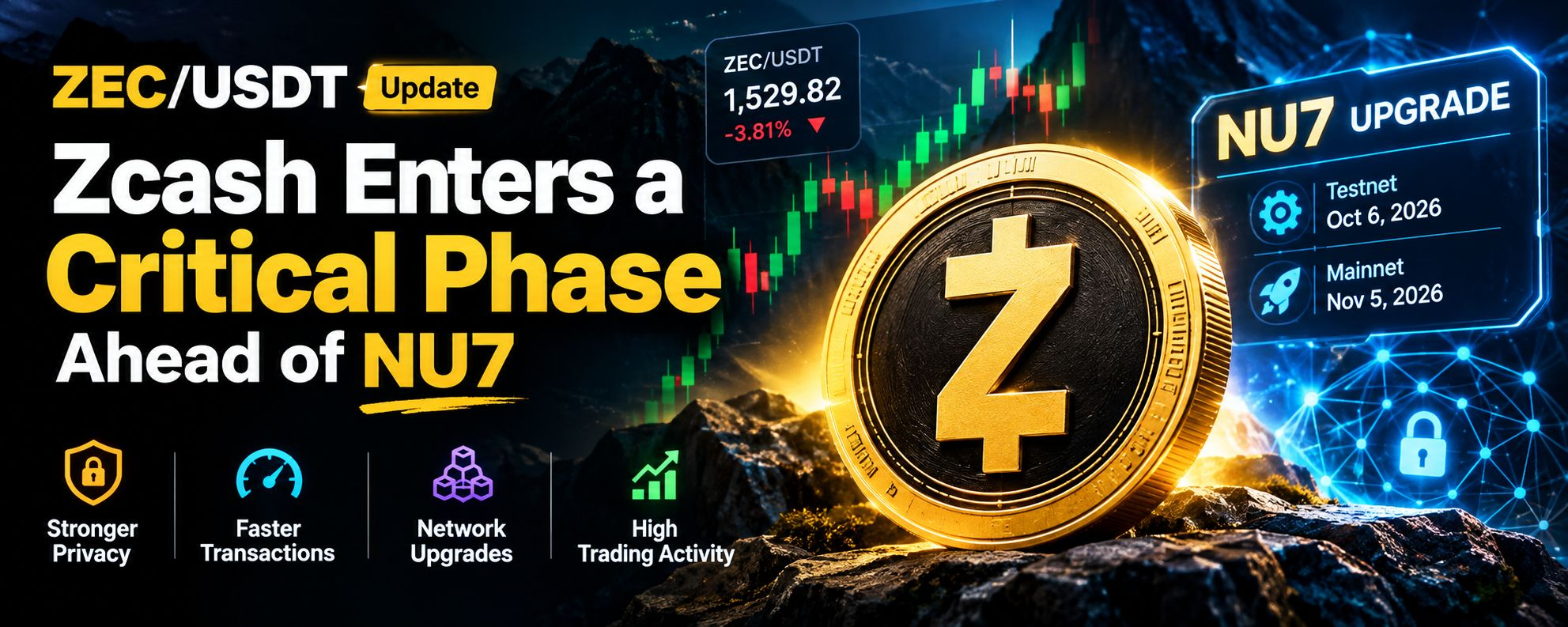


I’m watching ZEC closely because the current move is no longer just about a privacy coin suddenly getting attention. Zcash is approaching one of the most important protocol changes in its recent history, while the market is already showing unusually large trading activity around the token.
On Binance Futures, ZEC/USDT is currently trading around $1,529.82, down 3.81% on the latest snapshot. The 24-hour range is wide, from $1,512.45 to $1,625.91, while reported futures volume has reached roughly 1.20 million ZEC, equivalent to about $1.87 billion in USDT volume.
That creates an interesting situation: the market is highly active, but the bigger question is whether this activity is being supported by the underlying network story.
The bigger catalyst is NU7
Zcash is preparing for its next major network upgrade, known as NU7.
According to the Zcash community's current timeline, testnet activation is planned for October 6, 2026, with mainnet activation targeted for November 5, 2026, subject to the final activation decision after testing.
The most visible change is the planned reduction in block spacing from 75 seconds to 25 seconds.
That is not simply a cosmetic upgrade.
Producing blocks more frequently can reduce the waiting time around transaction confirmation and change how the network handles transaction processing. In other words, Zcash is attempting to improve the basic experience of using its blockchain without abandoning the privacy-focused architecture that has defined the project.
A September governance vote also showed strong support among participating ZEC holders for 25-second blocks and for preserving the existing Bitcoin-style halving schedule. CoinDesk reported that nearly 2.4 million ZEC participated, representing roughly two-thirds of eligible tokens.
But the interesting part is what happens underneath
The market tends to focus on the headline:
“Zcash is getting faster.”
I think the more important story is that the engineering work around Zcash is also moving forward.
The latest Zcash Foundation engineering update described improvements to Zebra, the Rust-based Zcash node implementation. Developers have been working on preparing block templates in the background, improving handling of competing blocks, supporting lower conventional transaction fees and strengthening testing and monitoring.
One proposed fee change would reduce the conventional transaction fee from 5,000 zatoshis to 1,000 zatoshis per logical action, although the Foundation notes that this remains a draft rather than a consensus-rule change.
That distinction matters.
Not every development mentioned around NU7 is already active on mainnet. Some changes are still proposals, some are under development, and others require future activation.
For traders, that means the current market narrative can move faster than the actual protocol implementation.
There is another detail traders should watch
Zcash recently had development-side security issues identified during engineering work.
The Foundation said several transaction-validation checks had been temporarily omitted from the development branch of Zebra. Those issues were restored and covered with regression tests, and the Foundation stated that the affected checks were not absent from published Zebra releases.
That is actually a useful reminder about the difference between development risk and live-network risk.
The discovery happened before the problematic code reached a published release, which allowed the team to correct it. But it also shows why major protocol upgrades require extensive testing before activation.
NU7 is therefore not simply a date on a calendar. The quality of the testnet phase and infrastructure preparation will matter.
Now look back at the ZEC chart
The current Binance snapshot shows ZEC around $1,529, after trading as high as $1,625.91 during the last 24 hours.
That means the market has already experienced a significant rejection from the session high.
The important zone is therefore not only whether ZEC can move higher. It is whether the market can absorb selling pressure while the NU7 narrative continues developing.
The reported $1.87 billion in 24-hour USDT futures volume is particularly notable. High derivatives activity can create rapid price movements in both directions, so volume alone should not be interpreted as proof of long-term demand.
This is where the current setup becomes interesting.
The network has a genuine technological catalyst coming.
The market also has genuine liquidity and speculation around ZEC.
But those two things are not automatically the same.
What I’m watching next
For me, the most important developments are the progression toward the NU7 testnet, the final mainnet activation decision, and whether the engineering changes continue moving from development into stable releases.
The scheduled November 5 mainnet target gives the market a clear event to watch, but the October testnet stage may provide an earlier signal about how smoothly the upgrade is progressing.
At the same time, traders should keep an eye on whether ZEC can stabilize after the sharp intraday range between approximately $1,512 and $1,626.
The interesting contradiction is this:
Zcash is preparing to become faster and improve its infrastructure, while the token itself is already trading in an extremely high-volume speculative environment.
If network development keeps progressing while market activity remains strong, the next phase of the ZEC story could become much more about infrastructure execution than simply privacy-coin speculation.
The real question is whether the market will continue focusing on the chart—or start pricing the actual transformation happening underneath the chart.
Are you watching ZEC mainly for the NU7 upgrade, or for the current trading momentum?
