


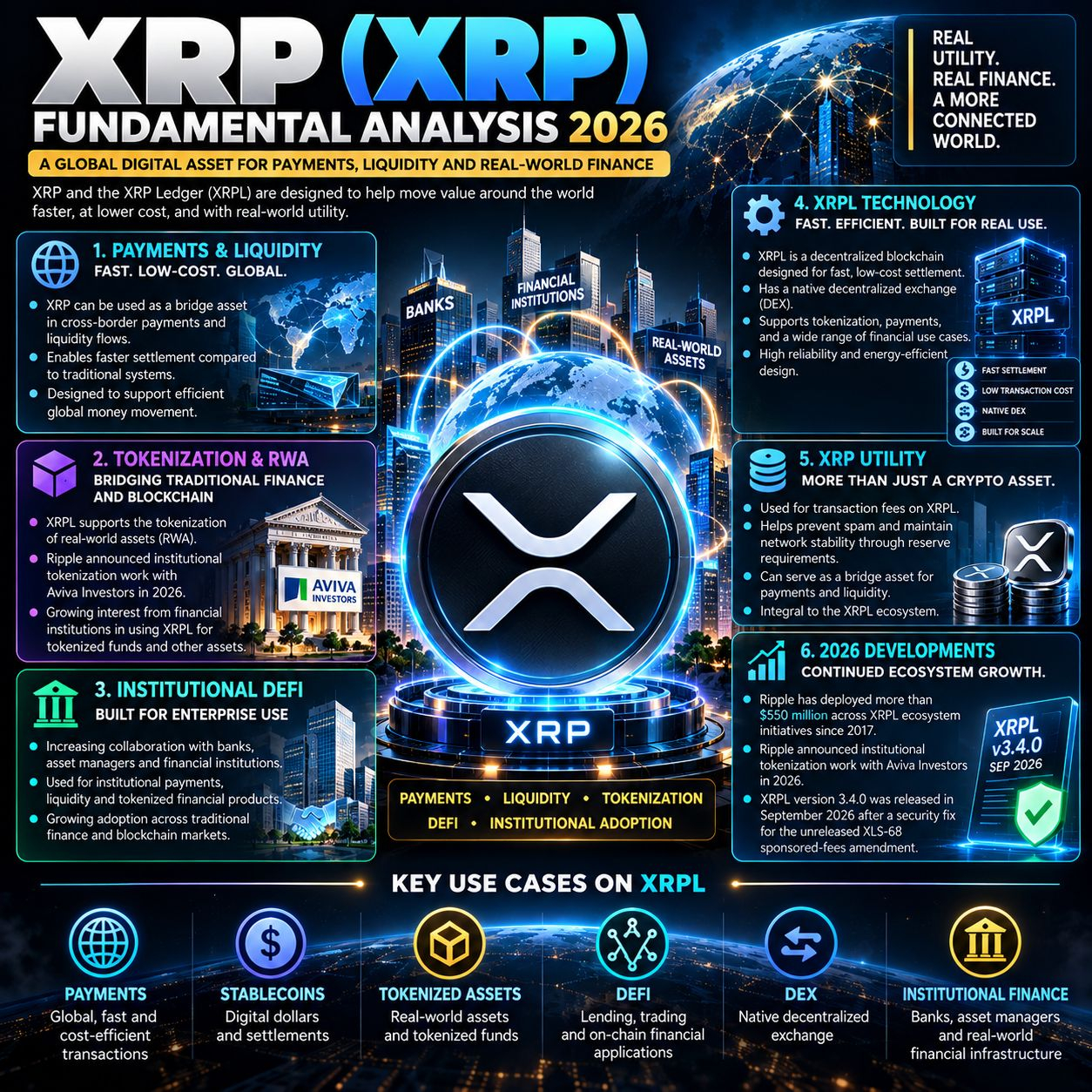
$XRP has a different fundamental story from Bitcoin, Ethereum and Solana.
Bitcoin focuses heavily on scarcity and decentralized monetary value. Ethereum focuses on programmable blockchain infrastructure. Solana emphasizes high-performance applications.
XRP's fundamental story is closely connected to payments, liquidity, settlement and tokenized financial assets.
The key question is:
Can the XRP Ledger convert its technology and institutional partnerships into sustainable real-world financial activity?
1. What Is XRP?
XRP is the native digital asset of the XRP Ledger (XRPL), a decentralized blockchain designed for fast and efficient settlement.
XRP can be used for:
Transaction fees
Network reserves
Liquidity
Cross-border value transfer
Bridging assets
XRPL applications
XRPL is designed specifically around financial use cases, including payments, trading, tokenization and settlement. Ripple says the ledger has processed more than $1 trillion in value and has operated for more than 12 years.
2. Payments & Liquidity
One of XRP's central use cases is its potential role as a bridge asset.
In a cross-border transaction, XRP can potentially help move value between different currencies or assets without requiring every currency pair to maintain direct liquidity.
This gives XRP a fundamentally different narrative from many smart-contract tokens.
Its value proposition is connected to:
Speed + liquidity + settlement efficiency
3. XRPL Is Built for Financial Applications
The XRP Ledger includes native functionality such as:
Decentralized exchange
Escrow
Token issuance
Automated market-making
Payment infrastructure
Tokenized assets
XRPL transactions are designed to settle within seconds at very low cost.
This architecture makes XRPL particularly relevant to financial institutions exploring blockchain-based settlement.
4. Tokenization — A Major Growth Area
One of the most interesting developments around XRPL is real-world asset tokenization.
Financial institutions can potentially tokenize:
Funds
Bonds
Securities
Commodities
Other financial assets
In February 2026, Aviva Investors announced a collaboration with Ripple to explore tokenizing traditional fund structures on the XRP Ledger.
Ripple has also expanded its digital-capital-markets infrastructure through investments in ZILO and Licuido, aimed at areas including issuance, transfer agency technology and collateral mobility on XRPL.
This is important because tokenization could connect traditional financial markets with blockchain infrastructure.
5. Institutional DeFi
XRPL is increasingly being developed around institutional financial applications.
The ecosystem has been adding functionality for:
Lending
Tokenized assets
Compliance
Permissioned markets
Institutional liquidity
Financial settlement
Ripple reported that XRPL had reached more than $1 billion in monthly stablecoin volume and entered the top 10 chains for real-world-asset activity in its 2025 institutional-DeFi update.
These figures are historical/issuer-reported metrics, so investors should independently monitor current on-chain data.
6. XRP's Role in the Ecosystem
XRP has several native uses within XRPL.
Transaction fees
Transactions on XRPL require XRP.
Reserve requirements
Accounts and certain ledger objects require XRP reserves.
Liquidity
XRP can act as a bridge asset between different currencies and tokens.
Asset settlement
XRP can be used within financial applications built on XRPL.
Decentralized exchange
XRP is part of XRPL's native trading infrastructure.
These mechanisms create potential utility beyond speculative trading.
7. XRP Supply
XRP has a very different supply structure from BTC.
There is a large predetermined supply of XRP, and XRP used for transaction fees is burned.
Therefore, XRP's investment thesis should not be based simply on scarcity.
The more important questions are:
How much XRP is actually being used?
How much liquidity is required?
How much financial activity is moving through XRPL?
How does circulating supply interact with demand?
8. Ripple vs XRP — An Important Difference
A common mistake is treating Ripple and XRP as the same thing.
They are not.
Ripple is a private company that develops blockchain and financial infrastructure.
XRP is the digital asset native to the XRP Ledger.
XRPL is the decentralized public blockchain.
Ripple can build products and partnerships around XRPL, but XRP itself exists independently as the native asset of the ledger.
Understanding this distinction is important when analyzing XRP fundamentals.
9. 2026 Ecosystem Development
The XRPL ecosystem continues to evolve technically.
XRPL version 3.4.0 was released in September 2026. The release included a fix related to the XLS-68 Sponsored Fees and Reserves amendment.
The XLS-68 issue is a useful reminder that even mature blockchain infrastructure requires continuous security testing and upgrades.
The vulnerability was identified during Devnet testing and was fixed before the amendment was activated on mainnet.
10. AI and Agentic Payments
Another emerging area is machine-to-machine payments.
Ripple launched an XRPL AI Starter Kit in June 2026 to help developers build applications where AI agents can make payments and settle transactions using XRP and RLUSD.
This is an early-stage use case, but it illustrates how XRPL is attempting to expand beyond traditional cross-border payments.
11. Ecosystem Investment
Ripple reported that more than $550 million had been deployed into XRPL ecosystem initiatives since 2017, supporting areas including payments, DeFi, tokenization, AI, gaming and enterprise applications.
For fundamental analysis, the important question is whether this investment produces sustainable applications, users and economic activity.
Capital deployment alone does not guarantee adoption.
12. Major XRP Catalysts
🌍 Cross-border payments
Greater blockchain adoption for international settlement could increase the relevance of XRP.
🏦 Institutional adoption
Banks, asset managers and financial institutions exploring XRPL could expand the ecosystem.
🏛️ Tokenization
Tokenized funds and other real-world assets could create new XRPL activity.
💵 Stablecoins
Stablecoins such as RLUSD can create additional financial activity on XRPL.
🤖 AI payments
Machine-to-machine transactions represent a potential new use case.
⚙️ Protocol development
New XRPL functionality can expand the range of applications developers can build.
13. Key Risks
XRP also has significant risks.
Regulation
Digital-asset regulation can materially affect institutional adoption and market access.
Competition
XRP competes with traditional payment systems and other blockchain networks.
Adoption risk
Partnership announcements do not necessarily translate into large-scale XRP demand.
Token supply
Large token supply means investors should carefully distinguish total supply, circulating supply and actual market demand.
Ecosystem concentration
Ripple plays a major role in XRP's ecosystem development, which creates an important distinction from fully community-driven networks.
Technology risk
Financial infrastructure requires very high standards of security and reliability.
Market volatility
XRP remains exposed to the broader crypto market and global liquidity conditions.
14. Bullish Fundamental Scenario
A constructive XRP fundamental environment could involve:
Greater institutional use of XRPL
Growth in tokenized financial assets
Increased stablecoin settlement
Expansion of cross-border payment applications
More XRPL DeFi activity
Greater developer adoption
Growing liquidity requirements
These factors could strengthen the economic role of the XRPL ecosystem.
They do not guarantee a particular XRP price.
15. Bearish Fundamental Scenario
The fundamental picture could weaken if:
Institutional projects remain mostly experimental
Competing blockchain networks capture financial applications
Regulation limits important use cases
XRPL activity fails to grow
Developers migrate elsewhere
Broader crypto liquidity deteriorates
Security or reliability problems reduce confidence
16. XRP Fundamental Dashboard
For serious XRP analysis, monitor:
MetricWhy it mattersXRP priceMarket valuationXRP/BTCRelative performanceXRPL transactionsNetwork activityActive walletsUser adoptionXRP DEX volumeOn-chain tradingStablecoin volumeFinancial activityRWA valueTokenization growthXRP liquidityPayment utilityXRP supply distributionMarket structureDeveloper activityEcosystem growthInstitutional projectsReal-world adoption
17. XRP vs BTC, ETH, BNB & SOL
Each has a different fundamental thesis:
BTC
Scarcity + decentralized monetary asset
ETH
Smart contracts + settlement + DeFi + Layer-2 ecosystem
BNB
Exchange ecosystem + BNB Chain + DeFi + utility
SOL
High-performance applications + payments + trading + tokenization
XRP
Payments + liquidity + settlement + institutional finance + tokenization
This means XRP should be evaluated primarily on financial infrastructure adoption and actual XRPL economic activity, rather than using the same metrics used for Bitcoin.
Final Thoughts
XRP's fundamental story is increasingly connected to the transformation of traditional finance.
Payments, tokenization, stablecoins, institutional DeFi and digital settlement are all areas where XRPL is attempting to establish a role.
The most important question for XRP investors is therefore:
"Can XRPL turn institutional interest and partnerships into sustained real-world economic activity and meaningful demand for XRP?"
That is the fundamental question to watch.
XRP has significant potential use cases, but it also faces competition, regulatory uncertainty, adoption risk and cryptocurrency-market volatility.
Understanding both the opportunity and the risks is more useful than relying on a simple price prediction.
Disclaimer
This article is for educational and informational purposes only. It is not financial advice or a recommendation to buy or sell XRP. Cryptocurrency markets are highly volatile, and investors should conduct their own research and consider their own risk tolerance before making financial decisions.
#XRPBEAR #Xrp🔥🔥
