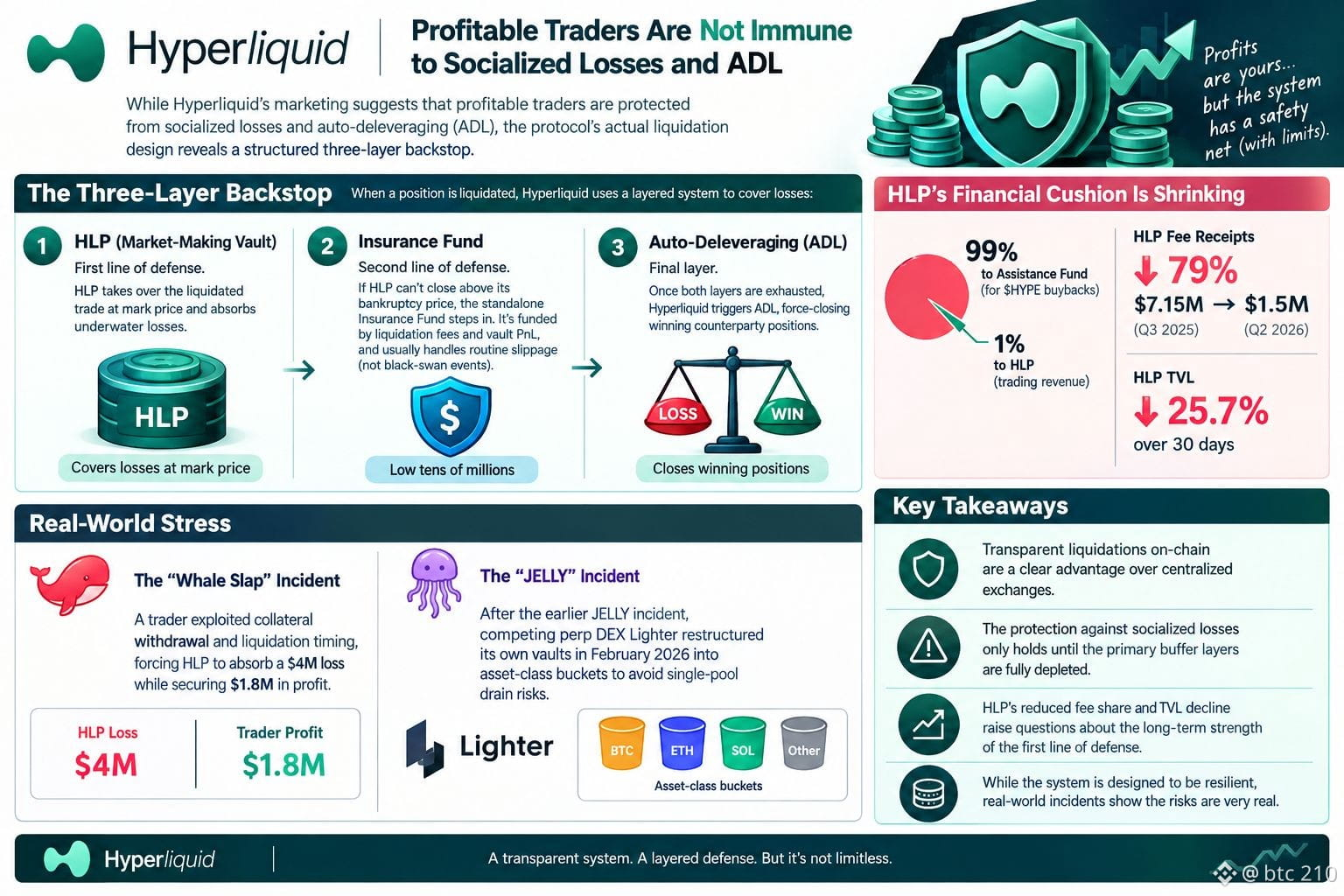
Hyperliquid’s marketing frequently highlights that profitable traders are immune to socialized losses and auto-deleveraging (ADL). However, examining the protocol’s documented liquidation design reveals a structured three-layer backstop.
When a position is liquidated, HLP (Hyperliquid’s market-making vault) acts as the first line of defense, taking over the trade at mark price and absorbing underwater losses. If HLP cannot close above its bankruptcy price, a standalone Insurance Fund funded by liquidation fees and vault PnL steps in. Sitting in the low tens of millions, this fund handles routine slippage rather than black-swan events. Once both layers are exhausted, Hyperliquid triggers Auto-Deleveraging, force-closing winning counterparty positions.
At the same time, HLP’s financial cushion has narrowed. DefiLlama data shows HLP receives only 1% of trading revenue, with 99% routed to the Assistance Fund for $HYPE buybacks. Consequently, HLP fee receipts dropped 79% from $7.15M in Q3 2025 to $1.5M in Q2 2026, while TVL fell 25.7% over 30 days.
The mechanism has faced real-world stress. During the "Whale Slap" incident, a trader exploited collateral withdrawal and liquidation timing, forcing HLP to absorb a $4M loss while securing $1.8M in profit. Following the earlier "JELLY" incident, competing perp DEX Lighter restructured its own vaults in February 2026 into asset-class buckets to avoid single-pool drain risks.
While Hyperliquid’s transparent on-chain liquidations offer clear advantages over centralized exchanges, the protection against socialized losses only holds until the primary buffer layers are fully depleted.$HYPE , $BTC #US10YTreasuryYieldHits19YearHigh
When a position is liquidated, HLP (Hyperliquid’s market-making vault) acts as the first line of defense, taking over the trade at mark price and absorbing underwater losses. If HLP cannot close above its bankruptcy price, a standalone Insurance Fund funded by liquidation fees and vault PnL steps in. Sitting in the low tens of millions, this fund handles routine slippage rather than black-swan events. Once both layers are exhausted, Hyperliquid triggers Auto-Deleveraging, force-closing winning counterparty positions.
At the same time, HLP’s financial cushion has narrowed. DefiLlama data shows HLP receives only 1% of trading revenue, with 99% routed to the Assistance Fund for $HYPE buybacks. Consequently, HLP fee receipts dropped 79% from $7.15M in Q3 2025 to $1.5M in Q2 2026, while TVL fell 25.7% over 30 days.
The mechanism has faced real-world stress. During the "Whale Slap" incident, a trader exploited collateral withdrawal and liquidation timing, forcing HLP to absorb a $4M loss while securing $1.8M in profit. Following the earlier "JELLY" incident, competing perp DEX Lighter restructured its own vaults in February 2026 into asset-class buckets to avoid single-pool drain risks.
While Hyperliquid’s transparent on-chain liquidations offer clear advantages over centralized exchanges, the protection against socialized losses only holds until the primary buffer layers are fully depleted.$HYPE , $BTC #US10YTreasuryYieldHits19YearHigh