


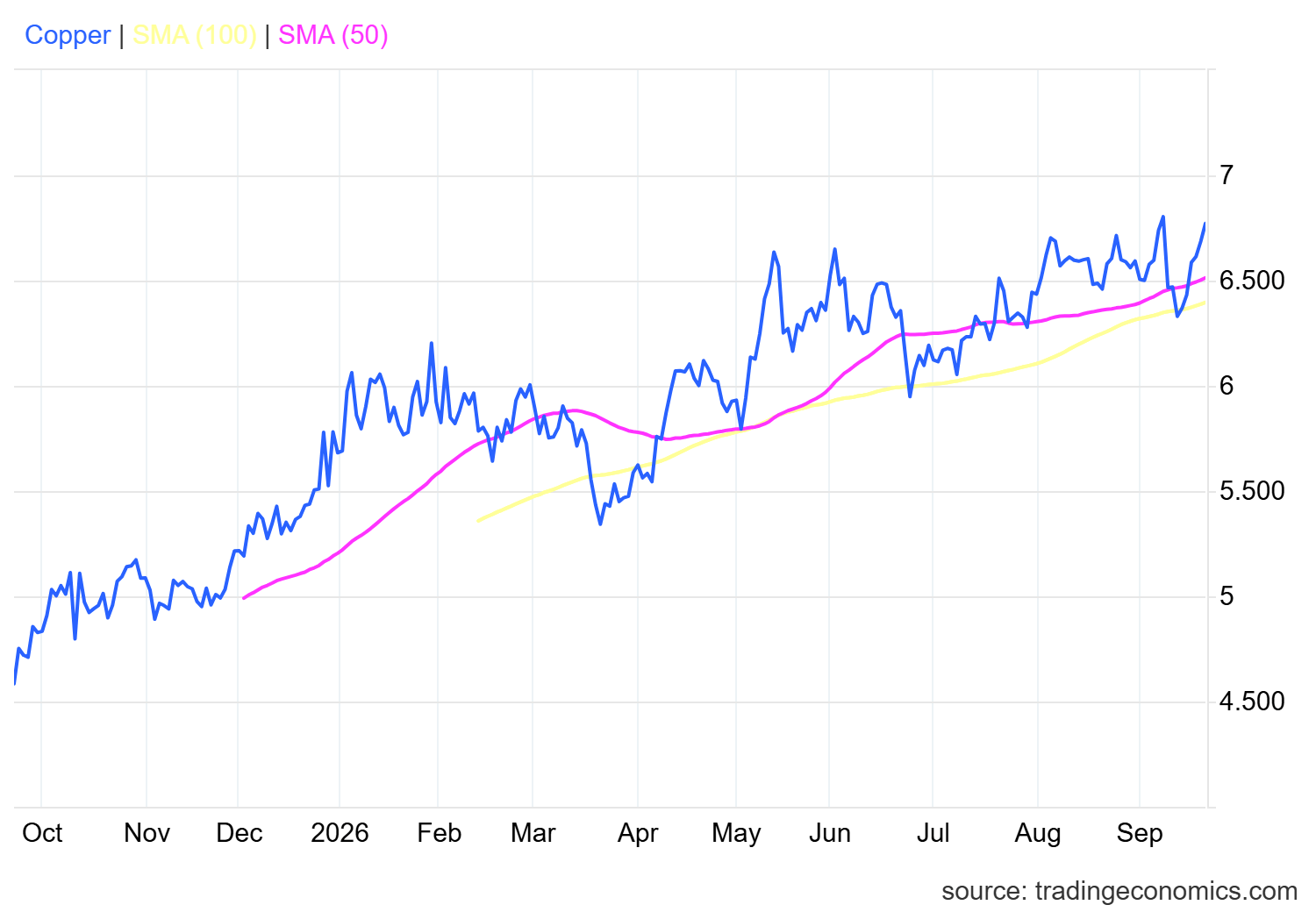
Copper futures rose above $6.70 per pound on Tuesday, marking a sixth straight session of gains as supply concerns continued to support prices. The metal has now climbed in six of the first nine months of 2026, from $5.95 in January to nearly $6.83 by September, roughly a 15% run. April and May did the heavy lifting, up 6% and 7%, and September has already tacked on another 2%.
Nobody can get enough copper right now, and nobody can make more of it fast enough. That's the whole story behind Freeport-McMoRan, Hudbay Minerals and Trekor Metals, which most people still call Taseko Mines, and honestly, so do half the trading terminals. All three stand to gain as the gap between what the world wants and what mines can actually deliver keeps widening, though they're not the same trade dressed up three ways.
China Is Paying Up, and Miners Can't Keep Pace
Start with China, because that's where the physical tightness shows up first. The Yangshan copper premium, what buyers pay to get imported refined copper actually delivered into the country, jumped to $121 a ton last week, up from $85 the week before.
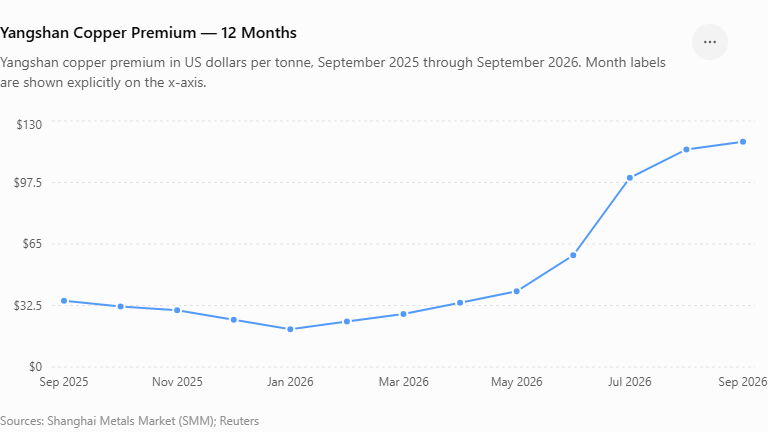
Reuters had that number, and it's the highest reading since late 2022. When Chinese buyers are willing to pay that much extra just to skip the line, that's not a futures trader making a bet. That's someone who needs the actual metal.
Shanghai Metals Market logged trades during the week of Sept. 14 somewhere between $108 and $121 a ton, averaging near $115. Shanghai copper itself gained 1.3% over that stretch, and London Metal Exchange copper was tracking toward a 1.6% weekly gain of its own.
Supply is moving the wrong way at exactly the wrong time. Sprott Asset Management found that global mined copper production fell 1.1% year over year in the first half of 2026, which would make this the industry's first annual output decline since 2017. Two mines did a lot of that damage on their own: Freeport's Grasberg complex in Indonesia and Ivanhoe's Kamoa-Kakula project in Congo, between them knocking out roughly 600,000 tonnes of expected 2026 production, or about 2.5% of the world's mine supply. Sprott's Jacob White made a fair point about it: higher prices don't make permits move faster, and they don't shorten the years it takes to actually build a mine.
Chile — which produced 23% of the world's mined copper in 2025 — is dragging on global supply exactly when the market can least afford it. Output fell 9.4% year-over-year in July after a 6.6% first-half decline, and Cochilco has already cut its 2026 forecast to 5.27 million metric tons, below last year's total. Codelco, the state miner and world's No. 2 producer, has missed its production target seven years running; it pulled its 2026 goal of 1.34 MMT in August and quietly shelved the plan to reach 1.7 MMT by decade's end, after ceding the global top spot to BHP in 2025.
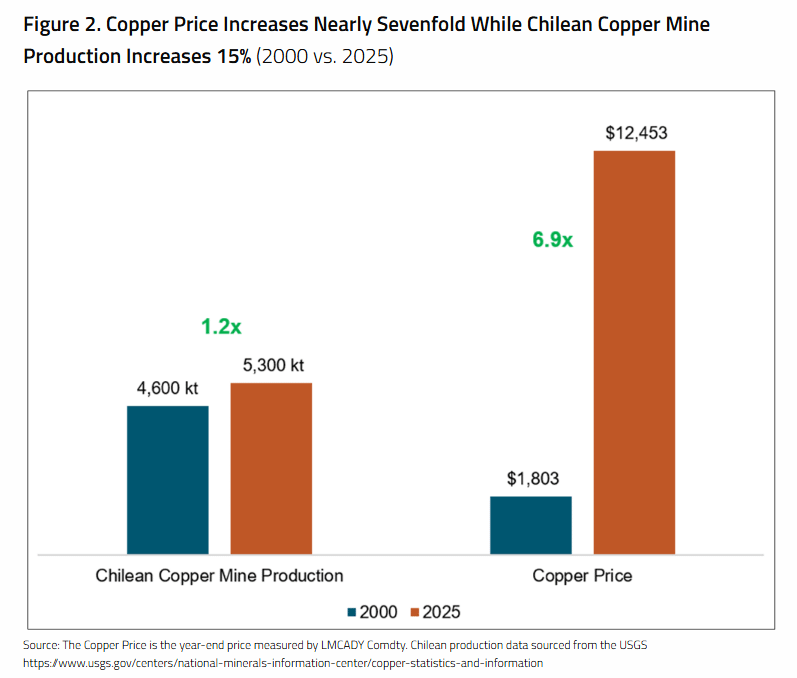
Antofagasta and Lundin Mining piled on, trimming a combined 35,000 to 55,000 tons from their 2026 guidance, and even Escondida, the world's largest mine, running at record rates, expects thinning ore grades to cost roughly 210,000 tons in FY2027, close to 1% of global mined supply. The mismatch is stark: copper prices climbed nearly sevenfold from 2000 to 2025, while Chilean output grew just 15%, proof that higher prices alone can't fix aging mines and declining grades.
With Chile stalling, the market is leaning on riskier growth from the DRC, China, and Russia. The DRC is set to add the most new supply in 2026, but its mines run on imported sulfuric acid, a real vulnerability given the Persian Gulf supplies about 25% of global sulfur output and half of seaborne sulfur trade. A disruption through the Strait of Hormuz, combined with China's halt on sulfuric acid exports, could squeeze that pipeline fast. DRC output has held up so far, but as stockpiles and existing contracts run down, that resilience looks increasingly borrowed on time.
Basically, the world's biggest copper miners keep missing their own numbers, and the backstop for global supply runs through a country whose mines depend on acid shipped past a chokepoint. That's not a comfortable place for a market already in deficit to be resting on.
Then there's the demand piece nobody was talking about three years ago. The International Energy Agency's latest critical minerals outlook says copper will add more demand than any other mineral through 2040, something like 7 million extra tonnes, mostly from grids and whatever technology needs power run to it. The agency's 2035 supply gap estimate has actually improved, down to about 25% from 30% a year ago, as new projects in Congo and Zambia move forward. Improved is a relative term. A quarter of expected demand still has nowhere to come from.
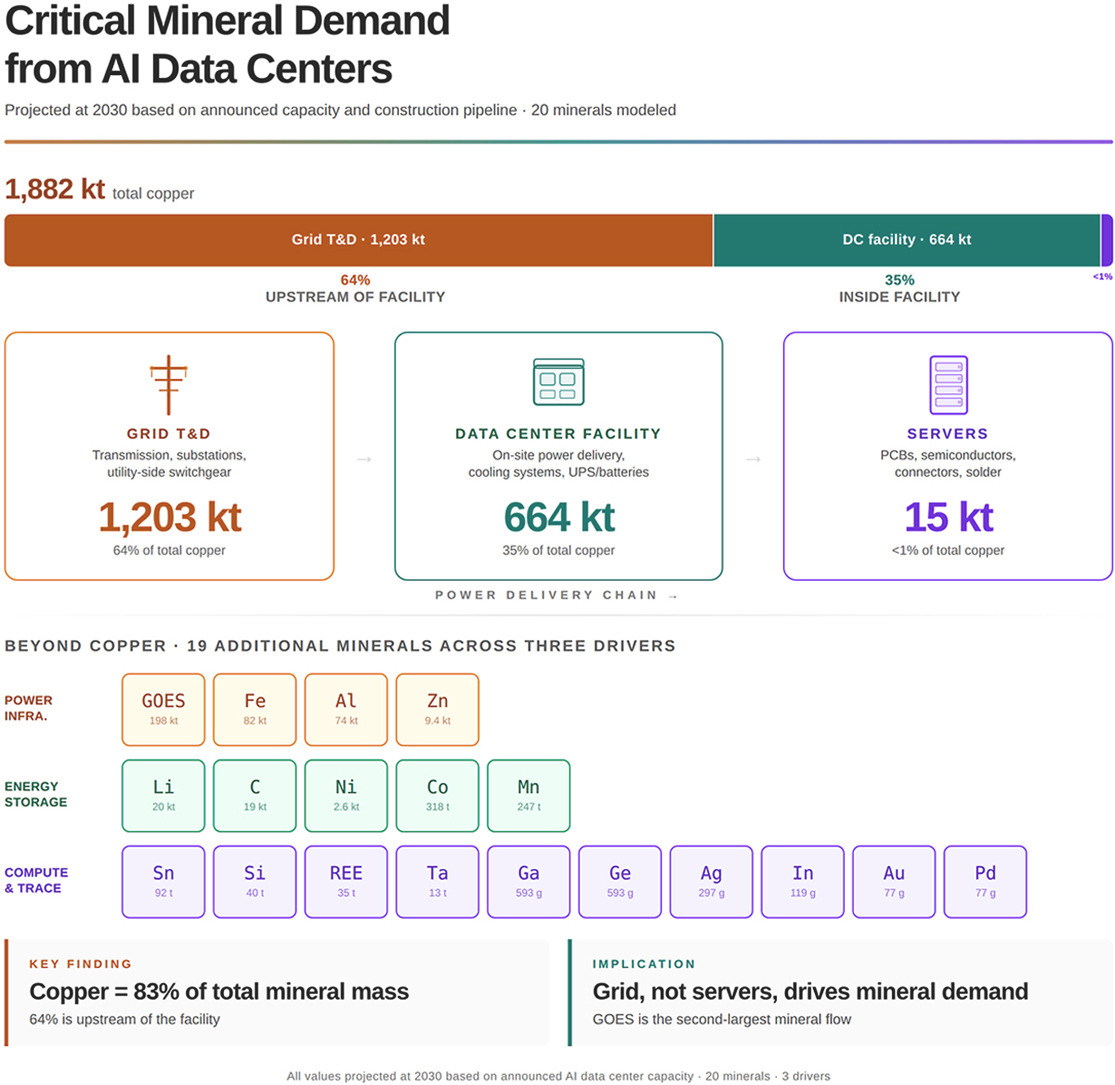
A study published in August in the journal Resources Policy tried to model exactly how much mineral demand the AI buildout creates, and copper ate up 82% to 83% of the total mineral mass in their model. Grid transmission and distribution alone accounted for almost two-thirds of that. Which tells you something: the chips get the press coverage, but it's the wire running to the building that eats the copper.
Tariffs are the part nobody can plan around. Washington still hasn't ruled on whether refined copper gets hit with one, and just the possibility has pulled metal into U.S. warehouses as a hedge. If the tariff actually lands, expect more of that stockpiling and a bigger split between what's available here versus everywhere else. If it doesn't, some of that copper could head back out, and supply loosens up in a hurry. Right now the market is pricing the uncertainty itself, not really either outcome.
The Futures Market Doesn't Believe This Is Speculation
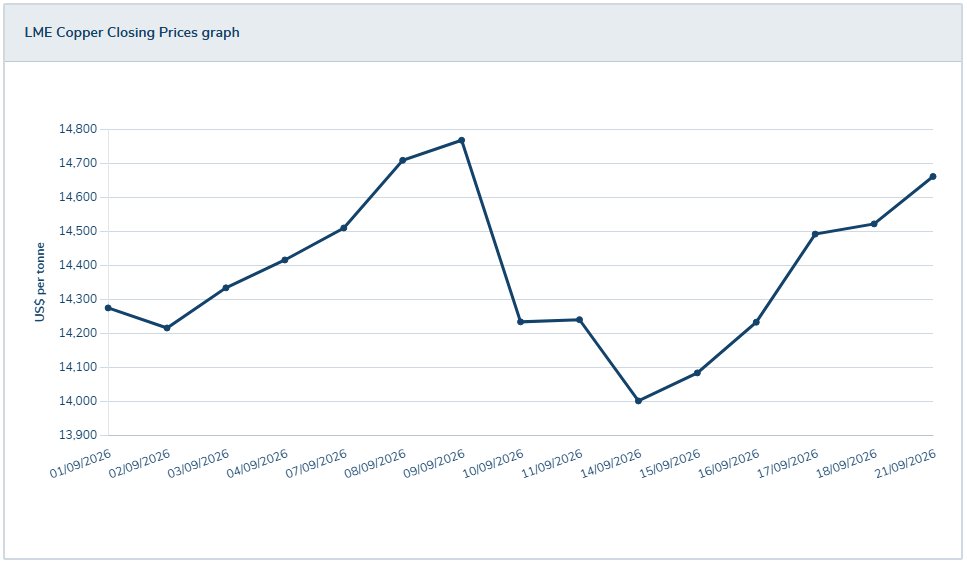
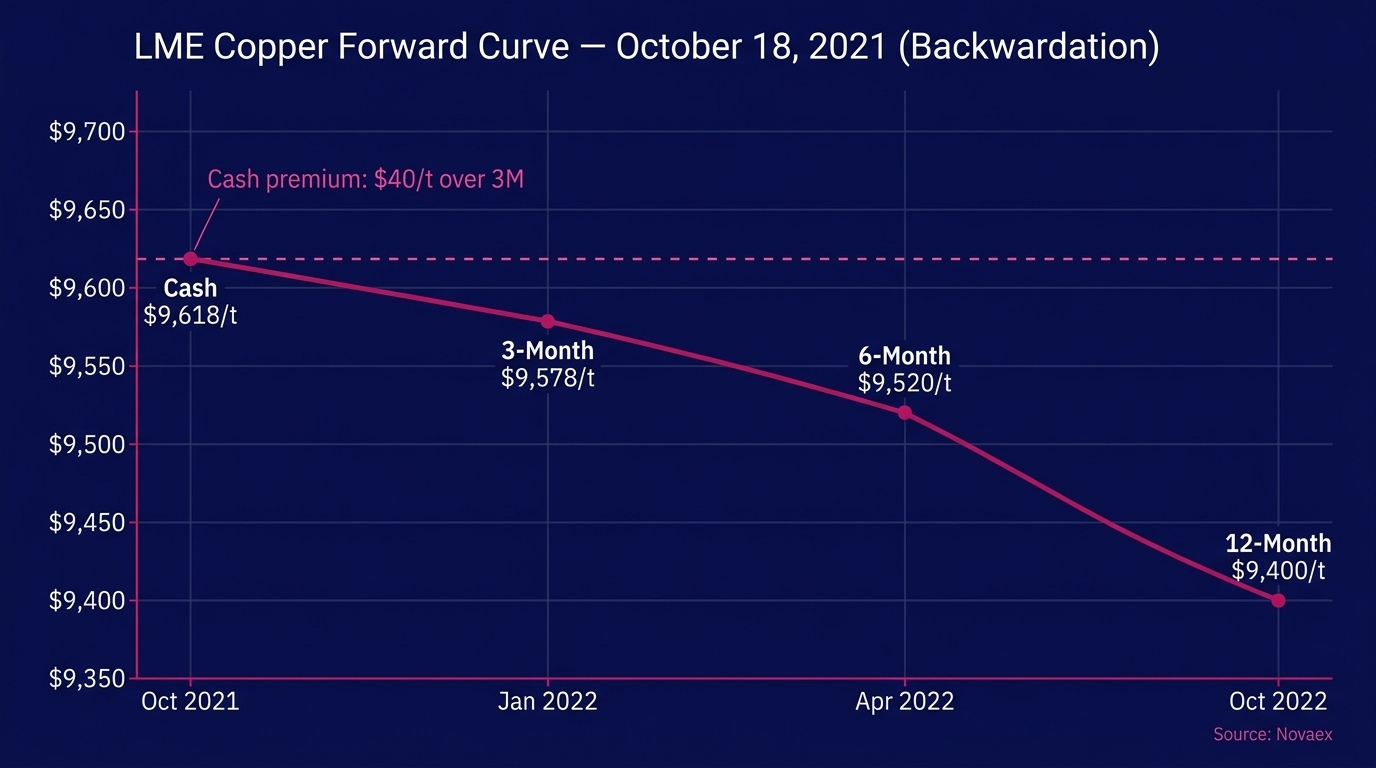
Normally a futures curve slopes upward. Store a pound of copper for six months, and someone has to pay for that storage and the financing, so a December contract should cost more than one for today. Copper's curve is doing the opposite right now, a setup traders call backwardation, and it means buyers would rather pay extra to get metal in hand today than wait for a cheaper contract three months out.
LME copper flipped into backwardation on October 18, 2021: cash traded at a premium to the 3-month forward, and the trader reading the full curve caught a $58,000 edge on a 250-tonne position that the spot-only trader missed. Same market data for both; the entire gap came down to how much of the curve they actually looked at.
Speculators don't usually manufacture that kind of thing. Nobody pays a premium for something already sitting in a warehouse two blocks away. What's actually happening is traders shipping metal into U.S. bonded warehouses ahead of a possible tariff, and once copper lands in one of those, it basically doesn't leave. So the rest of the world is quietly losing access to supply even while American stockpiles grow. A surplus that looked comfortable on paper a year ago now looks tight outside the U.S., and closer to a deficit if this keeps up.
There's No Fast Way to Mine More Copper
Zoom out and the numbers get worse, not better. The U.S. Geological Survey figures humanity has dug up something like 700 million metric tons of copper across all of recorded history. S&P Global's own January study on copper and the energy transition expects demand to jump from about 28 million tonnes in 2025 to 42 million by 2040, a 50% increase, and it warns that primary mined supply could actually end up lower in 2040 than it is right now if nobody invests more. Their number for the gap: roughly 10 million tonnes of primary supply, and no clear source for it. Average time to bring a new mine online, start to finish: about 17 years.
The ore itself isn't helping. Grades have dropped roughly 40% worldwide since 1991, so miners are grinding through more rock for the same pound of copper, at higher cost and with more energy burned along the way. Independent analyst Thierry von Arvy has been tracking this closely, and his work shows global supply essentially going flat in the early 2030s right as demand keeps climbing. There's no version of this where more drilling fixes it quickly. Find a deposit today, and it's well into the next decade, at best, before it's producing anything at all.
Three Names, Three Different Bets
Here's why miners move harder than the metal itself does. Once a mine is up and running, most of its costs are fixed, so a dollar move in the copper price flows almost straight through to profit, at least until the company has to spend more building something new. That's really the entire investment case in the three names below, and it plays out differently depending on size.
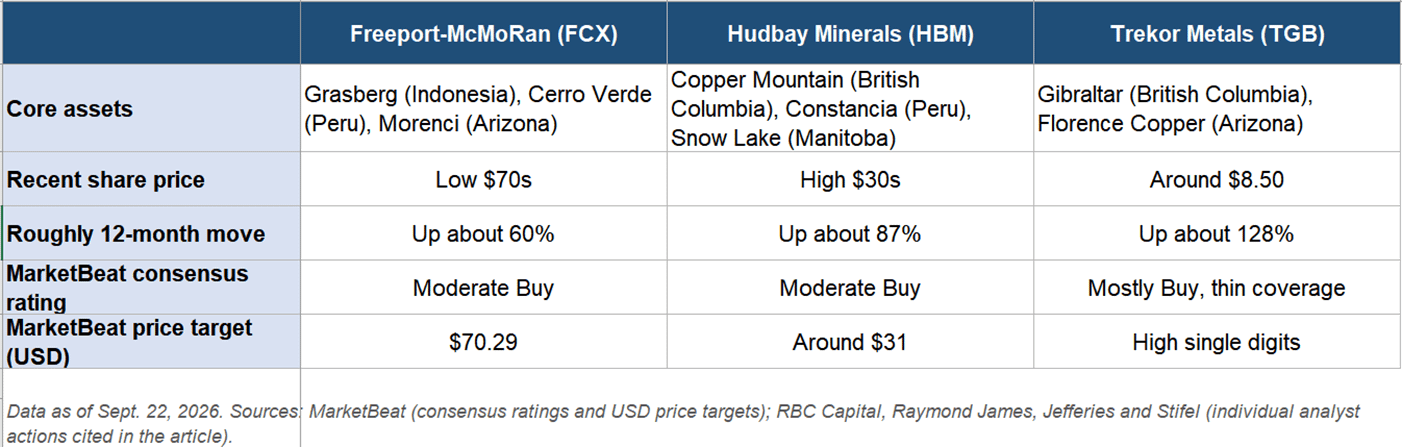
Worth knowing: RBC and Raymond James quote their Hudbay and Trekor targets in Canadian dollars, since both stocks trade primarily in Toronto. The MarketBeat numbers above are U.S. dollars, matching the American listings.
Freeport Already Has the Copper Coming Out of the Ground
Freeport is the big one here, the largest U.S.-listed producer and the country's biggest source of refined copper. Shares hit an all-time high near $80 in late August, pulled back some, and are still sitting in the upper half of their 52-week range, with institutions owning most of the float.
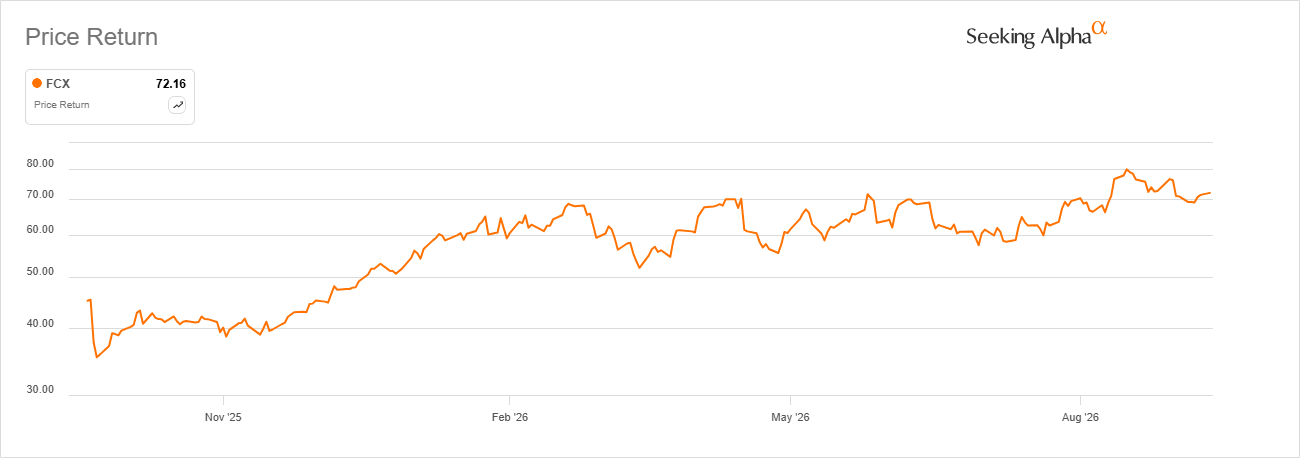
First-half 2026 net income was up 65% from a year earlier, and the U.S. mining segment more than doubled its operating income. That's the fixed-cost math above showing up in an actual earnings report. Year-to-date, compared to the S&P 500, Freeport has gained 42% while the broad index has gained only 13%.
Analysts don't agree on what to do with any of that. RBC took its target to $85 from $73 on Sept. 16 but kept a Sector Perform rating, which is a strange combination if you sit with it: raise the number, keep the stock at a shrug. Bernstein went the other way and cut its target to $47 that same week.
Freedom Broker downgraded the stock to Hold from Buy without even moving its $75 target, and Erste Group started fresh coverage with a Buy, betting Freeport's growth beats the sector average this year. Add it all up across roughly two dozen analysts, and MarketBeat calls it a Moderate Buy with a consensus target of $70.29, just about where the stock already sits. Everyone keeps adjusting their number. Nobody seems any more convinced than before.
Hudbay and Trekor Trade Scale for Torque
Hudbay is the middle case, built on Copper Mountain in British Columbia, Constancia in Peru, and the Snow Lake operations in Manitoba, and it just posted its best trailing-12-month adjusted EBITDA yet. Analysts have been chasing that with higher targets. RBC went to C$48 from C$40 on Sept. 16, and Raymond James to C$42 from C$41 a couple of weeks earlier, both still calling it Outperform. On the U.S.-listed side, MarketBeat counts 13 analysts, 11 of them at Buy, for an overall Moderate Buy. Year-to-date, compared to the S&P 500, Hudbay has gained 34% while the broad index has gained only 13%.
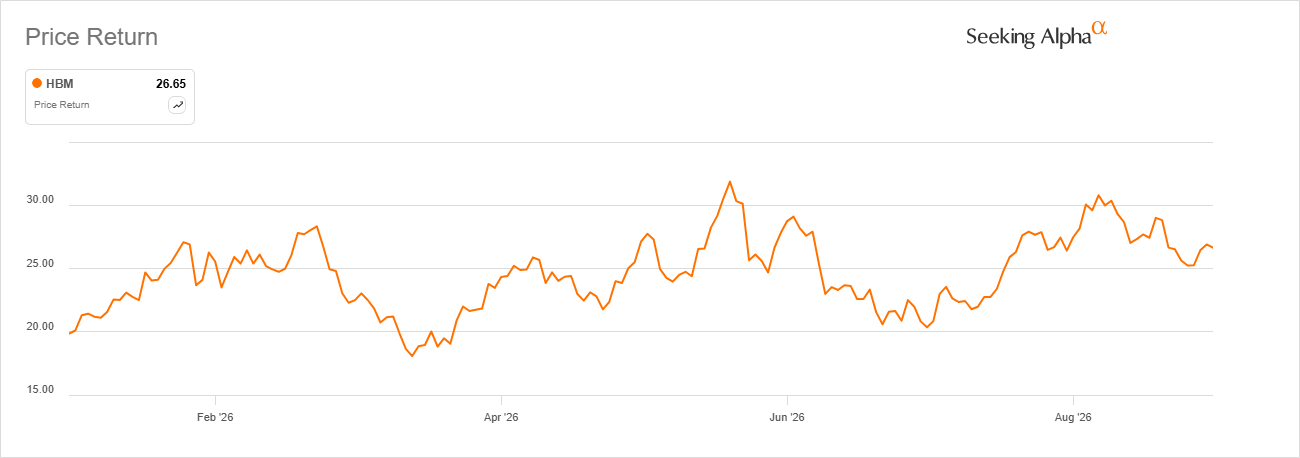
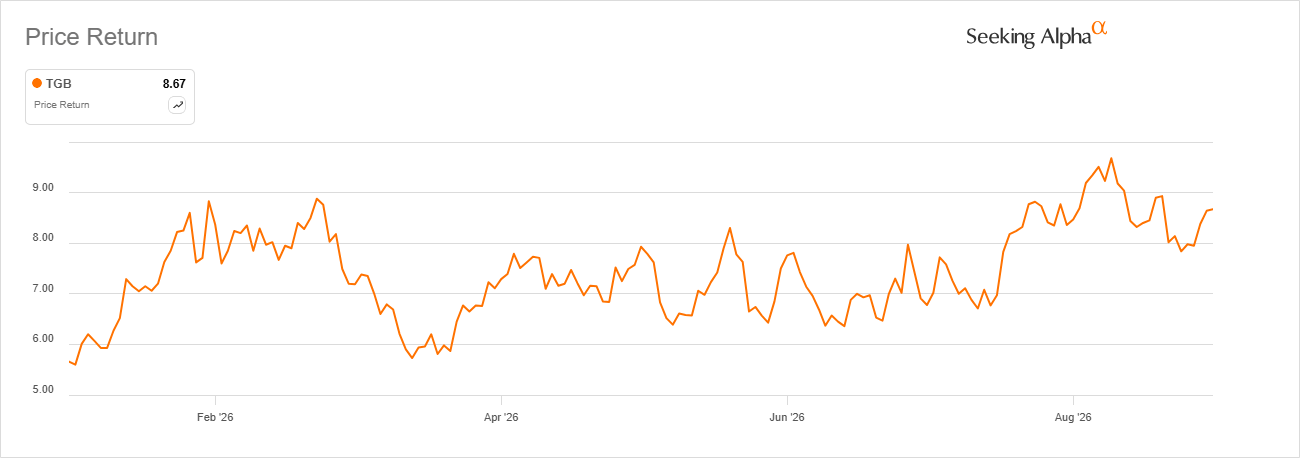
Trekor is the new name for an old company. Shareholders voted in June to rename Taseko Mines to Trekor Metals, though the ticker didn't budge on either exchange, so anyone pulling up a chart probably wouldn't even notice. Gibraltar in British Columbia still does most of the producing, and Florence Copper in Arizona poured its first cathode back in February, which makes this a two-mine company now, with a domestic U.S. asset at a moment when Washington keeps talking about bringing supply chains home.
Jefferies started it at Buy in August with a C$15 target, and Stifel bumped its own target to C$13.50 from C$12.50 around the same time, both well above where the stock actually trades. That gap is fairly normal for a small producer, since institutional money, and the analyst coverage that tends to follow it, gets thinner the smaller you go. Anyone who would rather not bet on a single name can get roughly the same exposure through the Global X Copper Miners ETF, which has about doubled over the past year. Year-to-date, compared to the S&P 500, Trekor has gained 53% while the broad index has gained only 13%.
Not Everyone Is Convinced
Not everyone buys the demand story at face value. Some of this, skeptics argue, is really a tariff premium dressed up as a copper shortage, and once Washington actually decides one way or the other, part of the move could simply evaporate.
Stanley Druckenmiller isn't in that camp, at least not about the metal itself. His Duquesne Family Office has been adding to Southern Copper, and he put the trade about as plainly as a billionaire can:
"We own copper. It's not a genius trade. It's a big consensus trade." Given the choice, he says he would rather hold the metal directly than the companies that mine it.
Which gets at the real difference between these three. Freeport's copper is already out of the ground, so its story from here is about price and cost, full stop. Hudbay sits somewhere in the middle. Trekor's whole re-rating rests on Florence continuing to ramp the way it is supposed to, and being the smallest of the three, it also has the most room to fall if copper stalls out.
Forget the spot price for a second. Watch the spread between spot and December delivery instead. As long as buyers keep paying up for copper they can touch today, the shortage behind this rally is real, and these three stocks stay exactly as exposed to it as they look.