⚖️
BALANCING DECENTRALIZED AI COMPUTE: HOW BTTINFERGRID SOLVES THE DEPIN OVERSUPPLY TRAP
In decentralized physical infrastructure networks (DePIN), premature hardware subsidization often triggers the idle oversupply trap: networks print heavy token emissions to bootstrap raw GPU capacity, but lacking organic, paying end-user demand, inflationary pressure outpaces real utilization. Hardware operators dump rewards, token value degrades, and miners abandon the grid.
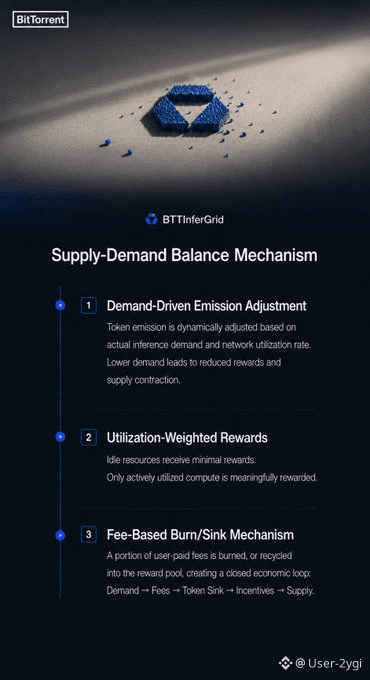
BTTInferGrid resolves this structural vulnerability by decoupling from static block inflation and anchoring compute economics to the Dynamic Supply-Demand Balance Mechanism.
1. The Core Problem: Static Inflation vs. Elastic AI Workloads
No Subsidies for Idle Silicon: Traditional models reward miners simply for registering an online device, creating ghost networks of unutilized compute. BTTInferGrid calibrates emissions strictly to verified, successfully executed inference queries.
Elastic Resource Scheduling: AI inference workloads exhibit sharp peak-to-trough fluctuations throughout the day. Elastic compute scheduling dynamically expands and contracts active compute pools around live developer task queues rather than paying fixed reservation fees.
2. Architectural Triad: Supply, Demand & Cryptoeconomic Verification
DemandPay-As-You-Go API GatewaysIndependent AI teams and developers run scalable model inference (Qwen, Llama) without centralized cloud markup.Decentralized StorageBTFS IntegrationShards heavyweight open-source model weights via Reed-Solomon $(k + m)$ erasure coding for fast local caching.Workload VerificationProbabilistic Auditing & Yuma ConsensusValidators inject randomized challenge tasks to detect lazy computation, replay attacks, or cached outputs.Consensus SettlementBitTorrent Chain (BTTC)Finalizes inference escrows and validator checkpoints with sub-cent gas fees ($<\$0.01$ per TX).
@BitTorrent_Official @Justin Sun孙宇晨 #TRONEcoStar
BALANCING DECENTRALIZED AI COMPUTE: HOW BTTINFERGRID SOLVES THE DEPIN OVERSUPPLY TRAP
In decentralized physical infrastructure networks (DePIN), premature hardware subsidization often triggers the idle oversupply trap: networks print heavy token emissions to bootstrap raw GPU capacity, but lacking organic, paying end-user demand, inflationary pressure outpaces real utilization. Hardware operators dump rewards, token value degrades, and miners abandon the grid.
BTTInferGrid resolves this structural vulnerability by decoupling from static block inflation and anchoring compute economics to the Dynamic Supply-Demand Balance Mechanism.
1. The Core Problem: Static Inflation vs. Elastic AI Workloads
No Subsidies for Idle Silicon: Traditional models reward miners simply for registering an online device, creating ghost networks of unutilized compute. BTTInferGrid calibrates emissions strictly to verified, successfully executed inference queries.
Elastic Resource Scheduling: AI inference workloads exhibit sharp peak-to-trough fluctuations throughout the day. Elastic compute scheduling dynamically expands and contracts active compute pools around live developer task queues rather than paying fixed reservation fees.
2. Architectural Triad: Supply, Demand & Cryptoeconomic Verification
DemandPay-As-You-Go API GatewaysIndependent AI teams and developers run scalable model inference (Qwen, Llama) without centralized cloud markup.Decentralized StorageBTFS IntegrationShards heavyweight open-source model weights via Reed-Solomon $(k + m)$ erasure coding for fast local caching.Workload VerificationProbabilistic Auditing & Yuma ConsensusValidators inject randomized challenge tasks to detect lazy computation, replay attacks, or cached outputs.Consensus SettlementBitTorrent Chain (BTTC)Finalizes inference escrows and validator checkpoints with sub-cent gas fees ($<\$0.01$ per TX).
@BitTorrent_Official @Justin Sun孙宇晨 #TRONEcoStar