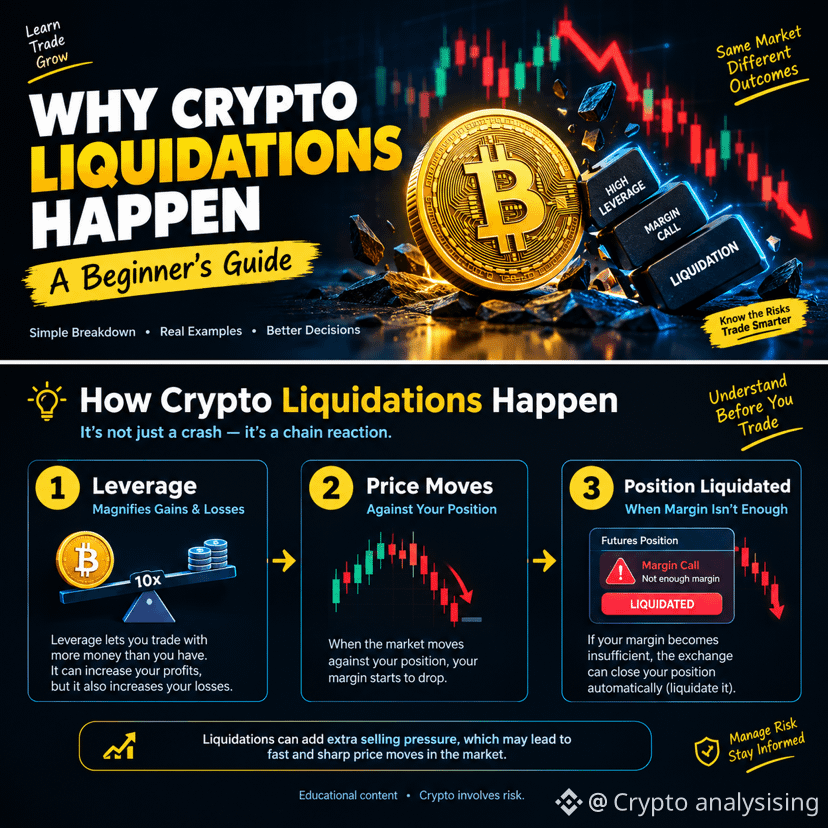
Why Crypto Liquidations Happen — A Beginner’s Guide 📉
One thing I wish I understood earlier about crypto is liquidation.
You may have seen the word “liquidation” during a big market move, but what actually happens when a crypto position gets liquidated?
Here’s the simple version 👇
1️⃣ LEVERAGE
Leverage allows traders to control a position larger than the amount of margin they put up.
It can increase potential gains, but it also increases potential losses.
2️⃣ THE MARKET MOVES AGAINST THE POSITION
If the price moves against a leveraged position, the trader’s available margin can start decreasing.
The higher the leverage, the less room there may be for the position to move against the trader.
3️⃣ LIQUIDATION
If the available margin becomes insufficient to maintain the position, the exchange can automatically close the position.
That forced closing is called liquidation.
And here is the part many beginners miss:
When many leveraged positions are liquidated around the same time, those forced trades can add extra buying or selling pressure and contribute to faster market moves.
That’s why a sudden crypto move can sometimes become much more intense than it initially looked.
My biggest takeaway:
Understanding leverage and liquidation is just as important as understanding the coin itself.
Don’t trade something you don’t understand.
Educational content only. Crypto involves risk. Always do your own research.
$BTC $ETH $SOL
#bitcoin #crypto #BTCBreaks80K #ETH #Liquidations
One thing I wish I understood earlier about crypto is liquidation.
You may have seen the word “liquidation” during a big market move, but what actually happens when a crypto position gets liquidated?
Here’s the simple version 👇
1️⃣ LEVERAGE
Leverage allows traders to control a position larger than the amount of margin they put up.
It can increase potential gains, but it also increases potential losses.
2️⃣ THE MARKET MOVES AGAINST THE POSITION
If the price moves against a leveraged position, the trader’s available margin can start decreasing.
The higher the leverage, the less room there may be for the position to move against the trader.
3️⃣ LIQUIDATION
If the available margin becomes insufficient to maintain the position, the exchange can automatically close the position.
That forced closing is called liquidation.
And here is the part many beginners miss:
When many leveraged positions are liquidated around the same time, those forced trades can add extra buying or selling pressure and contribute to faster market moves.
That’s why a sudden crypto move can sometimes become much more intense than it initially looked.
My biggest takeaway:
Understanding leverage and liquidation is just as important as understanding the coin itself.
Don’t trade something you don’t understand.
Educational content only. Crypto involves risk. Always do your own research.
$BTC $ETH $SOL
#bitcoin #crypto #BTCBreaks80K #ETH #Liquidations