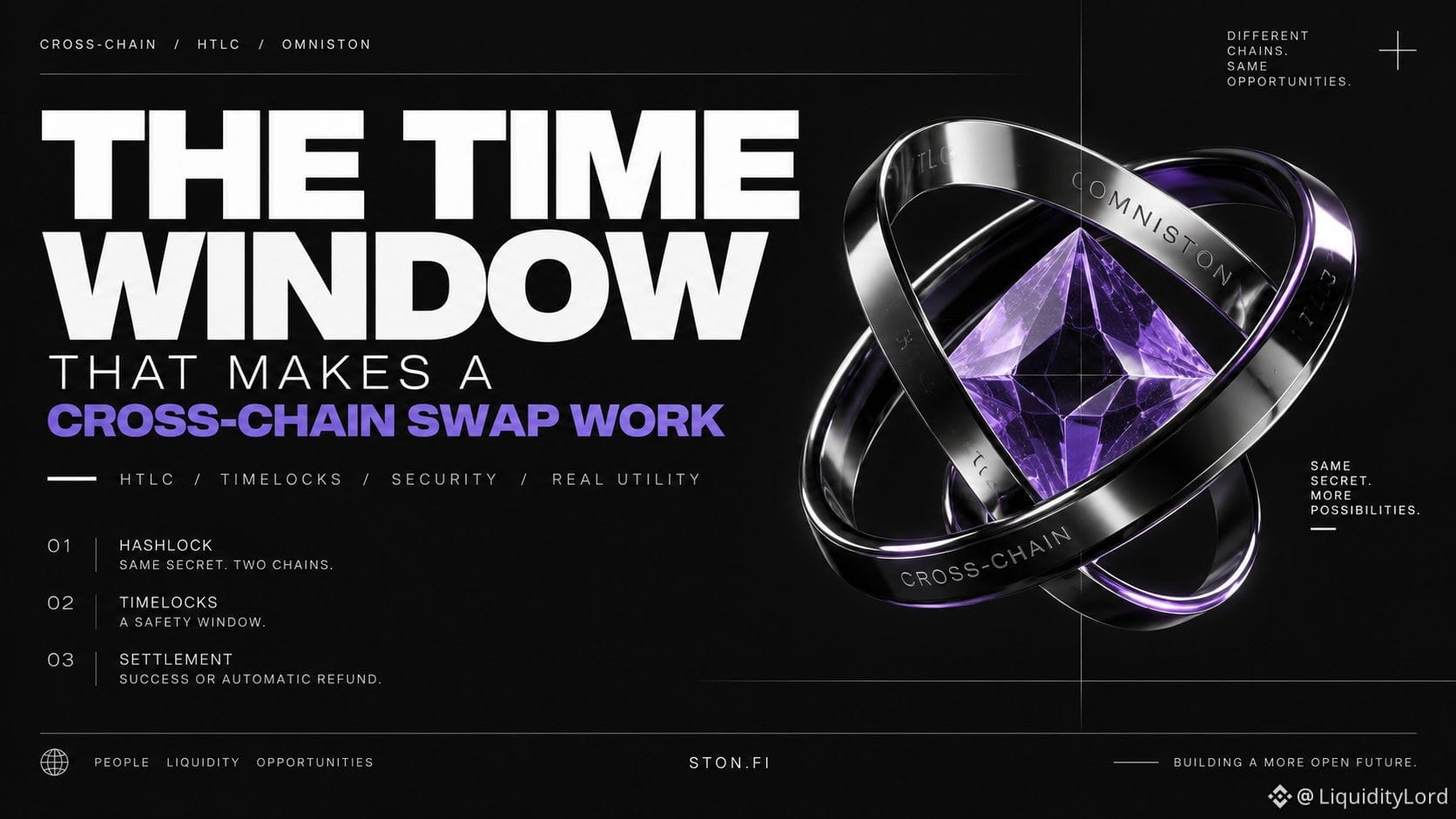
⏳ THE TIME WINDOW THAT MAKES A CROSS-CHAIN SWAP WORK
Two blockchains do not share transaction state. Cross-chain swaps therefore need a mechanism that makes both success and failure safe.
HTLCs provide it through a hashlock and staggered timelocks. Two contracts share the same secret hash, but deadlines differ. The secret holder’s side expires later; the counterparty’s side expires first. That gap is the safety window.
🧠 THE CLEVER PART IS THE ASYMMETRY
A user locks an asset on one chain while a resolver locks the destination asset on another. When the user reveals the secret to claim the destination asset, it becomes visible on-chain and the resolver can use it to claim the source-side funds.
If the user never reveals it, the earlier timelock expires and the resolver refunds. Reverse the timelocks and the safety model breaks: the secret holder could refund their own side first and still claim the counterparty’s funds. The hashlock would work; the timing would be the vulnerability.
🔄 WHY OMNISTON NEEDS MORE THAN HTLC
HTLCs solve settlement, not price discovery. Before funds are locked, Omniston can run an RFQ among independent resolvers competing on the requested pair and size.
The separation matters: finding a counterparty happens off-chain first; capital is locked only after a quote is accepted. The resolver funds the destination side, while HTLC makes failure automatic.
💸 THE COST OF SAFETY
The timelock window has a cost. The user waits, while the resolver has capital locked. Failed trades can create refund gas costs, and a tight gap can become dangerous.
Those seconds are the security model. HTLCs trade time and temporary capital lockup for a specific property: the exchange completes, or the contracts move toward refunds without a trusted intermediary.
Omniston separates the jobs: RFQ handles the market; HTLC handles the trust boundary.
NFA - DYOR
$GRAM
Two blockchains do not share transaction state. Cross-chain swaps therefore need a mechanism that makes both success and failure safe.
HTLCs provide it through a hashlock and staggered timelocks. Two contracts share the same secret hash, but deadlines differ. The secret holder’s side expires later; the counterparty’s side expires first. That gap is the safety window.
🧠 THE CLEVER PART IS THE ASYMMETRY
A user locks an asset on one chain while a resolver locks the destination asset on another. When the user reveals the secret to claim the destination asset, it becomes visible on-chain and the resolver can use it to claim the source-side funds.
If the user never reveals it, the earlier timelock expires and the resolver refunds. Reverse the timelocks and the safety model breaks: the secret holder could refund their own side first and still claim the counterparty’s funds. The hashlock would work; the timing would be the vulnerability.
🔄 WHY OMNISTON NEEDS MORE THAN HTLC
HTLCs solve settlement, not price discovery. Before funds are locked, Omniston can run an RFQ among independent resolvers competing on the requested pair and size.
The separation matters: finding a counterparty happens off-chain first; capital is locked only after a quote is accepted. The resolver funds the destination side, while HTLC makes failure automatic.
💸 THE COST OF SAFETY
The timelock window has a cost. The user waits, while the resolver has capital locked. Failed trades can create refund gas costs, and a tight gap can become dangerous.
Those seconds are the security model. HTLCs trade time and temporary capital lockup for a specific property: the exchange completes, or the contracts move toward refunds without a trusted intermediary.
Omniston separates the jobs: RFQ handles the market; HTLC handles the trust boundary.
NFA - DYOR
$GRAM