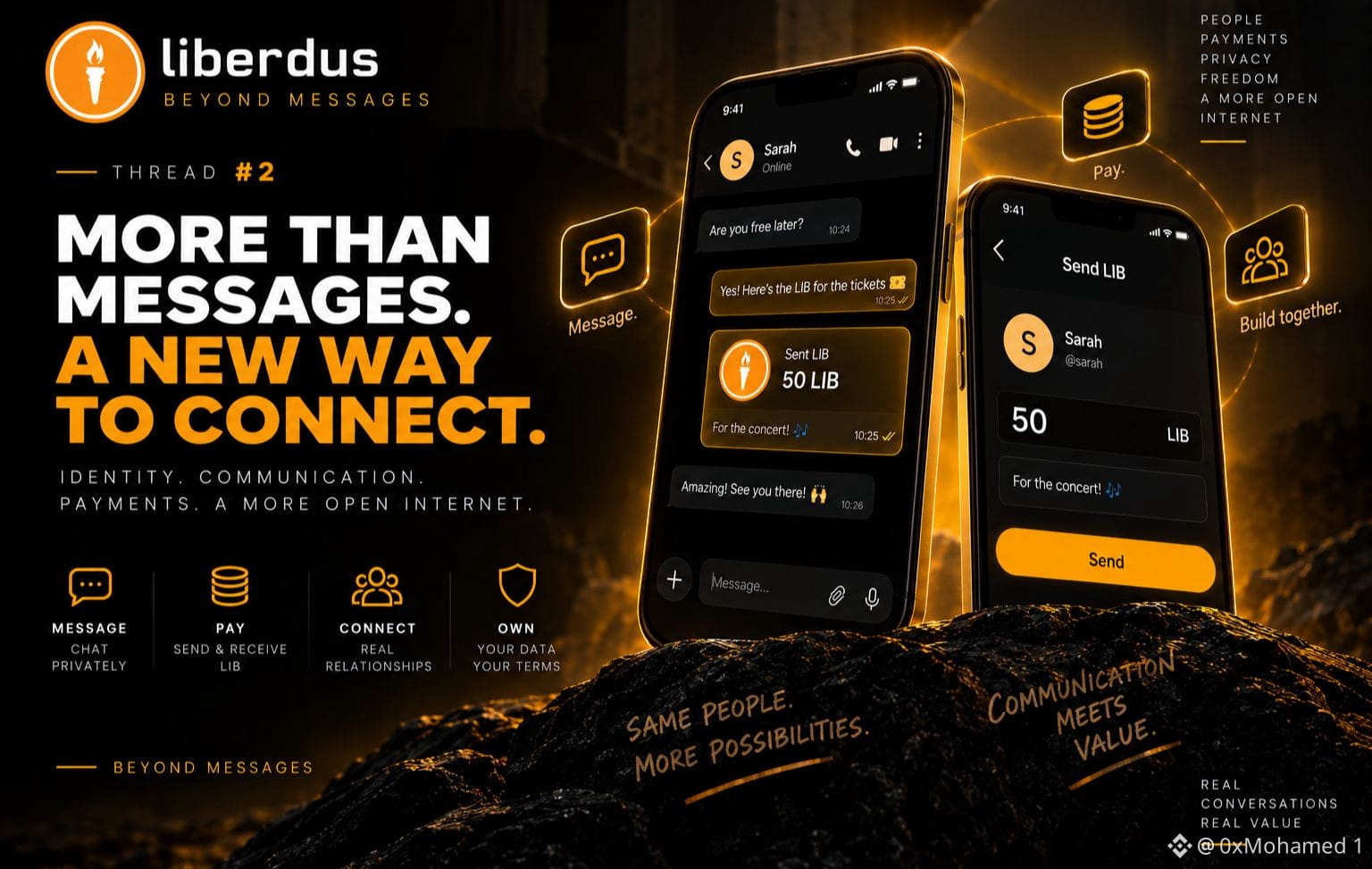
The interesting part about crypto payments isn’t the payment. It’s what happens when money becomes part of the communication layer. For years, we’ve treated messaging and payments as two completely different things. You talk in one app, you pay in another, you manage your wallet somewhere else. But Web3 makes another model possible. Liberdus combines messaging and LIB payments in the same ecosystem. You can send LIB directly from a conversation, with the recipient already selected from the chat. That sounds simple, but the architecture behind it is more interesting. Think about the layers: Identity → Communication → Value The same username can be used for messaging and payments, while being mapped to a Liberdus wallet address. One identity layer can therefore connect different interactions. That changes the meaning of a messaging app. It’s no longer only, how do I send a message? It becomes, what can I do with someone I’m already connected to? Message, pay, receive value, interact. But there’s an important trade-off. Combining identity, communication and payments also means you need to understand what information each layer exposes. For example, Liberdus states that LIB transactions are not anonymous and contain transaction metadata. That’s why I think privacy needs more precise conversations. No phone number ≠ anonymous transactions. Decentralized ≠ invisible. Self-custody ≠ no responsibility. The interesting questions are in the details. And that’s where Web3 becomes more than a collection of tokens. It becomes an experiment in redesigning how we identify → communicate → exchange value. The question I keep coming back to, should money be a separate layer from our digital relationships or should they eventually work together? @Liberdus #FIRO $FIRO