
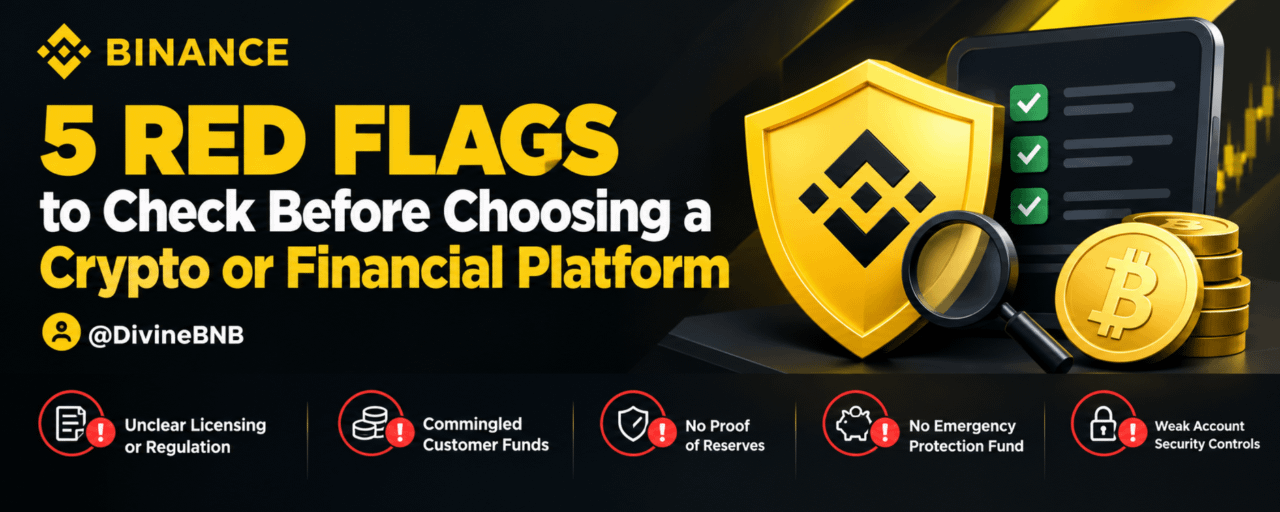
Before choosing a crypto or financial platform, check its licensing, custody structure, proof of reserves, emergency protection and account security. If a platform is unclear about these areas, that’s a warning sign worth taking seriously.
1. Unclear Licensing or Regulation
A platform that doesn't clearly explain which entities operate its services, where they are licensed or what regulatory requirements apply can make it difficult for users to understand the protections available to them.
Always check the platform's official regulatory information and the entity you're actually signing up with.
2. Commingled Customer Funds
Another major red flag is a lack of clarity around how customer assets are held.
Look for platforms that explain their custody arrangements and how customer assets are separated from company funds. Clear custody information can make it easier to understand how your assets are handled.

3. No Proof of Reserves
If a platform provides no way to verify that it holds sufficient assets to support customer balances, users have less transparency.
Binance publishes Proof of Reserves (PoR) and uses Merkle Tree verification, allowing users to check information about their included assets and verify their balances through the available PoR system.
4. No Emergency Protection Fund
Crypto markets can move quickly, and unexpected security incidents can happen.
A platform offering an emergency protection mechanism provides another layer of resilience. Binance's Secure Asset Fund for Users (SAFU) was established as an emergency fund to help protect users in certain extreme situations.

5. Weak Account Security Controls
A platform can have strong infrastructure, but your account still needs protection.
Look for security features such as passkeys, two-factor authentication (2FA), anti-phishing codes and withdrawal allowlisting. These controls can help reduce the risk of unauthorized access and suspicious withdrawals.
Final Thoughts
Choosing a crypto or financial platform shouldn't be based only on fees or the number of assets available.
Before depositing funds, check the regulatory status, custody arrangements, Proof of Reserves, emergency protection and account security controls. These five checks can help you understand how seriously a platform approaches transparency and user protection.
Do your own research and make sure the platform's services are available and appropriate for your jurisdiction.
FAQs
Is Binance regulated in South Africa?
Binance is available to South African users and states that it is actively engaged in the South African CASP licensing process. Regulatory status can change, so users should verify the current status of the specific Binance entity and product they plan to use.
How do I know if Binance is safe?
No crypto platform is completely risk-free. Users should evaluate Binance's security controls, Proof of Reserves, custody arrangements, SAFU protection, regulatory structure and their own account-security practices before using the platform.
How does Binance protect customer assets?
Binance says customer assets are backed 1:1 and provides Proof of Reserves verification using Merkle Trees and zk-SNARKs. It also maintains SAFU as an emergency fund and provides multiple account-security controls.
What is Binance Proof of Reserves?
Proof of Reserves is a system that allows users to verify that Binance's reported reserves cover customer assets on a 1:1 basis. Binance uses Merkle Trees and zk-SNARKs so users can verify that their own account balance was included without exposing other users' private information.
#Binance | @Binance Angels | @Binance Square Official | #SAFU🙏