
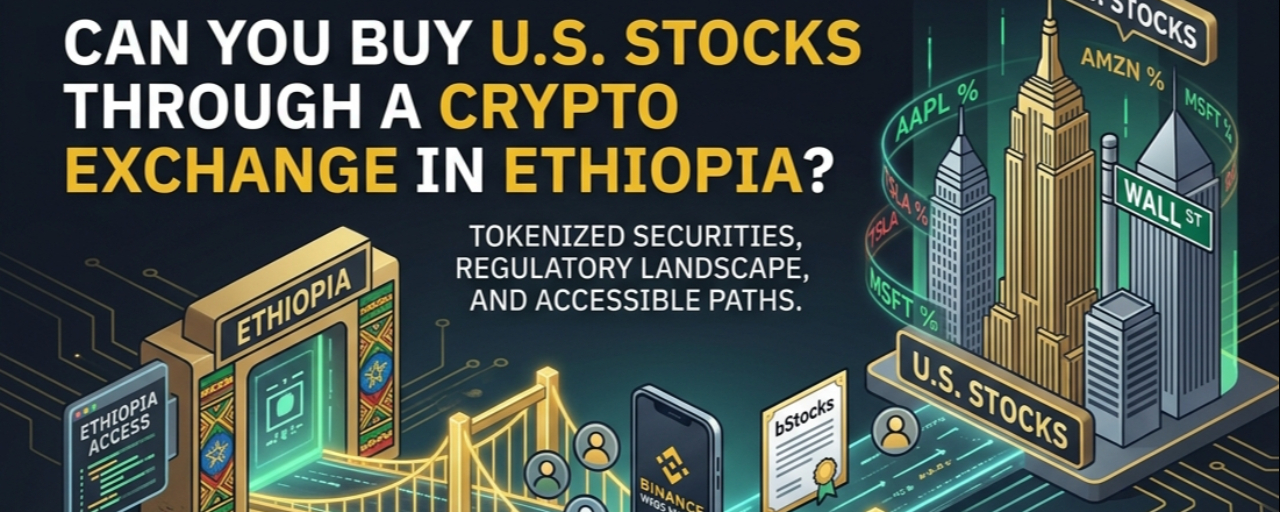
Yes, eligible users in Ethiopia can buy and sell more than 7,000 U.S.-listed stocks and ETFs through Binance using supported crypto balances. Binance Stocks Trading is provided through Nest Trading Limited, which routes securities orders to Alpaca Securities LLC for execution, clearing, settlement and custody. Availability depends on the user's jurisdiction, account status and eligibility.
For crypto users, this creates a different way to access traditional markets: instead of moving crypto to a separate brokerage, eligible users can access U.S. stocks and ETFs through the Binance ecosystem.
The important distinction is that Binance Direct Stocks and Binance bStocks are two different products. Direct Stocks give eligible users beneficial ownership of the securities they purchase, while bStocks are blockchain-based tokenized securities backed 1:1 by underlying securities but do not represent direct ownership of the underlying shares.
Can You Buy U.S. Stocks on Binance in Ethiopia?
For eligible Ethiopian users, Binance provides access to its U.S. Stocks & ETFs trading service.
Binance currently advertises more than 7,000 listed stocks and ETFs, with investments starting from as little as $5. Selected stocks also support fractional investing, allowing users to buy less than one whole share.
This means an eligible user does not necessarily need to open a separate traditional brokerage account to gain access to the supported U.S. securities through Binance.
However, availability should always be checked inside the user's Binance account. Binance states that securities products may not be available in every region, and eligibility can depend on jurisdiction and applicable requirements.
For Ethiopian users, this distinction is important: being able to access Binance itself does not automatically mean every Binance financial product is available to every user.
How Does Stock Trading on Binance Work?
Binance Stocks Trading is provided by Nest Trading Limited and operates in cooperation with an external brokerage. For securities transactions, Nest Trading acts as the introducing broker and routes orders to Alpaca Securities LLC, which handles execution, clearing, settlement and custody. Binance does not itself handle or custody the securities.
The user experience, however, remains inside Binance.
Stock purchases are primarily made using USDC. Binance also supports certain other assets, including USDT and BNB, which can be automatically converted to USDC when an eligible stock order is submitted. The assets used for the purchase need to be held in the Funding or Spot Account.
For example, an eligible user holding USDT does not necessarily need to manually sell the USDT for USDC first. Binance can handle the supported conversion as part of the stock-order process.
When a stock is sold, the proceeds are credited as USDC to the user's Funding Account.
Binance currently describes stock trading as supporting different trading sessions depending on the security, including Regular, Extended and 24-hour sessions. Market orders are available during Regular Trading Hours, generally 9:30 a.m. to 4:00 p.m. Eastern Time.
Which U.S. Stocks and ETFs Can You Trade on Binance?
Binance currently advertises access to more than 7,000 listed stocks and ETFs.
The selection covers companies and funds across different sectors and market segments. The Binance Stocks page currently highlights names including:
Apple
Microsoft
NVIDIA
Alphabet
Amazon
Meta
Tesla
Netflix
AMD
JPMorgan
Visa
Mastercard
The exact securities available to an individual user can depend on product availability and eligibility.
The platform also supports fractional shares for selected stocks, meaning users do not always need enough capital to purchase an entire share. Binance says the minimum investment can start at $5.
This can be particularly relevant when a single share of a company has a high market price: instead of buying one complete share, an eligible user can purchase a fraction.
Which U.S. Stocks Can You Trade Through Binance?
The answer is broader than simply a handful of large technology companies.
Binance's current offering includes 7,000+ listed stocks and ETFs, giving eligible users access to securities across multiple sectors and categories. That can include large-cap companies, smaller companies and ETFs, depending on what is supported by the brokerage infrastructure and available to the user's account.
The important point is that Binance's stock product is not simply a collection of tokenized versions of a few famous companies.
Direct Stocks are actual securities exposure through the brokerage structure, with the user identified as the beneficial owner of the shares they purchase. That is fundamentally different from buying a crypto token that merely tracks the price of a stock.
Can You Buy Binance bStocks in Ethiopia?
bStocks require a separate explanation.
bStocks are tokenized securities issued by BTech Holdings Limited, a Binance group affiliate. Each bStock is backed 1:1 by a corresponding U.S. share held with a regulated custodian. However, owning a bStock is not the same thing as directly owning the underlying U.S. share.
bStocks are structured as certificates representing interests in underlying securities. They can trade on Binance's spot market and, where permitted, can be withdrawn to a compatible BNB Smart Chain wallet.
There is an important geographic limitation.
Binance currently states that bStocks are not available in all jurisdictions and are offered only to eligible users in permitted jurisdictions on a secondary-market basis. Binance also provides a country-eligibility mechanism for determining whether a jurisdiction qualifies. Therefore, it would be inaccurate to state that every Ethiopian Binance user automatically has access to bStocks.
For an Ethiopian user, the practical check is whether bStocks appear as an available product in the Binance account and whether the account passes the applicable eligibility requirements.
This is also why Binance Stocks and Binance bStocks should not be treated as interchangeable products.
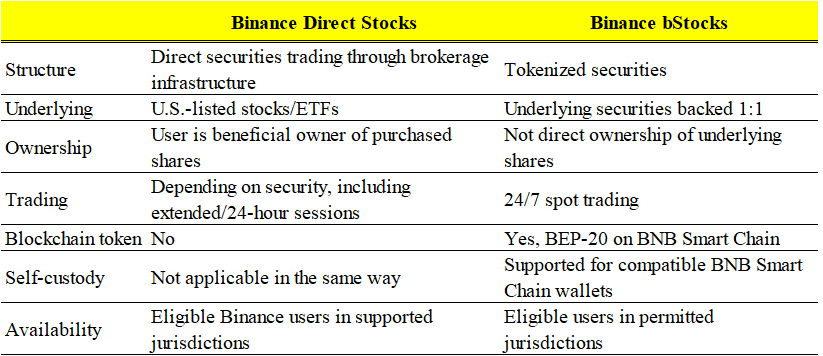
The distinction is important because the two products serve different purposes.
Relevant FAQs
Are Binance bStocks available in Ethiopia?
bStocks are subject to geographic eligibility and are not available in every jurisdiction. Binance's current terms state that bStocks are offered only to eligible users in permitted jurisdictions on a secondary-market basis. Users should check their Binance account and the current eligibility requirements rather than assuming availability based solely on country.
Are bStocks the same as U.S. shares?
No.
A bStock is a tokenized security backed 1:1 by an underlying U.S. share, but it does not give the holder direct ownership of that underlying share. Binance describes bStocks as certificates representing interests in the underlying securities.
By contrast, Binance's Direct Stocks product identifies the user as the beneficial owner of the shares purchased through the securities-trading service.
Can you buy U.S. stocks on Binance using USDT?
Yes, for eligible users.
Binance's current Stocks Trading documentation says stock purchases are primarily made using USDC, while supported assets including USDT and BNB can be automatically converted to USDC when the stock order is submitted.
So a user holding USDT can potentially fund a stock purchase without first manually transferring funds to a separate brokerage.
Can you buy U.S. stocks on Binance from Ethiopia?
Eligible users in Ethiopia can access Binance's Stocks & ETFs product, subject to the applicable account, product and jurisdictional requirements.
The available securities and services can change, so users should check the Stocks section of their Binance account before trading. Binance currently advertises more than 7,000 listed stocks and ETFs and a minimum investment starting at $5.
What is the difference between buying a stock and buying a bStock?
Buying a stock through Binance's Direct Stocks service gives the user beneficial ownership of the purchased security through the brokerage structure.
Buying a bStock instead provides exposure through a tokenized security backed 1:1 by the underlying share. The bStock itself is not direct ownership of that share.
For crypto-native users, bStocks additionally bring blockchain features such as 24/7 trading and the ability, where permitted, to withdraw the token to a compatible BNB Smart Chain wallet.
The Bigger Shift: From Crypto Exchange to Multi-Asset Platform
For Ethiopian crypto users, the significance of Binance's stock offering goes beyond simply adding another asset category.
A user can hold crypto, stablecoins and other digital assets while also accessing U.S. stocks and ETFs through the same broader ecosystem, subject to eligibility.
That does not make Binance a replacement for every traditional brokerage. Different platforms have different products, jurisdictions, fees and legal structures.
But the direction is clear: the boundary between a crypto exchange and a broader investment platform is becoming less distinct.
For users in markets where international investment access can be difficult, the ability to move between supported crypto balances and U.S. securities within one platform represents a meaningful change in how those markets can be accessed.
The key is understanding what you are actually buying.
Direct Stocks, bStocks and crypto assets may all appear within the same Binance ecosystem, but they have different legal structures, ownership rights, settlement mechanisms and geographic restrictions.
That distinction matters just as much as the number of assets available.