
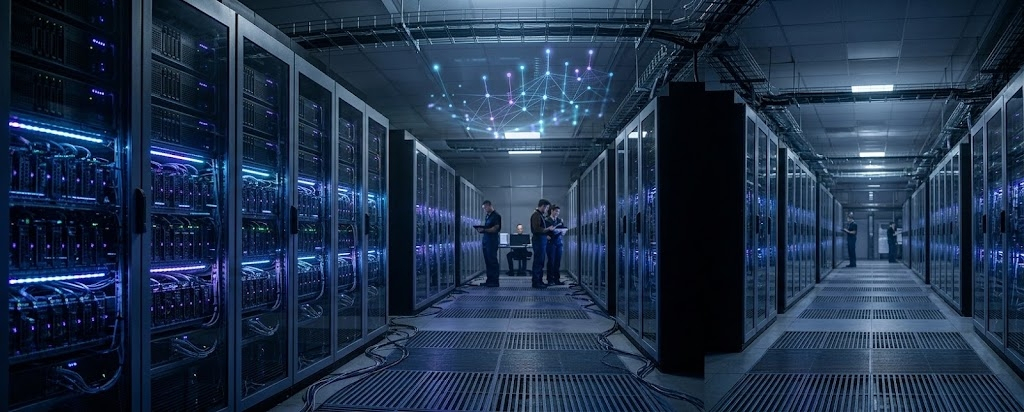


You've probably noticed the rotation. While much of the market has been choppy, a cluster of AI-linked and DePIN names has quietly pushed higher. The sector added roughly $1.6 billion in market value, taking the AI token complex toward $18.6 billion. NEAR led with a gain of about 20.8%. RENDER advanced around 10%. Broader AI and DePIN names rose between 5% and 9%.
Fear & Greed sitting near 57 helps explain the tone. Risk appetite is present without being euphoric. That is usually the window where capital tests growth narratives instead of chasing pure momentum. The question is whether this move is just another narrative bounce or whether it is starting to track something more durable: real demand for decentralized compute.
Why This Matters Now
What stands out is the combination of price and a few concrete signals. Confidential TVL on NEAR has moved past $70 million. That is not speculative volume; it is capital sitting inside privacy-preserving applications on a chain that has spent years positioning itself for AI and agentic workloads. At the same time, the market keeps returning to the same bottleneck: high-quality GPU capacity remains scarce and expensive.
DePIN projects that can coordinate real hardware and pay node operators in a transparent way sit at the intersection of those two forces. Traders are treating the latest strength as more than a meme rotation. They are treating it as an early read on whether decentralized compute can capture a slice of institutional and commercial demand that used to flow only to centralized cloud providers.
Funding rates and open interest in AI perpetual markets have expanded with the move. That tells you leverage is participating. It also tells you the move is no longer purely spot-driven. When OI rises alongside price, the next leg usually depends on whether new buyers keep showing up or whether the trade becomes crowded and mean-reverts.
Technical and On-Chain Picture
NEAR and RENDER both show RSI readings that are approaching overbought territory on shorter timeframes. That does not automatically mean the move is over. It does mean the easy part of the rally may be behind us. Order-block and prior-breakout retests become more important from here. If those zones hold on pullbacks, the structure stays constructive. If they fail quickly, the advance starts to look like a squeeze rather than a trend.
On-chain, the more interesting data is not just price. Active addresses in several GPU and compute-related tokens have risen. There are signs of whale accumulation in names tied to rendering and decentralized infrastructure. In DePIN networks, supply dynamics often favor longer-term holders when node growth and real usage increase, because emissions and rewards are at least partially tied to actual work rather than pure inflation. That does not remove drawdown risk. It does change the quality of the buyer.
What I'm watching closely is whether rising activity is concentrated in a few large wallets or whether it is broadening. Speculative runs often look the same on the surface. Sustainable ones usually show wider participation over time.
Fundamentals and Tokenomics Angle
The core claim behind this complex is straightforward. AI training and inference need compute. Centralized providers dominate today, but cost, availability, and, increasingly, concerns around control and data handling create room for alternatives. Decentralized physical infrastructure networks try to turn idle or distributed hardware into a market. Tokens sit in the middle as coordination and incentive layers.
NEAR's positioning around confidential computing and AI agents gives it a different flavor from pure GPU marketplaces. RENDER and similar names are more directly exposed to rendering and compute supply. The sector-wide bid suggests the market is not picking a single winner yet. It is re-rating the category.
Tokenomics still matter. High emissions without corresponding demand for the service can cap upside even when the narrative is strong. Networks that can show rising node counts, utilization, and fee or reward flows tied to real workloads have a clearer path. Those that only offer exposure to the AI story without usage metrics will likely lag once the initial rotation fades.
Risks, Opportunities, and Practical Implications
The main risk is obvious. AI and DePIN have already delivered several narrative-driven rallies that faded when usage did not follow price. Overbought technicals, rising leverage, and a still-moderate Fear & Greed reading leave room for a sharp pullback if broader risk sentiment turns or if the next wave of catalysts disappoints.
There is also concentration risk. A handful of names can dominate sector performance. When they correct, the entire basket often moves with them.
The opportunity sits on the other side of that. If institutional and commercial demand for decentralized or hybrid compute continues to grow, the tokens that sit closest to real hardware and real workloads can re-rate on fundamentals rather than pure narrative. For pro traders, that means treating strength as a signal to manage risk around technical levels and funding, not as a reason to abandon sizing discipline. For longer-term investors, it means separating projects with measurable network activity from those that mainly offer thematic exposure.
One practical approach is to watch three things together: price structure on pullbacks, on-chain activity and whale behavior, and any hard metrics around TVL, node growth, or compute utilization. When all three align, the case is stronger. When only price is rising, caution is warranted.
Closing View
This rally is real in market terms. AI-linked tokens have taken meaningful capital and attention. NEAR's relative strength and the confidential TVL print give the move more texture than a pure meme rotation. At the same time, the sector has a history of running ahead of adoption.
What the data suggests right now is a market willing to pay for exposure to decentralized compute while the broader tone remains risk-on but not euphoric. Whether that payment proves justified depends on the next set of usage and infrastructure signals, not on the size of the latest percentage move. The interesting phase is the one that comes after the easy bid—when the market has to decide which projects are still priced for narrative and which ones are starting to be priced for work.