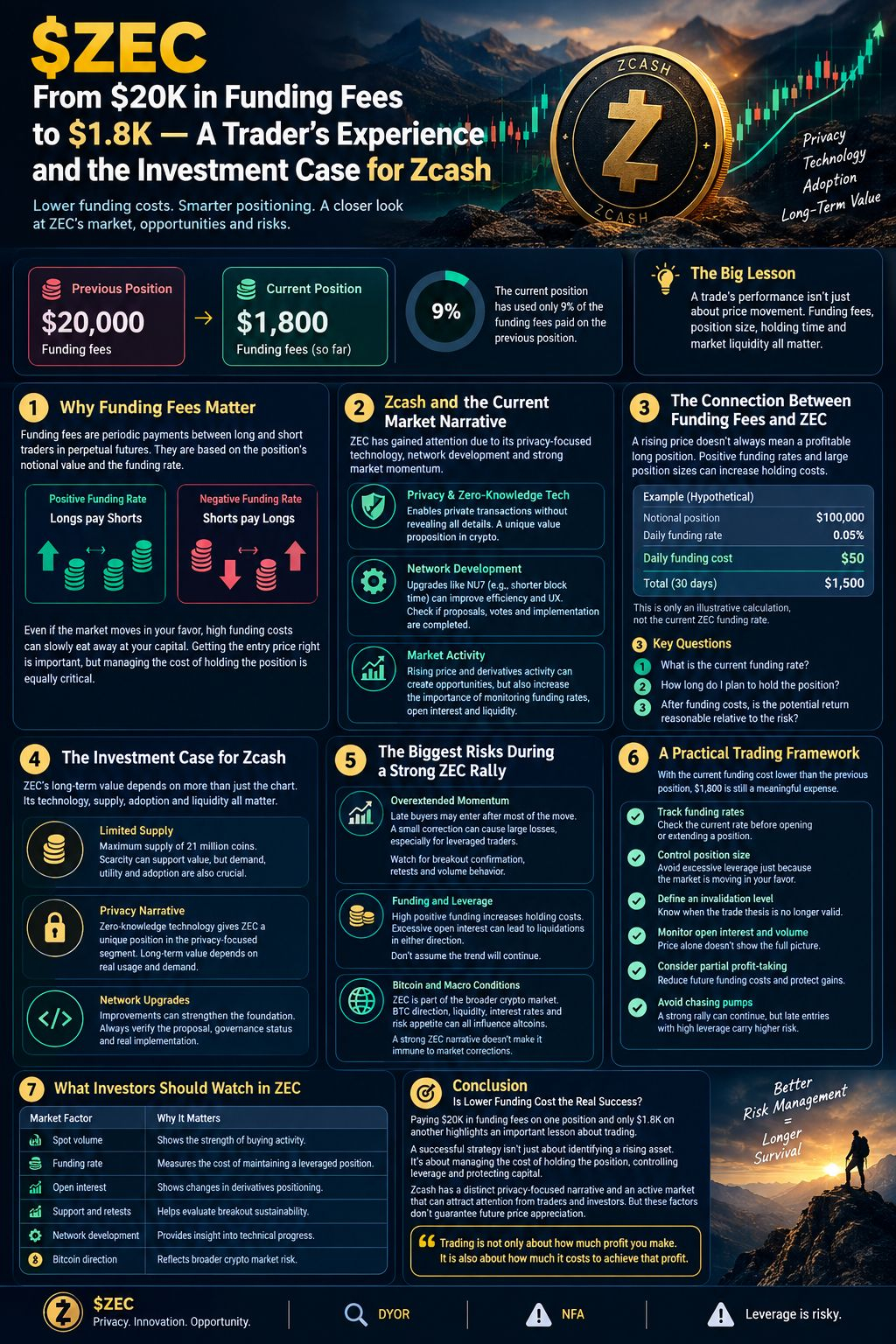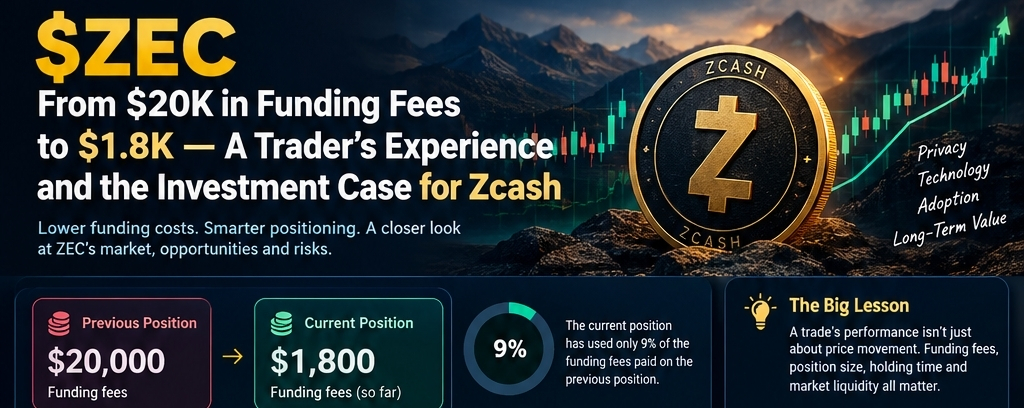

A previous position cost me $20,000 in funding fees. This one has cost me only $1,800 so far. That difference is more than just a number. It raises an important question about the cost of holding leveraged positions, funding rates, and trading strategy in the futures market.
My previous funding cost: $20,000
Current funding cost: $1,800
The current position has used approximately 9% of the funding fees paid on the previous position.
The key lesson is that a trade’s performance cannot be measured by price movement alone. Funding fees, position size, holding time, and market liquidity all matter. When we connect this experience with the market structure and investment narrative surrounding Zcash, several important points emerge for futures traders and crypto investors.
1. Why Funding Fees Matter More Than Many Traders Realize
Funding fees are periodic payments exchanged between long and short traders in perpetual futures contracts. They are generally calculated based on the position’s notional value and the funding rate.
When funding is positive, long traders typically pay short traders. When funding is negative, the opposite may happen.
A trader can be correct about the market direction and still lose a significant amount of money if the cost of maintaining a leveraged position becomes too high.
Imagine holding a large position for an extended period. Even if the market does not move against you, funding fees can gradually reduce your capital. This means that getting the entry price right is only one part of the equation. Managing the cost of staying in the trade is equally important.
In my example, the difference is clear:
Previous funding fees: $20,000.
Current funding fees: $1,800.
Difference: $18,200.
Current fees represent approximately 9% of the previous position’s funding cost.
These numbers do not represent trading profit. They represent the cost of maintaining positions. That distinction matters because a lower funding bill does not automatically mean a profitable trade.
2. Zcash and the Current Market Narrative
Zcash has attracted attention because of its privacy-focused technology, network development, and recent market momentum.
The project uses zero-knowledge proofs to enable privacy-preserving transactions. This gives Zcash a distinct identity within the cryptocurrency market and makes it relevant to investors interested in financial privacy and decentralized technology.
The broader market narrative around ZEC can be divided into three areas.
Privacy and Zero-Knowledge Technology
Zcash’s core value proposition is the ability to verify transactions without necessarily revealing all transaction details. As interest in financial privacy and privacy-preserving digital systems develops, this technology may remain an important part of the project’s long-term narrative.
Network Development
Network upgrades can affect transaction efficiency, user experience, and the future direction of a blockchain. However, investors should distinguish between a proposed upgrade, a governance vote, and an upgrade that has actually been implemented.
Market Activity
ZEC’s price movement and derivatives activity can create opportunities, but they also increase the importance of monitoring funding rates, open interest, and liquidity. Strong momentum does not eliminate risk.
3. The Connection Between Funding Fees and $ZEC
A rising cryptocurrency does not automatically make every long position profitable.
When funding rates are positive and position sizes are large, the cost of holding a long position can increase over time. A trader needs to consider whether the expected price movement is sufficient to cover the funding expense.
For example, a hypothetical $100,000 notional position with a daily funding rate of 0.05% would generate:
Daily funding cost: $50
Over 30 days, the total would be approximately $1,500, assuming the position size and funding rate remain unchanged.
This is only an illustrative calculation, not a current ZEC funding rate.
The lesson is simple: before holding a leveraged position, ask three questions.
What is the current funding rate?
How long do I plan to hold the position?
After funding costs, is the potential return reasonable relative to the risk?
4. The Investment Case for Zcash
Zcash’s long-term value cannot be assessed through a chart alone. Its technology, supply structure, adoption, and market liquidity all deserve consideration.
Limited Supply
Zcash has a maximum supply of 21 million coins, similar to Bitcoin’s fixed-supply model. Limited supply can contribute to a scarcity narrative, but scarcity alone does not guarantee price appreciation. Demand, utility, adoption, and market conditions remain important.
Privacy as a Distinctive Narrative
Privacy-focused digital assets serve a different purpose from many general-purpose cryptocurrencies. Zcash’s zero-knowledge technology gives it a recognizable position in this segment.
However, the long-term investment case depends on whether that technology attracts sustained usage and demand, not simply whether the privacy narrative becomes popular during a market rally.
Network Upgrades and Development
Network improvements can strengthen the project’s technical foundation. Investors should verify the details of each upgrade, including its proposal, governance status, and implementation.
A proposed change should not be treated as a completed development until it is confirmed.
5. The Biggest Risks During a Strong ZEC Rally
Overextended Momentum
When a cryptocurrency rises rapidly, late buyers may enter after much of the move has already occurred. A small correction can then create substantial losses, particularly for leveraged traders.
Breakout confirmation, retests, and volume behavior are useful areas to monitor.
Funding and Leverage
High positive funding can increase the cost of long positions. At the same time, excessive open interest can make the market vulnerable to liquidations in either direction.
A trader should not assume that a strong price trend will continue indefinitely.
Bitcoin and Macro Conditions
ZEC remains part of the broader cryptocurrency market. Bitcoin’s direction, liquidity conditions, interest rates, and overall risk appetite can influence altcoin performance.
A strong $ZEC -specific narrative may support demand, but it does not make the asset immune to broader market corrections.
6. A Practical Trading Framework
The current funding cost is lower than the previous position’s cost, but $1,800 is still a meaningful expense.
A practical approach to managing a leveraged position includes:
Track funding rates: Review the current rate before opening or extending a position.
Control position size: Avoid using excessive leverage simply because the market is moving in your favor.
Define an invalidation level: Decide in advance when the trade thesis is no longer valid.
Monitor open interest and volume: Price movement alone does not reveal the full market structure.
Consider partial profit-taking: If the position moves substantially in your favor, reducing exposure can lower future funding costs and protect part of the gains.
Avoid chasing pumps: A strong rally can continue, but entering late with high leverage creates a different risk profile from holding an earlier position.
7. What Investors Should Watch in ZEC
Market factor
Why it matters
Spot volume
Helps assess the strength of buying activity
Funding rate
Measures the cost of maintaining a leveraged position
Open interest
Shows changes in derivatives positioning
Support and retests
Helps evaluate breakout sustainability
Network development
Provides insight into technical progress
Bitcoin direction
Reflects broader crypto market risk
For ZEC, the important question is not simply how high the price can go. It is whether the market structure, demand, and risk conditions support the position being taken.
Conclusion: Is Lower Funding Cost the Real Success?
The experience of paying $20K in funding fees on one position and only $1.8K on another highlights an important lesson about trading.
A successful trading strategy is not only about identifying a rising asset. It is also about managing the cost of holding the position, controlling leverage, and protecting capital.
Zcash has a distinct privacy-focused technology narrative and an active market that can attract attention from traders and investors. But these factors do not guarantee future price appreciation.
The most important takeaway is this:
Trading is not only about how much profit you make. It is also about how much it costs to achieve that profit.
In a volatile market like $ZEC , capital preservation, disciplined position sizing, and a clear risk-management plan can be more valuable than chasing every price move.
DYOR • NFA • Leverage is risky.

#zec #BitcoinSurpasses$77000 #cryptouniverseofficial #Binance #BinanceSquare