
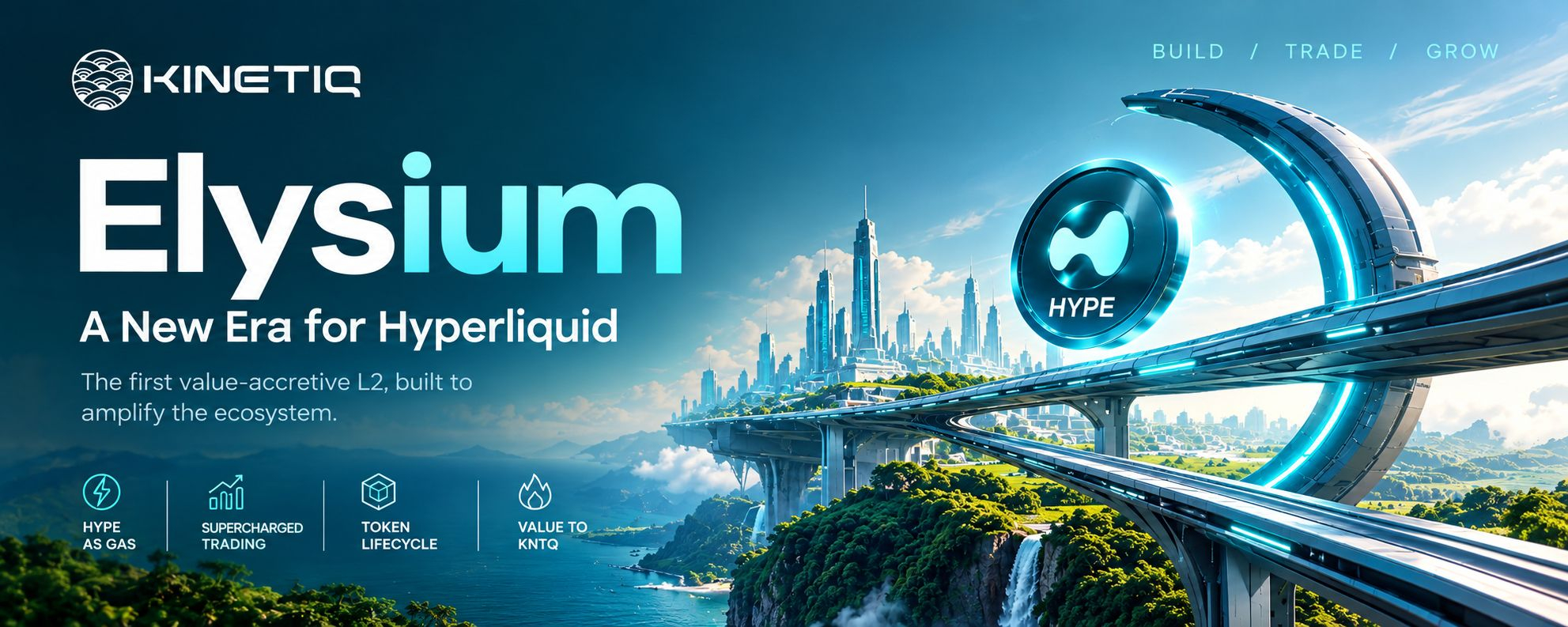

Layer 2s are usually sold as scaling solutions. But scaling alone does not answer the more important question: where does the economic value created by that additional activity ultimately go?
That is what makes Kinetiq’s Elysium worth examining beyond the usual L2 narrative.
#Kinetiq describes Elysium as a Hyperliquid-aligned Layer 2 designed to address a specific problem: HyperEVM is useful for composability with HyperCore, but its deliberately constrained execution environment is not designed for sustained, high-frequency workloads. Kinetiq’s documentation puts the current target at 300 Mgas/s and 100–200 ms blocks for Elysium, compared with HyperEVM’s smaller execution blocks.
The interesting part is not simply making Hyperliquid faster. It is making additional activity economically useful to the ecosystem around it.
Why Hyperliquid Needs Another Execution Layer
Hyperliquid’s architecture creates an unusual opportunity. HyperCore already provides native trading infrastructure, but pushing intensive EVM activity directly into HyperEVM can run into throughput and execution constraints.
Elysium therefore takes a different approach: rather than replacing HyperCore, it sits alongside it.
Its architecture is an Arbitrum Orbit/Nitro-based L2 that settles to HyperEVM while remaining co-located with HyperCore. That distinction matters because Elysium is being designed around DeFi workloads that need speed without abandoning Hyperliquid-native liquidity and settlement.
HYPE Becomes the Gas Layer
One of Elysium’s simplest but most important decisions is using HYPE as its native gas token.
There is no requirement for users to acquire another ecosystem token simply to transact. $HYPE bridges into Elysium 1:1 as native gas and can withdraw 1:1.
That creates a cleaner economic relationship between the L2 and its underlying ecosystem.
Instead of creating an isolated gas economy, Elysium keeps HYPE at the center.
Built Around Trading, Not Just Transactions
Elysium’s bigger opportunity may be its focus on spot markets and PropAMMs.
High-frequency market makers need rapid execution, inexpensive transactions and reliable market data. Elysium targets those requirements while providing access to HyperCore information through its planned read layer.
The technical roadmap goes further: contracts will be able to access HyperCore order-book data, prices, balances and positions through a native precompile, while a separate writer mechanism is designed to let applications drive HyperCore trading actions.
That could make sophisticated market-making strategies considerably easier to build.
A Token Can Have a Lifecycle
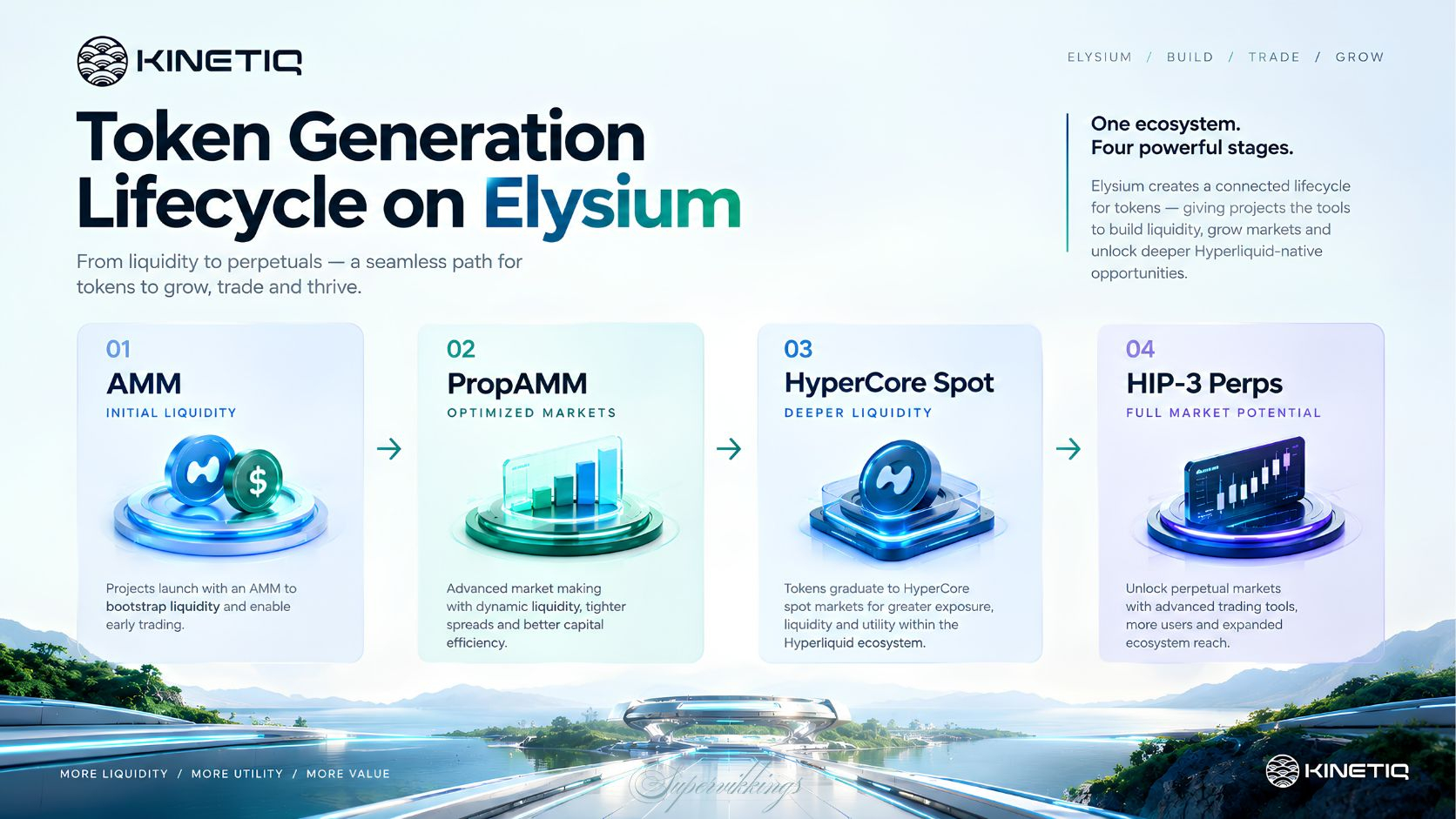
Another interesting component is the proposed token lifecycle:
AMM → PropAMM → HyperCore Spot → HIP-3 Perps
The significance is not that every project automatically progresses through these stages. Rather, Elysium provides a connected pathway for projects to bootstrap liquidity, develop markets and potentially progress toward deeper #Hyperliquid -native markets.
Kinetiq’s documentation already describes permissionless token bridging and mechanisms allowing Elysium-native assets to move toward HyperCore spot markets.
The Economic Experiment: 25 / 25 / 50
This is where Elysium becomes particularly different from the conventional L2 model.
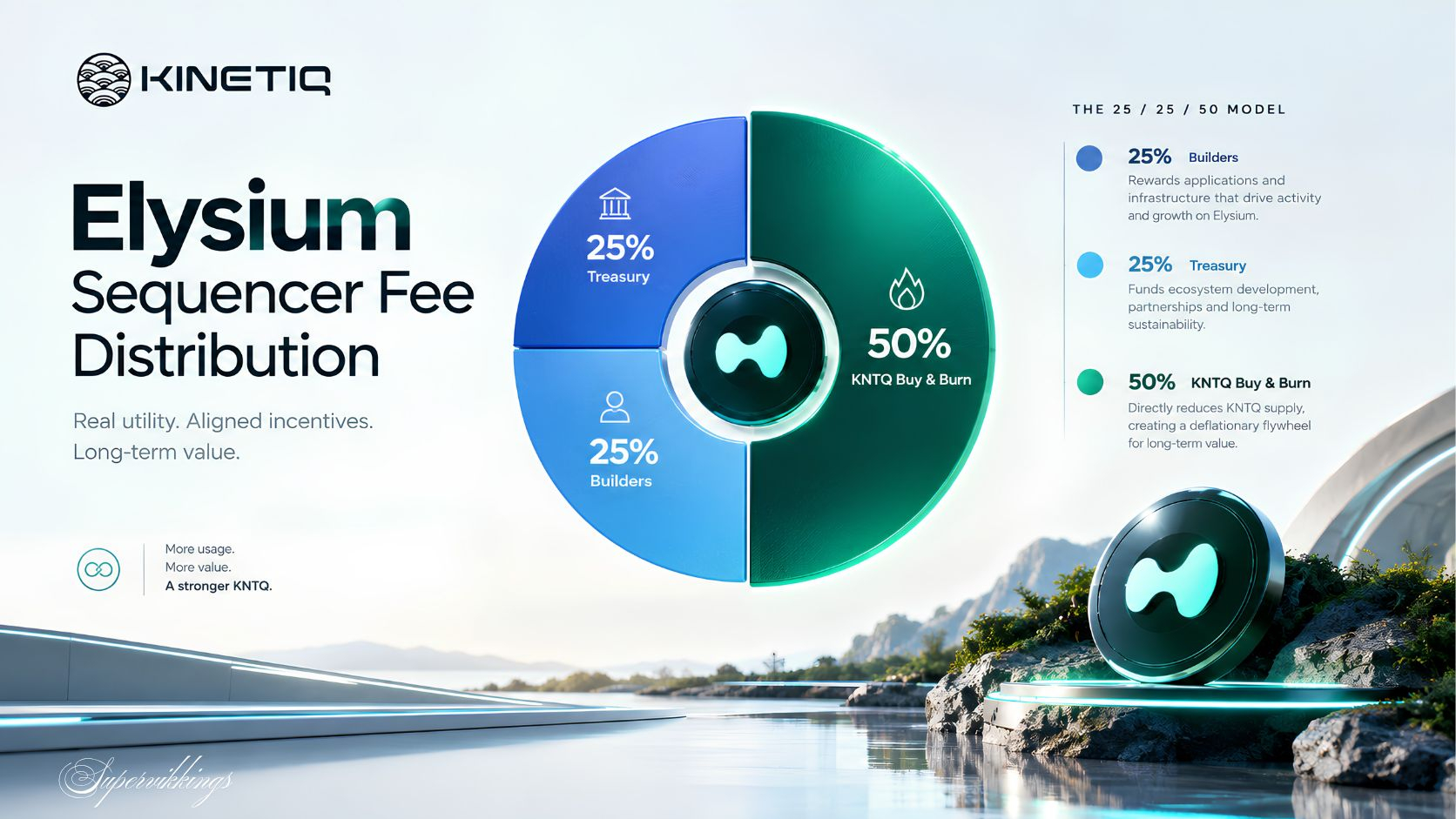
The proposed sequencer-fee allocation is:
25% → Builders
25% → Treasury
50% → KNTQ buybacks and burns
The first 25% rewards the applications generating activity. The second gives the ecosystem resources for continued development. The final 50% creates a direct link between Elysium usage and KNTQ supply reduction.
That produces an interesting feedback loop:
More useful applications → more transactions → more sequencer fees → more KNTQ purchased → more KNTQ removed from circulation.
Kinetiq’s existing documentation already identifies KNTQ as the protocol’s central value-accrual instrument and lists multiple buyback mechanisms.
My Take: The Mechanism Is Stronger Than the Hype
I think the most interesting aspect of Elysium is not the word “L2.” It is the alignment.
Traditional L2 economics can create situations where activity migrates away from an L1 while value capture remains concentrated at the execution layer. Elysium is attempting the opposite: use Hyperliquid’s native HYPE, leverage HyperCore infrastructure, create incentives for builders, and route half of sequencer revenue toward KNTQ buybacks and burns.
But there is an important reality check.
Deflationary mechanics do not automatically create economic value.
The burn becomes meaningful only if Elysium attracts sustained users, applications, trading volume and fee-generating activity. Likewise, ambitious throughput targets must ultimately survive real-world demand and production conditions. Kinetiq itself currently describes Elysium as pre-launch and notes that specifications may still change.
That is why I see #Elysium less as a finished victory and more as a fascinating economic and technical experiment.
If execution matches the thesis, Elysium could demonstrate that an L2 does not have to be an extraction layer sitting beside its parent chain.
It can be an amplifier.
And that may ultimately be the most important idea behind Elysium.