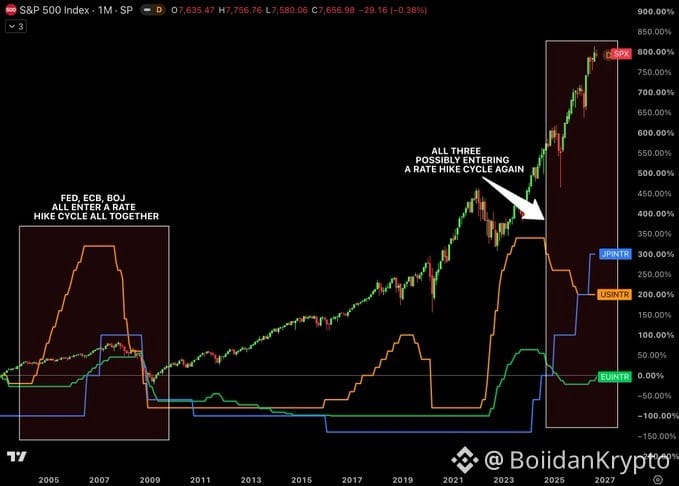
🚨 FOR THE FIRST TIME SINCE 2006 — THE FED, ECB, AND BOJ MAY ALL HIKE RATES TOGETHER.
Back in 2022, when the Fed and ECB slammed on the brakes, Japan didn't. Rates stayed negative. That meant one thing: cheap yen was still out there, funding trades all over the world.
That era is over. 💴
🔹 BOJ rate: now 1% — the highest since 1995
🔹 Bond purchases: cut by ~¥200B every quarter
🔹 Balance sheet: ¥662T (March) → ¥643T (August) — already shrinking
🔹 ECB deposit rate: hiked again Sept 10 → 2.50%
🔹 US: Fed hasn't moved yet, but hike odds are climbing fast after August core CPI hit 2.4%, with energy up 16.3% YoY — the same energy shock that pushed euro area inflation to 3.3%
Here's the part most people miss: 👇
Japan isn't just a cheap-funding tap. It's the largest foreign holder of US Treasuries — $1.116T as of June. It doesn't need to sell a single bond to move global yields. It just has to buy less. As JGB yields rise, Japanese insurers and pensions have less incentive to chase yield abroad — and that alone can push up borrowing costs everywhere.
And it's not only about yields. When the yen strengthens, it can force leveraged investors who borrowed in yen to dump other assets fast to cover their positions.
We saw exactly this in August 2024 — one BOJ hike, and the Nikkei crashed 12.4% in a single day. Japanese life insurers had already slashed dollar hedges from ~60% to 40% beforehand, because hedging costs got too expensive.
The last time all three central banks were hiking in sync? 2006. Right before 2008.
That's not a prediction — balance sheets are much bigger now, and the Fed/ECB/BOJ have standing dollar swap lines built specifically to stop funding markets from seizing up.
But here's the real question: what happens if inflation stays hot enough that all three keep hiking — right as Japan stops being the world's cheapest source of leverage? 🤔
#Macro #FederalReserve #BankOfJapan
$NVDA
$MU
$BTC
Back in 2022, when the Fed and ECB slammed on the brakes, Japan didn't. Rates stayed negative. That meant one thing: cheap yen was still out there, funding trades all over the world.
That era is over. 💴
🔹 BOJ rate: now 1% — the highest since 1995
🔹 Bond purchases: cut by ~¥200B every quarter
🔹 Balance sheet: ¥662T (March) → ¥643T (August) — already shrinking
🔹 ECB deposit rate: hiked again Sept 10 → 2.50%
🔹 US: Fed hasn't moved yet, but hike odds are climbing fast after August core CPI hit 2.4%, with energy up 16.3% YoY — the same energy shock that pushed euro area inflation to 3.3%
Here's the part most people miss: 👇
Japan isn't just a cheap-funding tap. It's the largest foreign holder of US Treasuries — $1.116T as of June. It doesn't need to sell a single bond to move global yields. It just has to buy less. As JGB yields rise, Japanese insurers and pensions have less incentive to chase yield abroad — and that alone can push up borrowing costs everywhere.
And it's not only about yields. When the yen strengthens, it can force leveraged investors who borrowed in yen to dump other assets fast to cover their positions.
We saw exactly this in August 2024 — one BOJ hike, and the Nikkei crashed 12.4% in a single day. Japanese life insurers had already slashed dollar hedges from ~60% to 40% beforehand, because hedging costs got too expensive.
The last time all three central banks were hiking in sync? 2006. Right before 2008.
That's not a prediction — balance sheets are much bigger now, and the Fed/ECB/BOJ have standing dollar swap lines built specifically to stop funding markets from seizing up.
But here's the real question: what happens if inflation stays hot enough that all three keep hiking — right as Japan stops being the world's cheapest source of leverage? 🤔
#Macro #FederalReserve #BankOfJapan
$NVDA
$MU
$BTC