
The August CPI report is finally here, but the bigger question for markets is no longer simply whether inflation was hot or cool.
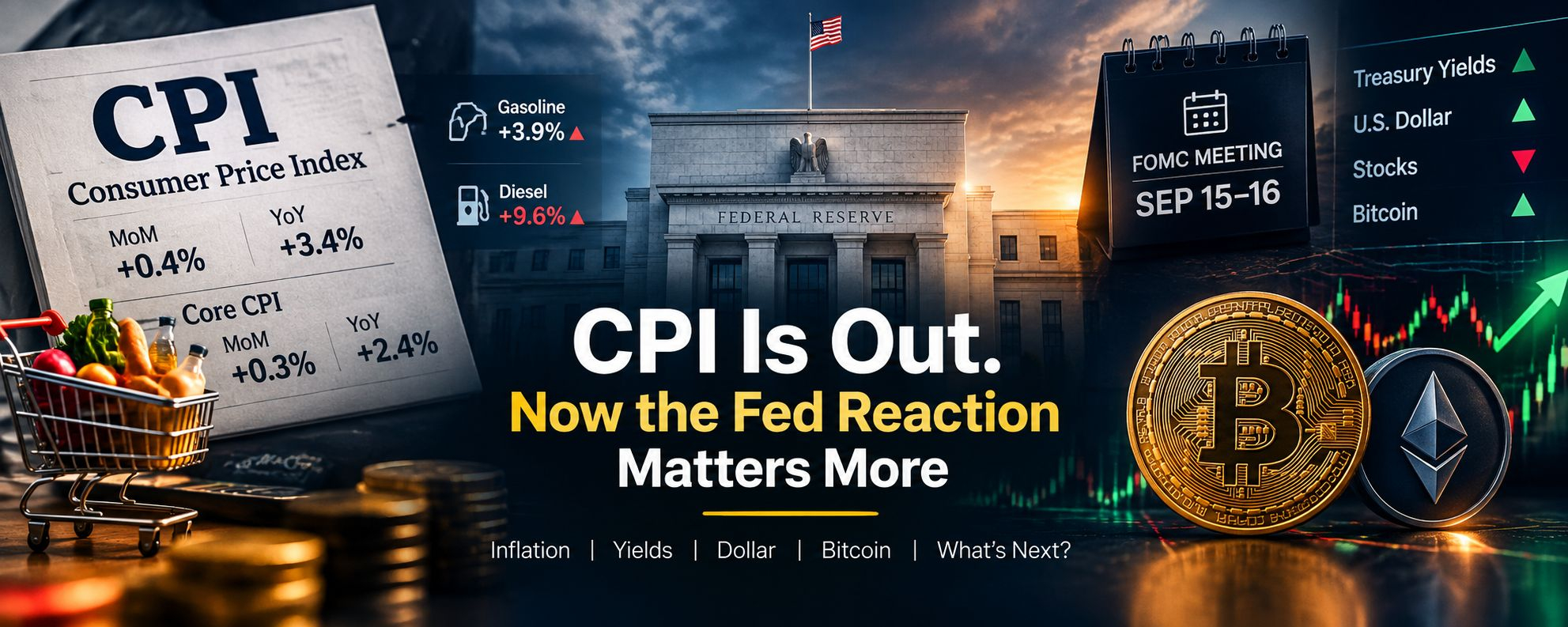
The real question is how the Federal Reserve will read the numbers ahead of its September 15–16 meeting, and how that interpretation could affect Bitcoin, stocks, Treasury yields and the U.S. dollar.
August CPI showed consumer prices rising 0.4% month over month and 3.4% year over year. Core CPI, which removes food and energy, increased 0.3% month over month and 2.4% year over year.
At first glance, the report was not the inflation shock many traders were preparing for. But some details deserve attention.
Gasoline prices rose 3.9% during the month, while diesel prices increased 9.6%. Energy remains an important variable because sustained increases can feed into broader inflation expectations.
Why This Report Matters
The Fed is walking into September with inflation still above its 2% target.
At the same time, the labor market is no longer as strong as it was earlier in the cycle, but it has not collapsed either. August nonfarm payrolls increased by 162,000 and unemployment remained at 4.1%.
That leaves policymakers in an uncomfortable position.
Cutting or easing too aggressively could risk reigniting inflation. Staying restrictive for too long could put additional pressure on employment and economic growth.
The latest PPI report adds another layer to this picture.
Producer prices increased 0.4% month over month in August and were up 5.4% year over year. Final-demand goods prices rose 1.1%, while energy prices increased 4.2%.
So the inflation story is improving in some areas, but it is far from completely settled.
The Market Reaction Is More Important Than the Headline
One thing I have learned from CPI days is that the first price move is not always the move that matters.
A hotter inflation reading would normally create a familiar chain reaction:
Higher inflation expectations
Higher Treasury yields
More hawkish Fed expectations
Stronger dollar
Pressure on stocks and crypto
Bitcoin is particularly sensitive to changes in liquidity and financial conditions. When yields rise sharply, risk assets can lose some of their appeal.
But the opposite is also possible.
If inflation continues to cool and yields move lower, financial conditions could become more supportive for equities and crypto. A weaker dollar could add another positive factor for dollar-priced risk assets.
Still, softer CPI does not automatically mean Bitcoin goes higher.
Positioning, leverage and expectations going into the event can completely change the reaction.
The Fed Is Still the Bigger Variable
This is where I think traders need to separate market pricing from the actual Fed decision.
Rate futures can move quickly after economic data. A high probability of a particular outcome does not guarantee that policymakers will deliver it.
The Fed will be looking at more than CPI.
CPI, PPI, employment, wages, consumer spending, inflation expectations and financial conditions all matter when policymakers decide what comes next.
That means the market can price one scenario today and completely rethink it before the meeting.
The September 15–16 FOMC meeting therefore becomes the next major checkpoint.
What I Am Watching in Bitcoin
Bitcoin has been trading around the $77K area, while Ethereum remains around $2.5K.
For BTC, I am less interested in predicting the immediate CPI candle and more interested in what happens after the volatility settles.
If Treasury yields move higher, the dollar strengthens and BTC struggles to reclaim resistance, that would suggest risk appetite is still fragile.
But if yields begin to ease, the dollar loses momentum and Bitcoin starts forming higher lows, that would be a much more constructive signal.
ETH is also worth watching because it has recently shown stronger relative momentum than Bitcoin.
The important thing is whether that strength continues after the macro volatility fades.
My CPI Approach
I am not interested in trading the first five-minute candle.
My process is much simpler:
CPI data → Treasury yields → dollar → Bitcoin structure → confirmation → trade
If the first move is aggressive, I wait.
If yields confirm the macro direction, I watch BTC.
If Bitcoin confirms that direction with volume and follow-through, then the setup becomes more interesting.
If the market gives no confirmation, I stay out.
There is no advantage in forcing a trade simply because an economic report created volatility.
Risk Matters More Than Prediction
CPI releases can create fast moves in both directions.
A breakout can become a rejection. A sell-off can become a squeeze. A clean-looking setup can disappear within minutes.
That is why leverage and position sizing matter so much during major economic events.
I would rather miss part of a confirmed move than take unnecessary risk trying to predict the exact first reaction.
The objective is not to be right about every candle.
The objective is to protect capital and participate when the market gives a clear signal.
Final View
The CPI report is important, but I think the next reaction is even more important.
Inflation remains above the Fed's target. The labor market is still relatively resilient. Energy prices remain a potential source of pressure. Treasury yields are elevated, and the dollar can quickly become a headwind for risk assets.
For Bitcoin, I am watching the relationship between yields, the dollar and price structure rather than focusing on the CPI headline alone.
I do not want to predict what the market should do.
I want to see what the market actually confirms before taking a position.
That is the approach I am taking into the September Fed meeting.
$LAB