
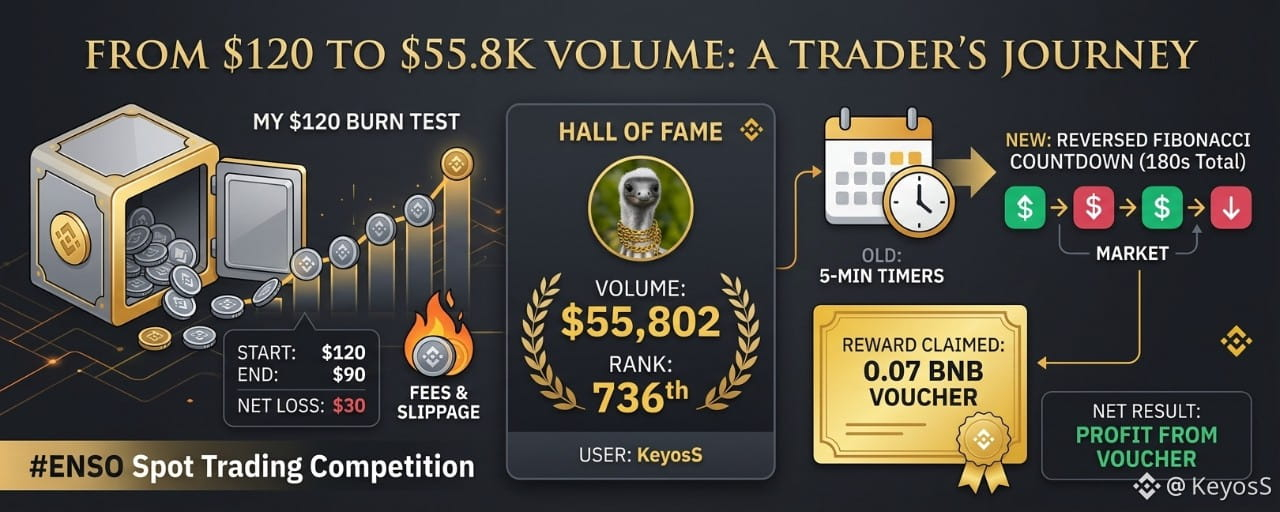

Trading competitions look straightforward on paper—generate volume, hit the leaderboard, and claim your share of the prize pool. But putting strategy into real-time execution tells a completely different story. Here is my experience testing market mechanics during the ENSO Spot Trading Competition.
1. The Setup & Initial Burn Experiment
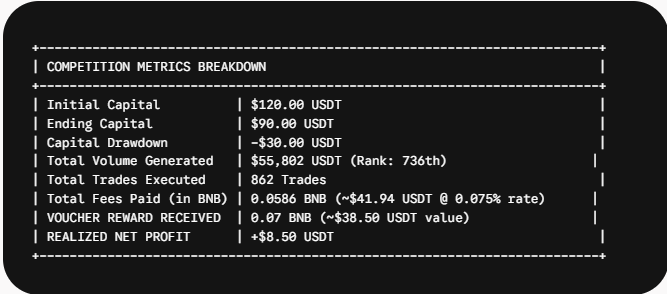
Starting Balance: $120 USDT
Ending Balance: $90 USDT
Net Loss / Cost: $30 USDT
Reward Claimed: 0.07 BNB (~$38.50 USDT value)
Net Result: Ended in net profit (~+$8.50) while securing 736th place on the leaderboard with $55,802 in volume.
My goal wasn't just to rank; it was to test high-frequency execution limits and see how far I could stretch a small $120 balance by intentionally "burning" capital for high volume.
2. Strategy Evolution: 5-Minute Timers to Reversed Fibonacci Countdown
Phase 1 (5-Minute Interval Order Execution):
Initially, I executed market buys and sells on rigid 5-minute fixed candle intervals. While predictable, market execution during low volatility meant spread slippage began eroding the capital base faster than expected.
Phase 2 (Reversed Fibonacci Countdown Schedule - 180s Total): To optimize execution frequency, I shifted to a 180-second Reversed Fibonacci
Countdown schedule:00:00 (3:00 mark): Market Buy execution.
00:34 (2:26 mark): Order validation & position check.
01:29 (1:31 mark): Peak taker absorption window.
02:24 (0:36 mark): Market Sell execution.
03:00 (0:00 mark): Instant cycle reset.
Using rapid market orders ensured 100% fill rates to churn volume, but executing as a Taker meant eating continuous taker fees and market spread.
3. The Breakdown: Fee & Slippage Math
As a VIP 0 / Regular User using BNB for fee payment (25% discount):
Taker / Maker Rate: 0.075% per trade
Total Executed Trades: 862 trades
Total Traded Volume: ~$55,923.51 USDT
Total Trading Fees Paid: ~0.0586 BNB (~$41.94 USDT equivalent)
4. Key Takeaways & Strategy Refinement
Slippage Kills Fast Scalping: Executing market orders back-to-back causes order-book spread loss that outweighs trading fees.
Limit Orders are Essential: Future competition runs must utilize tight Limit Orders (Maker) rather than Market (Taker) orders to avoid spread degradation.
Reward Math Works: Even after losing $30 in capital drawdown and paying ~$42 in fees, receiving the 0.07 BNB Token Voucher brought the entire experiment into net profit.
Reference / Original Discussion: