


Financial markets love a good narrative about central banks stepping back. For years, the Bank of Japan printed massive amounts of money to buy up domestic debt and keep interest rates pinned down. Now, policymakers are letting their balance sheet shrink. Mainstream headlines treat this as a total retreat. Look past the surface data, and you will see that the central bank remains the absolute master of the Japanese bond market.
❍ A Massive Footprint Despite the Reduction
The scale of the Bank of Japan bond portfolio is shrinking, but it still dwarfs every other financial institution in the country.
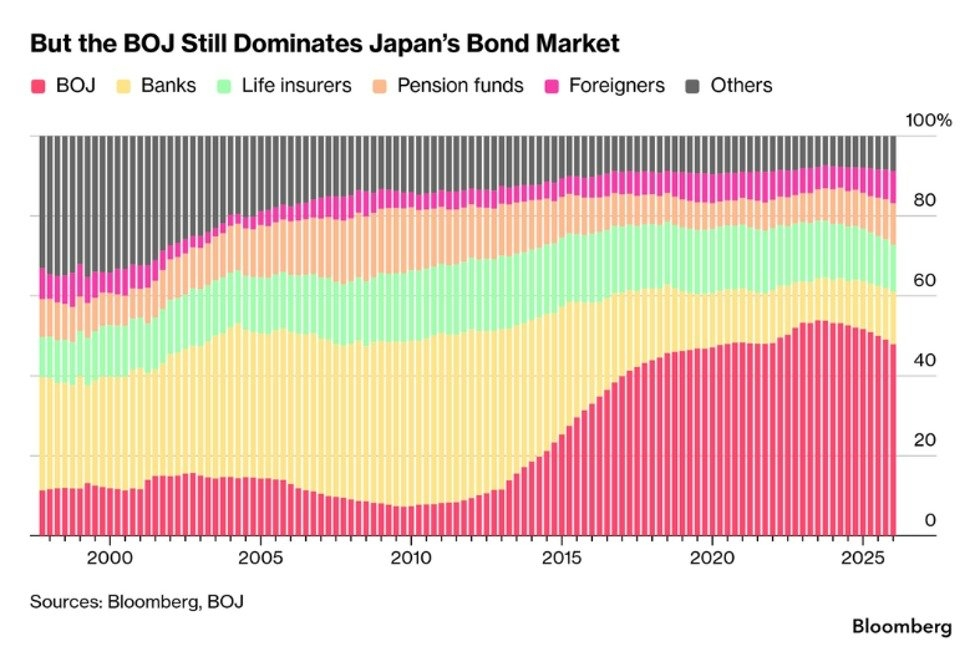
The Bank of Japan now holds roughly 46 percent of all Japanese government bonds. This is down eight percentage points from its 2023 peak, marking the lowest proportion we have seen since 2021.
Even with this reduction, the central bank still holds more government debt than commercial banks, life insurers, pension funds, and foreign investors combined.
To understand how far the market has evolved, the central bank owned a mere 10 percent of all government bonds back in 2013 before aggressive monetary easing took over.
❍ Record Declines and Historical Context
The current contraction in the central bank balance sheet is happening faster than anything we witnessed in modern financial history.
Holdings of Japanese government bonds dropped by 310 billion dollars over the twelve months ending in July. This stands as the largest twelve month decline ever recorded.
This sharp drop brought total central bank holdings down to roughly 3.3 trillion dollars, hitting the lowest point since 2020.
Despite this historic pullback, current holdings remain roughly 400 percent higher than they were back in 2012.
Some Random Thoughts 💬
Central banks never truly let go of the wheel once they take total control of a sovereign debt market. A reduction of a few hundred billion dollars makes for great headlines, but when a single institution still owns nearly half of an entire nation's debt, normal market pricing does not really exist. For global investors tracking macro liquidity, the Bank of Japan remains the ultimate anchor for international capital flows. When the largest holder of debt decides to step back even slightly, domestic bond yields rise and send shockwaves across global currency markets. True market freedom in Japan is still a long way off.