


One of the most misunderstood things in crypto is how losses and recoveries actually work.
If a coin falls 50%, many traders assume it only needs to rise 50% to return to the original price.
It doesn't.
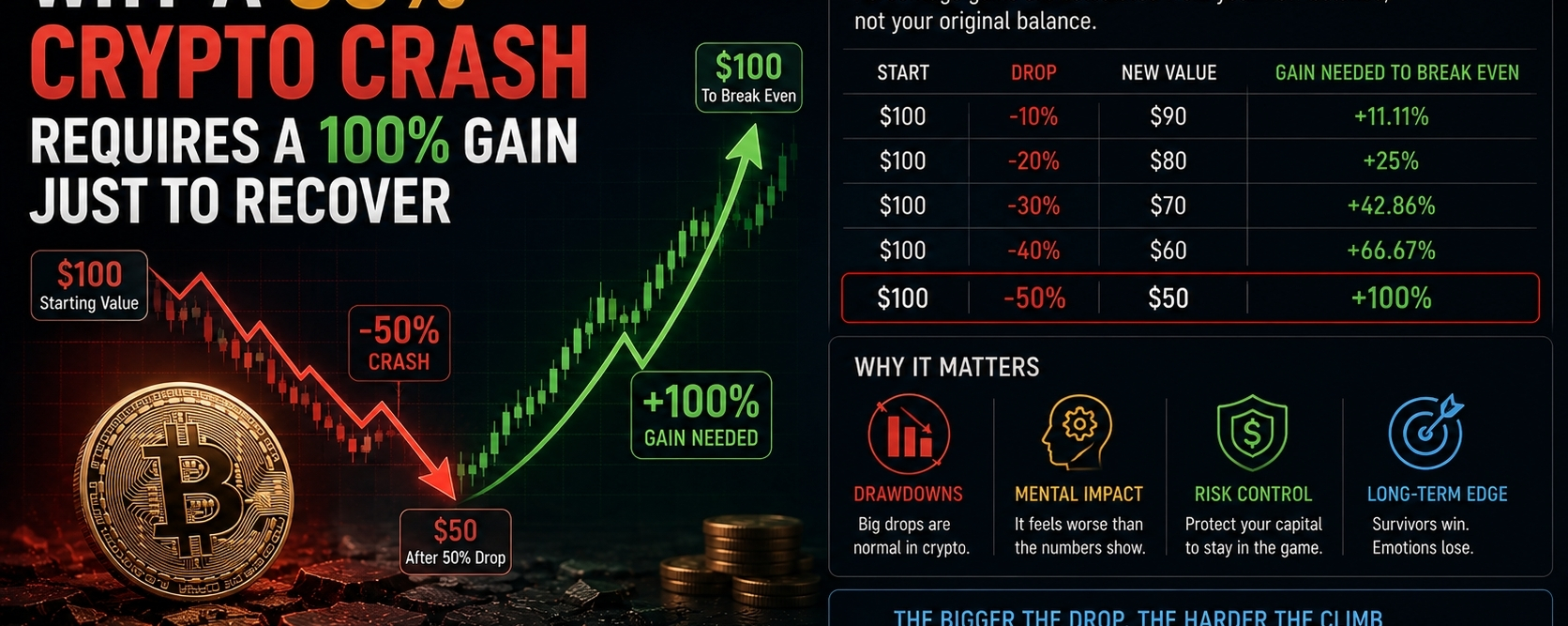
After a 50% crash, the asset needs to gain 100% from its new price just to get back to where it started.
The Simple Math
Imagine you buy a coin at $100.
The price drops 50%, leaving it at $50.
Now imagine it recovers by 50%. A 50% gain on $50 is only $25, meaning the price reaches $75 — not $100.
To move from $50 back to $100, the coin needs to double.
That's a 100% gain.
Bigger Losses Make Recovery Even Harder
This effect becomes much more dramatic as losses increase.
Suppose a token drops from $100 to $20. That's an 80% decline.
Getting back from $20 to $100 requires the price to increase by $80. Compared with the new $20 starting point, that's a 400% gain.
This is why avoiding huge losses can matter just as much as finding huge winners.
“It’s Down 70%” Doesn't Automatically Mean Cheap
Crypto traders often see a token far below its previous high and immediately assume it's undervalued.
But a large decline doesn't guarantee a large recovery.
The market may have changed. Demand could have disappeared, token supply may have increased, the original narrative could be gone, or capital may have rotated into newer projects.
A coin can be down 70% and still fall another 50% from its current price.
This Is Why Risk Management Matters
Many traders focus almost entirely on potential profit.
“How much can this coin pump?”
“What if it goes 10x?”
“What’s the next target?”
But experienced risk management also asks another question:
What happens if I'm wrong?
Protecting capital gives you the ability to participate in future opportunities. A huge drawdown makes that recovery much harder.
Leverage Makes the Problem Bigger
Leverage can amplify profits, but it also magnifies losses.
A relatively small move against a highly leveraged position can cause significant damage or even liquidation.
That's why leverage shouldn't be treated as a shortcut to faster profits. Greater potential reward comes with greater risk.
Don't Confuse Price Recovery With Portfolio Recovery
There's another important difference.
A coin eventually returning to your original entry doesn't necessarily mean your overall portfolio has fully recovered.
Trading fees, previous realized losses and other unsuccessful positions can all affect the final result.
This is why portfolio-level risk matters alongside individual trades.
The Lesson Is Simple
Crypto naturally attracts people because of its massive upside potential.
But staying in the market isn't only about finding the next coin that gains 100%.
Sometimes avoiding a 50% loss is equally powerful.
The mathematics makes the reason clear:
Lose 10% → need about 11.1% to recover.
Lose 25% → need about 33.3%.
Lose 50% → need 100%.
Lose 80% → need 400%.
The deeper the loss, the steeper the climb back.
Before asking how much you can make on a trade, always understand how much you're willing to lose if the market moves the other way.