
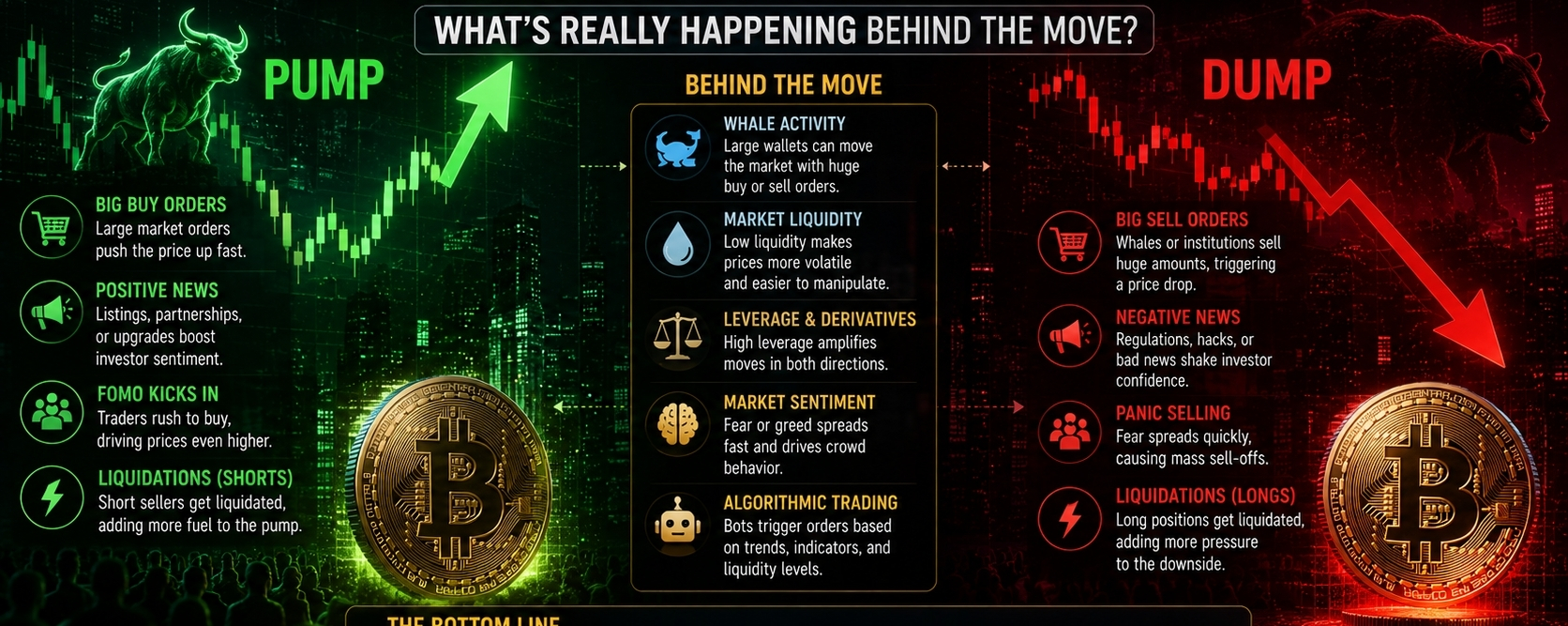


One minute Bitcoin is moving sideways. The next, it jumps thousands of dollars or suddenly drops.
Then Ethereum, XRP, Solana and dozens of altcoins start moving with it.
To a new trader, these moves can look completely random. But behind most major crypto pumps and dumps there is usually a combination of liquidity, leverage, news, large orders and trader psychology.
Understanding these forces won't allow anyone to predict every move. But it can make sudden volatility much easier to understand.
It Starts With Buyers and Sellers
At the simplest level, crypto prices move because buyers and sellers compete.
When aggressive buying is stronger than available selling at current prices, buyers must accept increasingly higher prices to get their orders filled. Price rises.
When aggressive selling overwhelms available buyers, sellers accept lower prices. Price falls.
But the size of the move depends heavily on something called liquidity.
Liquidity Can Turn a Normal Move Into a Huge One
Liquidity describes how easily an asset can be bought or sold without causing a major price change.
A highly liquid market usually has many orders waiting around the current price.
A less liquid market has fewer.
Imagine a token trading at $1.00. There may be plenty of sell orders between $1.00 and $1.02 but very few between $1.02 and $1.10.
If a large market buy suddenly arrives, it can consume those available sell orders quickly.
The trade starts filling at $1.01, then $1.02, $1.04 and potentially much higher.
This is one reason smaller altcoins can move 10%, 20% or more surprisingly quickly.
Their order books are often much thinner than Bitcoin's.
Then Leverage Makes Everything Faster
Crypto's derivatives market can dramatically amplify price movements.
Traders can use leverage to control positions larger than the money they actually provide as collateral.
This creates an important risk: liquidation.
If the market moves too far against a leveraged trader and their margin becomes insufficient, the position can be automatically closed according to the exchange's rules.
When many traders are positioned in the same direction, those liquidations can create a chain reaction.
How a Short Squeeze Creates a Pump
Imagine thousands of traders expect Bitcoin to fall.
They open leveraged short positions.
Instead, Bitcoin starts rising.
As the price climbs, highly leveraged short positions begin reaching their liquidation levels. Those positions are forced to close, which can add buying pressure.
That additional buying pushes price higher.
More shorts then get liquidated.
More buying follows.
Suddenly, what began as a relatively small upward move becomes a powerful green candle.
This is known as a short squeeze.
The opposite can happen when leveraged longs become overcrowded.
How Long Liquidations Accelerate a Dump
Suppose traders become extremely bullish after a strong rally.
Large numbers of leveraged long positions build up.
Bitcoin then falls unexpectedly.
Some longs hit their liquidation levels, adding forced selling to the market.
That pushes price lower, potentially triggering another group of liquidations.
The cycle can continue until enough leverage has been removed.
This is why crypto sometimes falls extremely quickly without an obvious piece of catastrophic news.
The market may simply have been carrying too much leverage.
Open Interest Can Reveal When Leverage Is Building
This is where open interest becomes useful.
Open interest represents outstanding derivatives contracts that haven't yet been closed or settled.
Rising open interest can indicate that more positions are entering the derivatives market.
That isn't automatically bullish or bearish.
But if price rises rapidly while open interest also becomes unusually elevated, it can suggest leverage is building alongside the move.
The market can become more vulnerable to sharp liquidations if positioning becomes too crowded.
That's why experienced traders often watch price, volume, funding rates and open interest together rather than looking at price alone.
Funding Rates Can Show Which Side Is Crowded
Perpetual futures contracts use funding payments to help keep their prices close to the underlying spot market.
When funding is positive, long-position holders generally pay short-position holders. When it is negative, shorts generally pay longs.
Very positive funding can indicate aggressive bullish positioning.
Very negative funding can indicate aggressive bearish positioning.
Neither guarantees an immediate reversal.
But extreme positioning can create the conditions for a squeeze if price suddenly moves against the crowded side.
Sometimes the biggest pump happens when almost everyone is positioned bearish.
Sometimes the hardest dump arrives when traders are overwhelmingly bullish.
News Can Provide the Spark
Of course, not every move begins with leverage.
News can instantly change how investors value an asset.
Interest-rate decisions, inflation reports, ETF developments, regulatory announcements, exchange listings, security incidents or major project updates can all trigger sudden volatility.
The important part is that news doesn't operate separately from market positioning.
Imagine Bitcoin receives positive news while many traders are short.
Spot buyers enter because of the news.
Price rises.
Shorts begin getting liquidated.
Algorithmic traders react to the breakout.
Momentum traders enter.
A single catalyst can therefore trigger several different sources of buying at once.
That's how a normal headline can sometimes produce an abnormal price move.
Whales Can Move Thin Markets
Large holders—often called whales—can also influence short-term price action.
A very large market order can consume significant liquidity, especially in smaller cryptocurrencies.
But seeing a whale transfer tokens doesn't automatically mean a dump is coming.
Moving crypto to an exchange can have many possible explanations. Moving tokens away from an exchange also doesn't guarantee accumulation.
On-chain activity provides clues, not certainty.
Context matters.
Bitcoin Can Drag the Whole Market With It
Crypto assets don't trade completely independently.
Bitcoin remains the largest cryptocurrency and heavily