
Plasma ($XPL) has been generating attention in the blockchain space with its innovative approach to stablecoin transfers. Unlike many traditional networks that impose high fees on every transaction, Plasma introduces a model where transfers can feel “free” to end-users while remaining economically sustainable for the network. This approach addresses one of the biggest friction points in crypto: making digital assets truly usable for everyone without sacrificing network security or sustainability.
1. Apps Pay for Their Users (The “Merchant Pays Fees” Reality)
Plasma allows applications to cover the transaction costs for their users.
End-users enjoy seamless transfers without seeing fees, while developers fund the infrastructure, making adoption frictionless.
Apps or platforms shoulder network fees to encourage usage.
Businesses can integrate stablecoin payments without passing costs to users.
Users experience smooth, free transfers, increasing overall network activity.
Merchants benefit from higher engagement and retention by removing transactional barriers.
By shifting the cost to applications rather than users, Plasma enables a more user-friendly experience and accelerates adoption organically.
2. “Free for Transfers” Doesn’t Mean “Free for Everything”
While basic transfers feel free, not all network operations are entirely costless.
This ensures economic sustainability while giving users a low-cost entry point to the ecosystem.
Simple transfers have near-zero fees, making day-to-day use seamless.
Advanced operations or specialized features may carry fees to support network health.
Balances user experience with operational sustainability.
Prevents overuse or abuse of the network, maintaining efficiency and security.
This approach allows casual users to transact freely, while ensuring that the network can continue functioning without compromise.
3. Tiered Sponsorship (Free Feels Free… Until You’re a Power User)
Plasma employs tiered models to ensure heavy users contribute to network maintenance.
Casual users enjoy a mostly free experience, while “power users” support the system through modest fees.
Small or occasional transactions remain free for most users.
High-volume or high-frequency users enter higher tiers with associated costs.
Encourages scalability without penalizing casual participants.
Maintains fairness by aligning costs with usage levels.
Tiered sponsorship ensures that Plasma can scale sustainably, accommodating both individual and enterprise users.
4. Value-Added Revenue Around The Rail (The Quiet Money)
Plasma generates revenue through services built on top of the core network infrastructure.
These secondary streams make the system profitable without charging for basic transfers.
Debit cards and cashback programs generate income while benefiting users.
Enterprise solutions and premium features provide long-term revenue.
Keeps basic transactions free while supporting continuous network development.
Encourages innovation by monetizing value-added services rather than core transfers.
By combining merchant-paid fees, tiered sponsorship, and value-added revenue streams, Plasma proves that “free” transactions can coexist with economic sustainability. Users enjoy low-cost, fast, and secure stablecoin transfers, while the network continues to grow and maintain operational health.
Plasma’s approach is a model for the future of payments: accessible, efficient, and economically viable. By prioritizing usability and building sustainable revenue structures around the core system, Plasma ensures that “free” stablecoin transfers are not just a gimmick 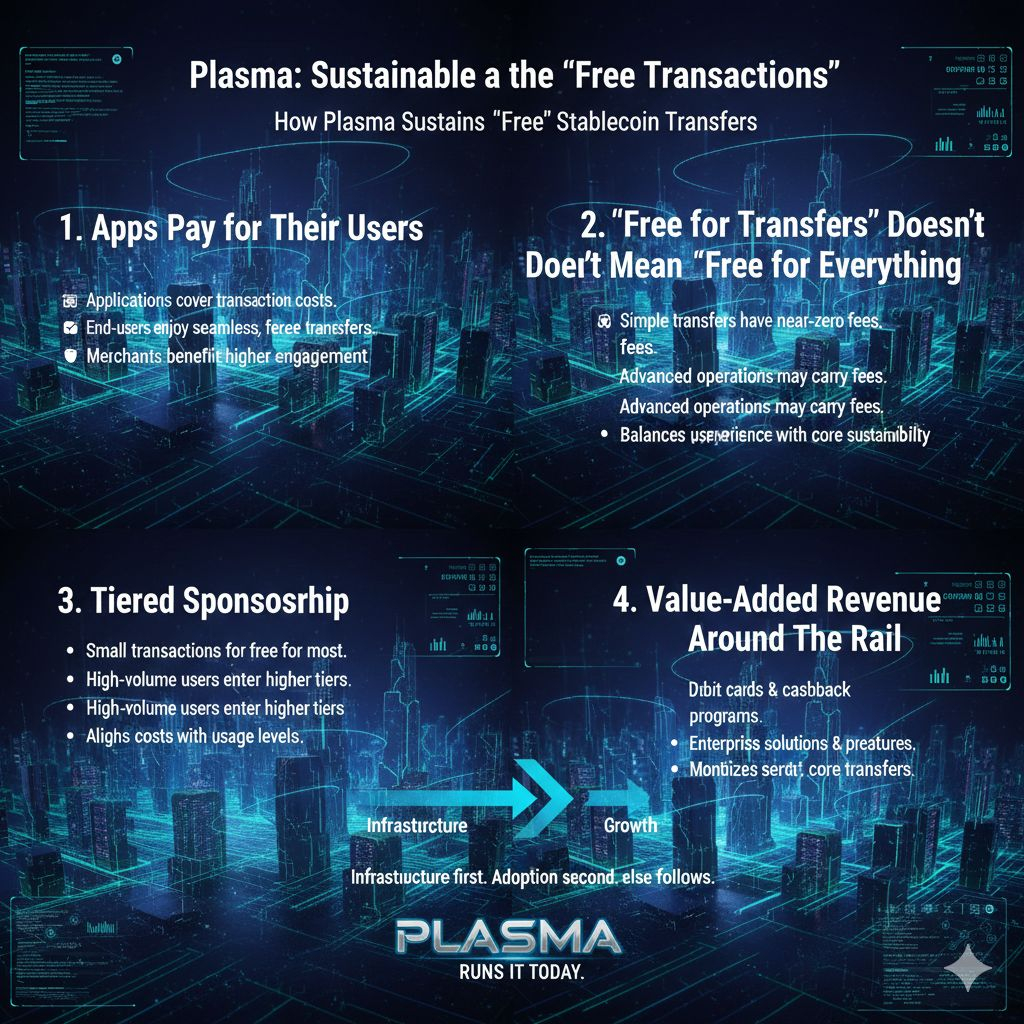 they are a foundation for real adoption, scale, and long-term growth.

