

DeFi has made borrowing and lending accessible on-chain, but one problem has remained difficult:
Interest rates can change quickly.
For borrowers, that makes future costs harder to predict. For lenders, changing rates can make expected returns less certain.
This is the problem TermMax is trying to address.
What Is TermMax?
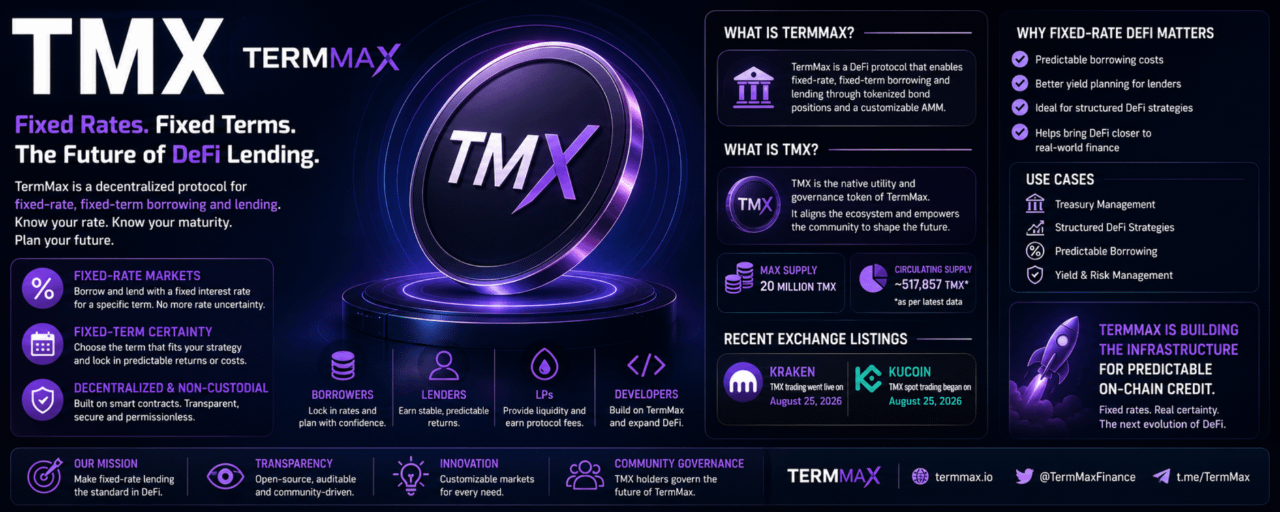
TermMax is a decentralized protocol built around fixed-rate, fixed-term borrowing and lending.
Instead of relying only on floating rates that continuously change with market conditions, TermMax allows users to enter positions with a known interest rate and maturity.
The protocol uses tokenized bond positions and a customizable AMM to create these fixed-rate markets.
That creates a simple proposition:
Know the rate.
Know the maturity.
Plan the position.
Why Fixed Rates Matter
Imagine borrowing an asset today and knowing that the interest rate could change significantly tomorrow.
That uncertainty can make financial planning difficult.
A fixed-rate system changes the equation.
If the rate is locked for a specific period, borrowers can better understand their financing costs, while lenders can plan around a predetermined yield.
This is especially interesting as DeFi becomes more sophisticated and begins attracting more structured financial activity.
What Is TMX?
TMX is the native utility and governance token of TermMax.
Its role is connected to the wider TermMax ecosystem, including governance and incentives. TermMax's token documentation describes TMX as part of the economic foundation designed to align users, liquidity providers, developers and long-term ecosystem participants.
The protocol's current token supply is reported at 20 million TMX, with roughly 517,857 TMX circulating according to current market data.
Because only a portion of the maximum supply is currently circulating, future token distribution and unlocks are important factors to watch.
Why TMX Is Interesting
The bigger story isn't simply the token.
It is the financial infrastructure behind it.
DeFi has already demonstrated that decentralized exchanges, lending markets and automated liquidity can work.
The next question is whether DeFi can offer more predictable financial products.
Fixed-rate borrowing and lending could become useful for:
Treasury management
Structured DeFi strategies
Predictable borrowing costs
Yield planning
Institutional-style financial products
TermMax is positioning itself around this particular part of the market.
Growing Market Presence
TermMax has recently expanded its exchange availability.
Kraken announced that TMX trading went live on August 25, 2026, while KuCoin also announced TMX spot trading beginning on August 25.
These listings can increase visibility and accessibility, but they don't automatically prove long-term adoption.
The more important metric will be whether TermMax can generate sustained usage of its fixed-rate markets.
The Bigger Picture
The evolution of DeFi may not simply be about faster transactions or more tokens.
It could also be about creating financial products with more predictable terms.
That is where TermMax becomes interesting.
DeFi started by recreating basic financial markets on-chain.
The next step could be making those markets more sophisticated.
TMX is the token connected to TermMax's governance and ecosystem, while the protocol itself is focused on solving a specific problem: bringing greater rate certainty to decentralized borrowing and lending.
The real test now is adoption.
If fixed-rate markets become increasingly useful to both DeFi users and larger financial participants, TermMax could have an interesting role in the evolution of on-chain credit.
TMX is not just a ticker to watch.
The more important question is whether TermMax can turn fixed-rate DeFi from an interesting concept into infrastructure people actually use.