

@PositiveMindsGlobalResults - @Binance Square Official - @Binance Earn Official
August 27, 2026
The most important financial signal of 2026 may not be Bitcoin, artificial intelligence stocks, gold, or even the Federal Reserve's next interest-rate decision.
It may be a number that rarely dominates mainstream headlines:
The U.S. 30-year Treasury yield.
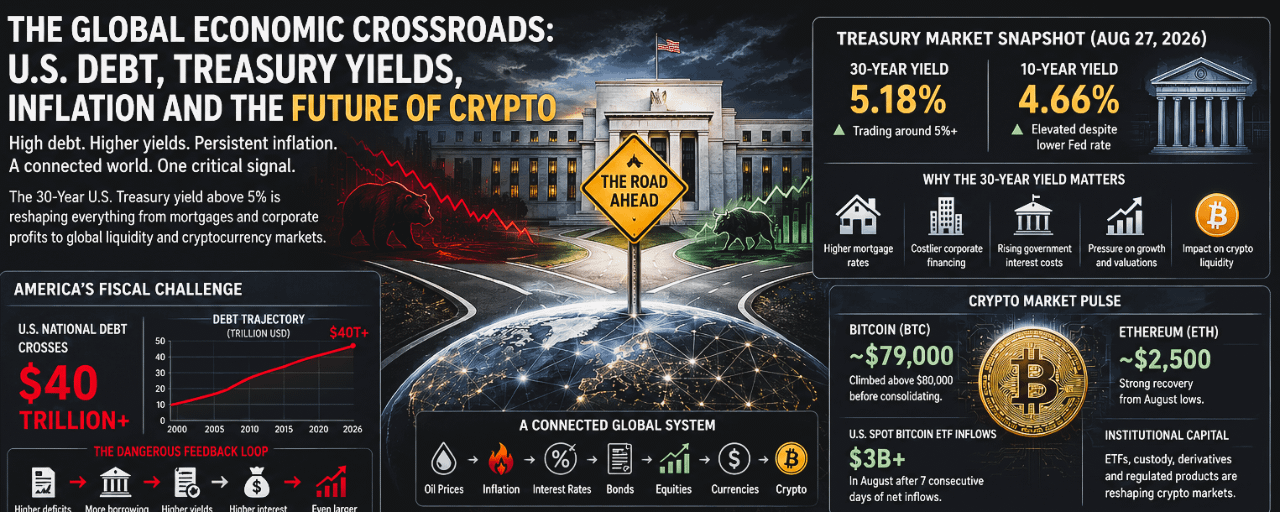
At around 5.18%, with the 10-year Treasury near 4.66%, long-term borrowing costs remain elevated even though the Federal Reserve's policy rate is considerably lower. That gap is telling investors something important: markets are demanding substantial compensation for the risks associated with inflation, government borrowing, fiscal deficits and holding long-duration U.S. debt.
And this matters far beyond Washington.
The 30-year Treasury market influences mortgage rates, corporate borrowing, government financing, equity valuations, emerging-market currencies and global liquidity. Increasingly, its effects can also be felt in Bitcoin and the wider cryptocurrency market.
The world is therefore approaching a financial crossroads where debt, inflation, energy, geopolitics, technology and crypto are becoming parts of the same market equation.
The Long Bond Is Sending a Message
The Federal Reserve controls the short-term policy rate, but it does not directly control the 30-year Treasury yield.
The long end of the bond market is determined by investors.
And investors are currently demanding higher returns to lend money to the U.S. government for three decades.
Why?
Because over such a long period, almost everything can change: inflation, economic growth, government borrowing, monetary policy, the value of the dollar and the geopolitical environment.
The 30-year Treasury therefore acts as a kind of long-term confidence gauge.
A sustained yield above 5% does not mean investors have lost faith in the United States. Treasuries remain among the world's most important reserve and safe-haven assets.
But it does mean the price of long-term financing has changed dramatically from the ultra-low-interest-rate era that followed the global financial crisis.
The transmission mechanism is straightforward:
Higher Treasury yields → higher borrowing costs → tighter financial conditions → weaker investment and housing affordability → pressure on economic growth and asset valuations.
That is why the long bond deserves much more attention.
America's Debt Problem Is Becoming a Market Problem
The United States is facing an increasingly difficult fiscal equation.
With national debt around $40 trillion, the challenge is not simply the headline debt number.
The bigger issue is the interaction between:
Large debt + persistent deficits + elevated interest rates + continuous refinancing.
Every time previously issued Treasury securities mature, the government must refinance that debt.
If the new borrowing cost is significantly higher than the old one, interest expenses rise.
This can create a potentially uncomfortable cycle:
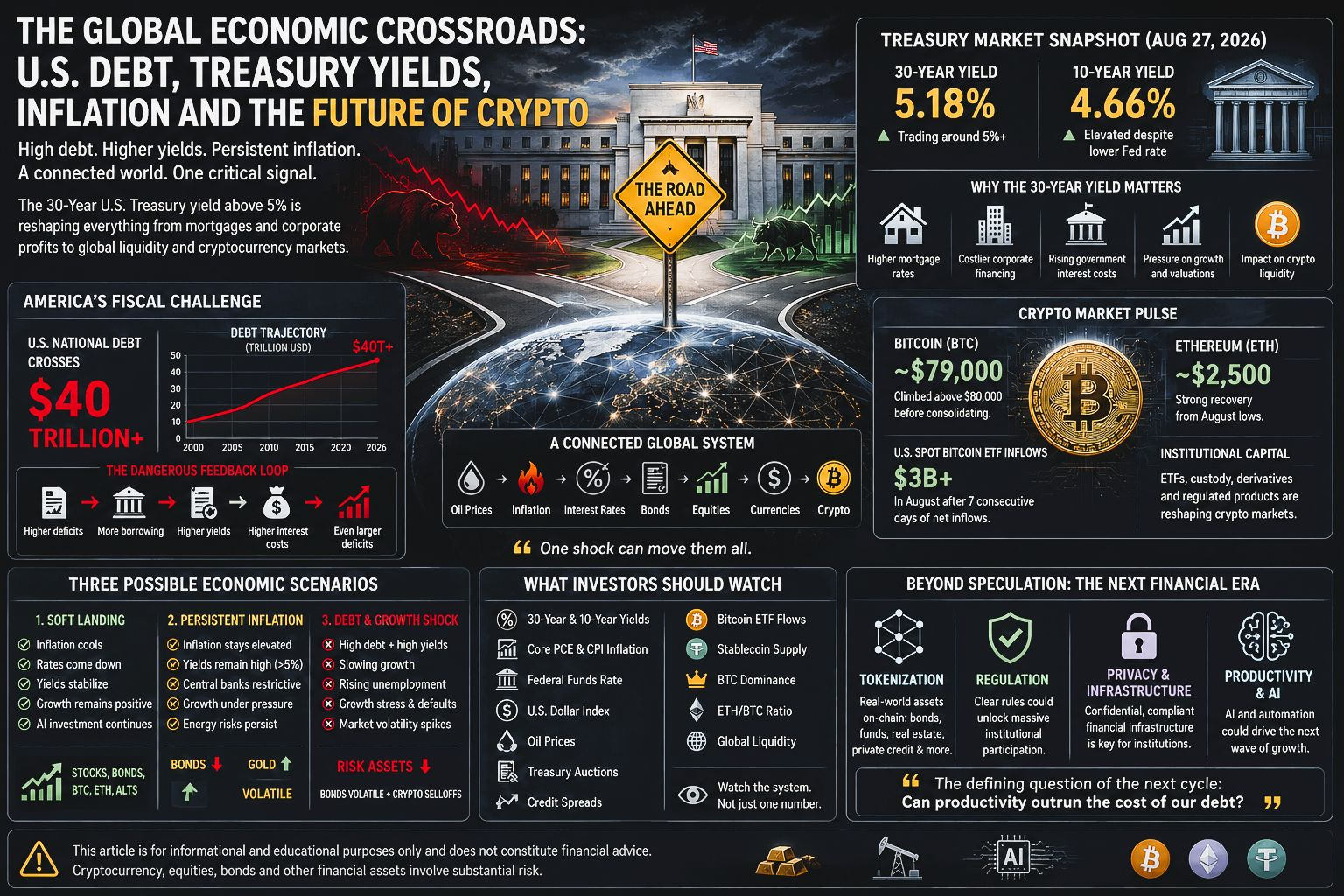
Higher deficits → more Treasury issuance → greater supply of government debt → higher required yields → higher interest costs → larger deficits → additional borrowing.
This does not guarantee a debt crisis.
But it creates a structural vulnerability that investors can no longer ignore.
The question facing markets is increasingly:
How much will investors demand to finance America's fiscal needs over the next decade and beyond?
The Term Premium: The Hidden Price of Uncertainty
Hidden Price of Uncertainty
Another important concept is the term premium.
Investors holding a 30-year bond are taking risks that simply do not exist to the same degree in a short-term security.
Nobody knows what inflation will look like in 2040 or 2050.
Nobody knows how large U.S. deficits will become.
Nobody knows how monetary policy will evolve or how global demand for dollar assets will change.
Investors therefore require compensation for locking their money away for decades.
That additional compensation is part of the term premium.
A high long-term yield can consequently be interpreted as a market message:
"We will finance the government—but we want to be paid more for taking long-term risk."
The bond market is not necessarily rejecting U.S. debt.
It is repricing the cost of that debt.
Inflation: The Federal Reserve's Difficult Balancing Act
The Federal Reserve faces a difficult policy triangle.
It must control inflation, support economic activity and operate within a financial system carrying historically large amounts of debt.
If inflation remains persistent, aggressive rate cuts could be dangerous.
But if interest rates remain restrictive for too long, economic activity could weaken.
That creates three competing objectives:
Fight inflation
Higher rates suppress demand but increase borrowing costs.
Protect economic growth
Lower rates support consumption, investment and housing—but can reignite inflation.
Maintain financial stability
Lower long-term yields would make government financing easier, but long-term yields ultimately depend on market expectations and Treasury supply and demand.
This is why a Federal Reserve rate cut does not automatically guarantee a collapse in the 30-year Treasury yield.
The Fed controls the policy rate.
The market controls the long bond.
Housing: Where Bond Yields Meet Everyday Life
For ordinary households, Treasury yields can sound like an abstract financial-market issue.
They are not.
Long-term Treasury yields are an important influence on mortgage rates.
When long-term yields rise, mortgage financing generally becomes more expensive.
The chain looks like this:
Treasury yields ↑ → mortgage rates ↑ → monthly payments ↑ → affordability ↓ → housing demand ↓
Existing homeowners can also become reluctant to sell if they hold exceptionally low mortgage rates.
This creates a "lock-in" effect that can reduce housing-market liquidity.
The consequences can spread into:
Home construction
Real-estate transactions
Consumer spending
Construction employment
Mortgage lending
Household wealth
The long bond can therefore influence the real economy without the Federal Reserve changing its policy rate at all.
Corporate America Faces a Refinancing Test
Businesses face a similar challenge.
A corporation that borrowed money at 3% several years ago may eventually have to refinance at significantly higher rates.
That can reduce:
Profit margins → free cash flow → investment → hiring → acquisitions → share buybacks.
The impact will not be evenly distributed.
Companies with strong balance sheets, low debt and powerful cash flows may be able to absorb higher financing costs.
Highly leveraged businesses could face much greater pressure.
This creates an increasingly important distinction for equity investors:
The era of "cheap money lifts everything" is becoming a much less reliable investment strategy.
At the same time, one major force is pushing in the opposite direction.
AI Could Become the Productivity Counterweight
Artificial intelligence is one of the most important reasons the global economic outlook is not simply a story about debt and inflation.
Massive investment in AI infrastructure, computing power, software and automation could produce significant productivity gains.
If AI allows companies to produce more with fewer resources, it could eventually help offset some of the pressures created by expensive capital.
That creates an extraordinary economic race:
Debt and interest costs are pulling growth down.
AI and productivity are attempting to push growth up.
The outcome could determine the next major market cycle.
If productivity accelerates strongly enough, economies may be able to grow their way through a portion of today's debt burden.
The Global Economy: Growth Without Comfort
The global economy is not necessarily heading toward an immediate collapse.
But neither is it returning to the easy-money environment of the previous decade.
The IMF's July 2026 outlook projects global growth of approximately 3.0% in 2026 and 3.4% in 2027, while global inflation remains a concern.
This creates an unusual environment:
Growth is continuing—but inflation risks have not disappeared.
Positive forces include:
Artificial intelligence investment
Technology productivity
Renewable-energy development
Resilient consumer demand
Energy diversification
Continued infrastructure investment
But the risks remain substantial:
High government debt
Elevated borrowing costs
Geopolitical conflicts
Trade tensions
Energy-price volatility
Persistent inflation
Currency instability
Weak fiscal positions
The result is a global economy that could best be described as:
Slow growth, high uncertainty.
Oil Could Become the Wild Card
Energy markets remain one of the biggest potential inflation triggers.
Geopolitical conflict can rapidly disrupt energy production, transportation and expectations.
The transmission mechanism is powerful:
Geopolitical shock → oil prices ↑ → inflation ↑ → central banks stay restrictive → bond yields ↑ → risk assets ↓
The Strait of Hormuz is particularly important because disruption to energy transportation could create another major global inflation shock.
This means investors cannot analyse bonds, currencies, equities and crypto in isolation.
A conflict thousands of kilometres away can ultimately influence the price of Bitcoin through the oil market and global interest rates.
The Dollar Is Entering a New Debate
The U.S. dollar remains the world's dominant reserve currency.
There is no credible basis for assuming that status will disappear overnight.
But investors are increasingly asking a different question:
Will global investors gradually diversify their reserves and portfolios away from dollar-denominated assets?
That distinction matters.
It does not require the dollar to collapse.
Even a gradual diversification could influence demand for U.S. Treasuries, gold and alternative stores of value.
Gold has already benefited from the broader debate surrounding inflation, geopolitical risk and monetary uncertainty.
Bitcoin is increasingly being discussed within the same conversation—but with an important difference.
Bitcoin: Risk Asset or Digital Hard Money?
Bitcoin has developed a unique dual identity.
During liquidity-driven selloffs, it can behave like a high-risk technology asset.
But when investors become concerned about:
Currency debasement
Government debt
Inflation
Monetary expansion
Sovereign risk
Bitcoin can increasingly be viewed as a form of digital scarcity.
That creates a fascinating contradiction.
Bitcoin can benefit from concerns about the traditional financial system while simultaneously suffering when liquidity tightens.
This explains why Bitcoin cannot simply be labelled a "safe haven."
Its long-term monetary narrative and short-term market behaviour can move in opposite directions.
Institutional Money Is Changing Crypto
One of the biggest changes in cryptocurrency markets is the growing role of institutional capital.
Bitcoin is no longer driven exclusively by retail traders and crypto-native investors.
Spot ETFs, custody infrastructure, derivatives and regulated investment products are creating new channels through which institutional capital can enter the market.
Recent Bitcoin ETF flows have demonstrated the growing importance of institutional demand.
This changes the structure of the market.
The crypto question is no longer simply:
"Do people believe in Bitcoin?"
It is increasingly:
"How much capital are institutions willing to allocate to Bitcoin at different levels of global liquidity and risk?"
That is a much more sophisticated market.
Ethereum and the Next Layer of Digital Finance
Bitcoin's core narrative is digital scarcity.
Ethereum represents something different.
Its broader proposition is:
Smart contracts + decentralized finance + tokenization + digital financial infrastructure.
That distinction could become increasingly important as traditional financial assets move onto blockchain networks.
When liquidity is strong, capital can rotate through the crypto market:
BTC → ETH → large-cap altcoins → smaller projects.
But during periods of stress, the reverse can happen:
Altcoins → ETH → BTC → cash/stablecoins.
This makes Ethereum and the wider altcoin market more sensitive to changes in liquidity and investor risk appetite.
The Biggest Crypto Variable May Be Liquidity
One of the biggest mistakes investors can make is assuming that technology adoption alone determines cryptocurrency prices.
It does not.
Crypto valuations are also influenced by:
Global liquidity
Treasury yields
Federal Reserve policy
Dollar strength
ETF flows
Stablecoin supply
Leverage
Derivatives positioning
Regulation
Institutional allocation
A blockchain project can continue developing successfully while its token price falls dramatically.
Why?
Because technology can remain unchanged while available capital disappears.
That is the fundamental difference between technological value and market liquidity.
Regulation Could Unlock the Next Institutional Wave
Regulation is another major variable.
Large institutions need clear rules before deploying substantial capital.
Greater regulatory clarity could accelerate:
Institutional investment
Crypto ETFs
Stablecoin adoption
Digital custody
Tokenized securities
Banking integration
Institutional DeFi
Blockchain-based settlement
The opposite is also possible.
If regulation becomes excessively restrictive, innovation and capital could migrate toward more favourable jurisdictions.
The next phase of crypto adoption may therefore depend as much on policy as on technology.
Tokenization: The Bigger Story Beyond Bitcoin
Perhaps the most important long-term development in digital finance is not Bitcoin's price.
It is tokenization.
Government bonds, funds, private credit, real estate and other financial assets can increasingly be represented through blockchain-based infrastructure.
This could fundamentally change how assets are issued, transferred, settled and recorded.
The future may not be:
Traditional finance OR crypto.
It may become:
Traditional finance + blockchain infrastructure + tokenized assets + regulated digital finance.
That is a much larger opportunity than cryptocurrency speculation alone.
Why Institutional Privacy Could Become Critical
There is another problem that public blockchains must solve.
Financial institutions cannot expose every transaction, investor position and trading strategy to the entire world.
They need:
Confidential transactions
Regulatory compliance
Identity controls
Auditability
Secure settlement
Private smart contracts
This is where privacy-focused blockchain infrastructure becomes increasingly relevant.
Projects such as Dusk Network are targeting the intersection of blockchain privacy, financial applications and compliance.
The institutional opportunity is therefore not necessarily about creating anonymous finance.
It is about creating confidential financial infrastructure that can operate within regulatory frameworks.
That distinction could become extremely important as tokenization expands.
Three Possible Paths for the Global Economy
The next phase could broadly develop through three scenarios.
1. The Soft Landing
Inflation gradually declines.
The Federal Reserve gains room to reduce rates.
Treasury yields stabilize.
Economic growth remains positive.
AI investment continues.
Under this scenario, risk assets could benefit significantly.
Stocks ↑ | Bonds ↑ | BTC ↑ | ETH ↑ | Altcoins ↑
2. Persistent Inflation
Energy prices remain elevated.
Fiscal deficits remain large.
Inflation stays above central-bank targets.
Long-term Treasury yields remain above 5%.
Central banks remain cautious.
This could create a more difficult environment:
Long-duration bonds ↓ | Mortgage costs ↑ | Growth stocks under pressure | Gold ↑ | Bitcoin potentially ↑ but volatile
Bitcoin could benefit from its hard-asset narrative, but tighter liquidity could limit the upside.
3. Debt and Growth Shock
The most dangerous scenario would combine:
High debt + high yields + slowing growth + rising unemployment.
That could produce a genuine financial tightening cycle.
Potential consequences include:
Equity-market weakness
Credit stress
Corporate defaults
Real-estate pressure
Treasury volatility
Strong demand for cash
Cryptocurrency selloffs
Importantly, Bitcoin could initially fall alongside other risk assets.
Its long-term monetary characteristics would not necessarily protect it from a short-term liquidity crisis.
The Market Dashboard Investors Should Watch
The next major market move is unlikely to be explained by one indicator.
Investors should watch the entire system.
Indicator Why It Matters
30-Year Treasury Yield Long-term financing and fiscal-risk signal
10-Year Treasury Yield Global benchmark borrowing cost
Core PCE Key U.S. inflation indicator
CPI Consumer inflation trend
Federal Funds Rate Short-term monetary policy
U.S. Dollar Global liquidity and currency strength
Oil Prices Inflation and geopolitical risk
Treasury Auctions Demand for U.S. government debt
Credit Spreads Corporate financial stress
Bitcoin ETF Flows Institutional crypto demand
Stablecoin Supply Crypto liquidity
BTC Dominance Capital rotation within crypto
ETH/BTC Appetite for higher-risk crypto assets
Global Liquidity Broad risk-asset environment
The important point is not simply watching these indicators individually.
It is watching how they interact.
The New Financial Era
The financial system is moving away from the extraordinary conditions that defined much of the post-2008 period.
For years, investors became accustomed to:
Low inflation + low interest rates + cheap money + quantitative easing.
That environment encouraged leverage, higher asset valuations and aggressive risk-taking.
The emerging environment looks different:
Higher debt + higher term premiums + persistent inflation risk + geopolitical uncertainty + expensive capital.
That means investors may increasingly need to focus on fundamentals:
Cash flow. Balance sheets. Debt levels. Productivity. Real economic growth.
But there is another side to the story.
AI, automation, blockchain infrastructure and tokenization could create a new productivity and financial-innovation cycle.
The global economy is therefore caught between two powerful forces.
The old burden:
Debt, inflation and expensive capital.
The new opportunity:
AI, productivity, blockchain and financial modernization.
The Bond Market May Be the Signal Nobody Can Afford to Ignore
Bitcoin may generate more excitement.
AI stocks may attract more headlines.
Gold may dominate conversations about inflation.
But the 30-year Treasury quietly influences all of them.
If the 30-year yield remains around 5% or higher, markets are effectively being told that long-term financing carries a meaningful price.
That price can travel through the financial system:
Treasury yields → mortgages → corporate debt → government interest expense → economic growth → dollar → global liquidity → equities → Bitcoin → crypto.
This is why the global economy should not be viewed as a collection of separate markets.
It is a connected financial ecosystem.
The United States must manage its debt while maintaining growth. Central banks must control inflation without triggering recession. Governments must navigate geopolitical and energy risks. Investors must adapt to higher long-term borrowing costs. And the cryptocurrency industry must evolve from a predominantly speculative market into a more mature component of digital financial infrastructure.
The defining question of the next economic cycle may therefore be:
Can productivity and real economic growth outrun the cost of accumulated debt?
If the answer is yes, the world could enter a powerful new expansion driven by AI, productivity, tokenization and digital finance.
If the answer is no, markets could face a prolonged period of higher borrowing costs, fiscal pressure, currency uncertainty and extreme volatility.
And somewhere in the middle of that struggle sits the quiet giant of global finance:
The U.S. 30-Year Treasury Yield.
It may not make the loudest headlines.
But it could be one of the most important numbers determining what happens next.
$BNB



$BTC #ETH #BNB #ZK #DeFi #Blockchain #Tokenization #Privacy #InstitutionalFinance #Crypto -
This article is for informational and educational purposes only and does not constitute financial advice. Cryptocurrency, equities, bonds and other financial assets involve substantial risk, and investors should conduct their own research before making investment decisions.