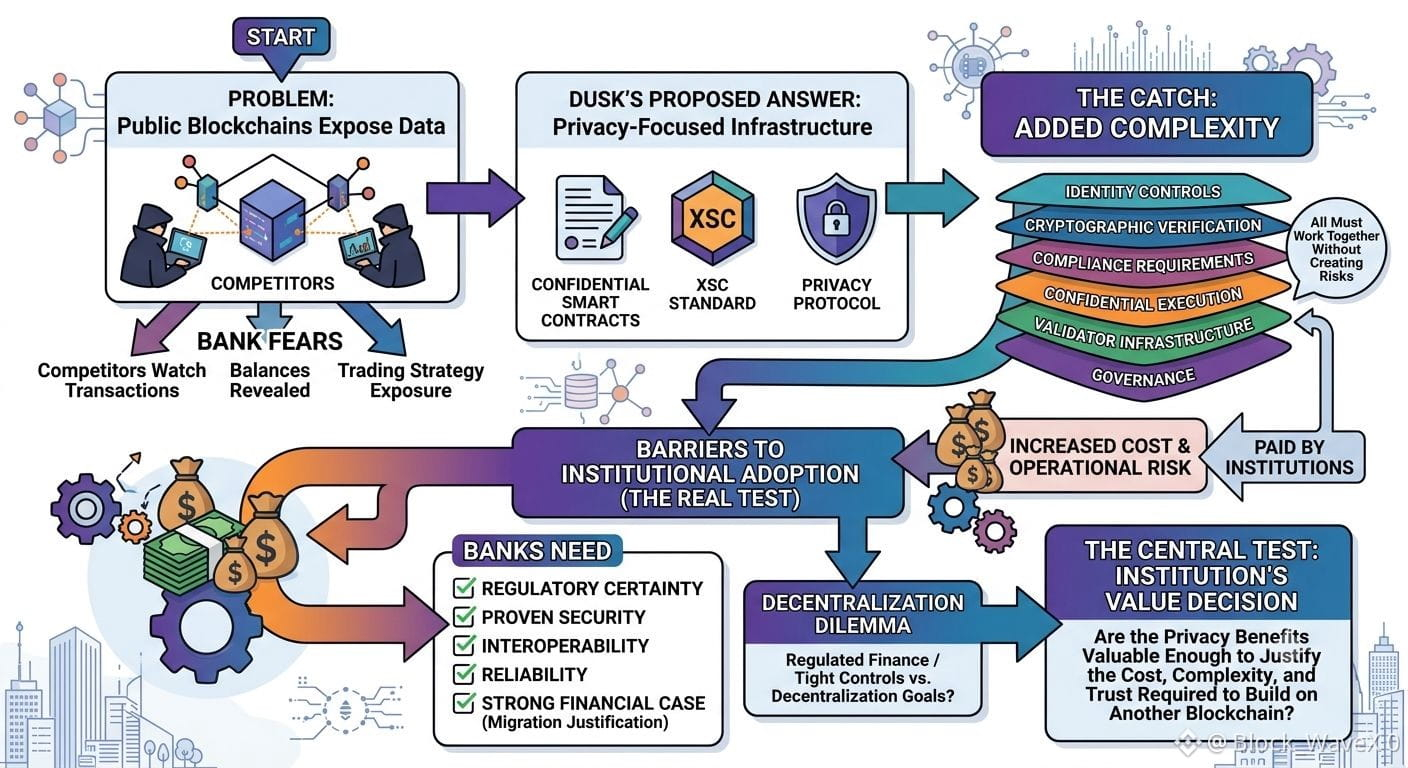
Look, Dusk is trying to fix a real problem: public blockchains expose too much information for serious financial institutions. Banks may want blockchain settlement, but they don’t want competitors watching every transaction, balance, or trading strategy.
The proposed answer is privacy-focused infrastructure, confidential smart contracts, and the XSC standard.
Sounds tidy. On paper, at least.
But here’s the catch: privacy doesn’t remove complexity. It adds it. Identity controls, cryptographic verification, compliance requirements, confidential execution, validator infrastructure, and governance all have to work together without creating new security or operational risks.
And who ultimately pays for that complexity?
The institutions Dusk wants to attract.
That’s where the real test begins. Banks don’t adopt infrastructure because the technology is clever. They need regulatory certainty, proven security, interoperability, reliability, and a financial case strong enough to justify migrating from systems they already understand.
Then there’s decentralization. If regulated finance demands tighter controls, restricted participation, and institutional oversight, how much decentralization can realistically survive those requirements?
I’ve seen this movie before. The technology can work while the commercial case struggles to gain traction.
The real test isn’t whether Dusk can protect financial data.
It’s whether institutions will decide that the privacy benefits are valuable enough to justify the cost, complexity, and trust required to build critical infrastructure around another blockchain.
@Dusk #dusk $DUSK
The proposed answer is privacy-focused infrastructure, confidential smart contracts, and the XSC standard.
Sounds tidy. On paper, at least.
But here’s the catch: privacy doesn’t remove complexity. It adds it. Identity controls, cryptographic verification, compliance requirements, confidential execution, validator infrastructure, and governance all have to work together without creating new security or operational risks.
And who ultimately pays for that complexity?
The institutions Dusk wants to attract.
That’s where the real test begins. Banks don’t adopt infrastructure because the technology is clever. They need regulatory certainty, proven security, interoperability, reliability, and a financial case strong enough to justify migrating from systems they already understand.
Then there’s decentralization. If regulated finance demands tighter controls, restricted participation, and institutional oversight, how much decentralization can realistically survive those requirements?
I’ve seen this movie before. The technology can work while the commercial case struggles to gain traction.
The real test isn’t whether Dusk can protect financial data.
It’s whether institutions will decide that the privacy benefits are valuable enough to justify the cost, complexity, and trust required to build critical infrastructure around another blockchain.
@Dusk #dusk $DUSK