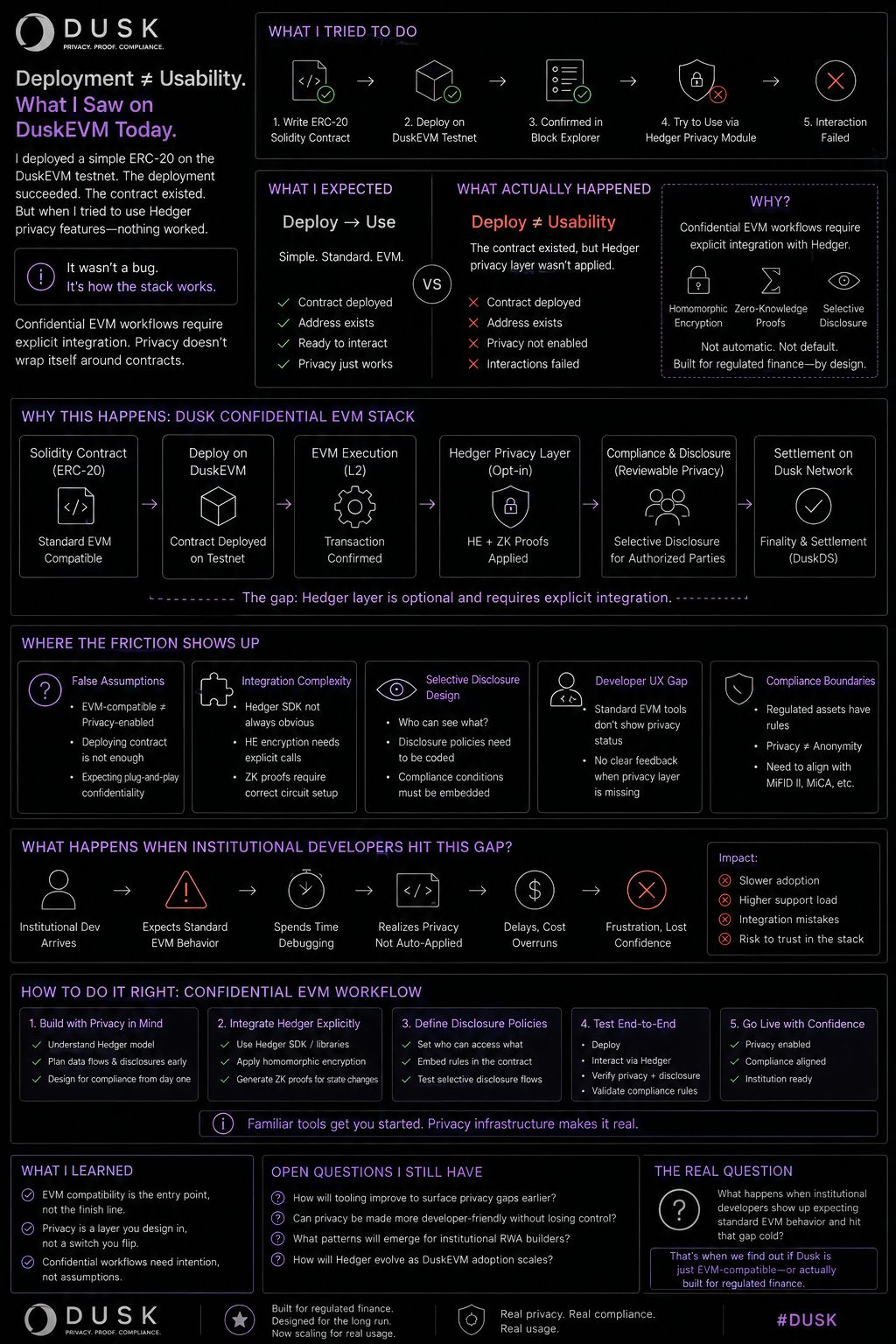

I was trying to deploy a simple ERC-20 on the DuskEVM testnet this afternoon. Nothing fancy—just a standard token contract compiled with Solidity. The deployment went through, the transaction was confirmed, and the contract address showed up in the explorer.
I assumed it was ready to go. That seemed obvious.
That was the first mismatch.
Deployment ≠ Usability. The contract existed, but when I tried to interact with it through the Hedger privacy module, nothing worked. The homomorphic encryption layer wasn't automatically applied. Turns out, confidential EVM workflows aren't magic—they require explicit integration. Hedger uses homomorphic encryption and zero-knowledge proofs to support reviewable privacy for regulated financial applications, but that infrastructure doesn't wrap itself around every contract by default.
What I keep coming back to is the gap between "EVM-compatible" and "actually usable for regulated assets." DuskEVM gives partners and institutions a familiar Solidity path, but familiarity doesn't mean the privacy features are plug-and-play. Builders need to understand where to apply the confidentiality, how to structure the selective disclosure, and what the compliance boundaries actually look like.
That's where the real friction lives. Not in the chain itself—but in the workflow between the contract and the privacy layer.
What happens when institutional developers show up expecting standard EVM behavior and hit that gap cold?
#dusk $DUSK @Dusk
I assumed it was ready to go. That seemed obvious.
That was the first mismatch.
Deployment ≠ Usability. The contract existed, but when I tried to interact with it through the Hedger privacy module, nothing worked. The homomorphic encryption layer wasn't automatically applied. Turns out, confidential EVM workflows aren't magic—they require explicit integration. Hedger uses homomorphic encryption and zero-knowledge proofs to support reviewable privacy for regulated financial applications, but that infrastructure doesn't wrap itself around every contract by default.
What I keep coming back to is the gap between "EVM-compatible" and "actually usable for regulated assets." DuskEVM gives partners and institutions a familiar Solidity path, but familiarity doesn't mean the privacy features are plug-and-play. Builders need to understand where to apply the confidentiality, how to structure the selective disclosure, and what the compliance boundaries actually look like.
That's where the real friction lives. Not in the chain itself—but in the workflow between the contract and the privacy layer.
What happens when institutional developers show up expecting standard EVM behavior and hit that gap cold?
#dusk $DUSK @Dusk