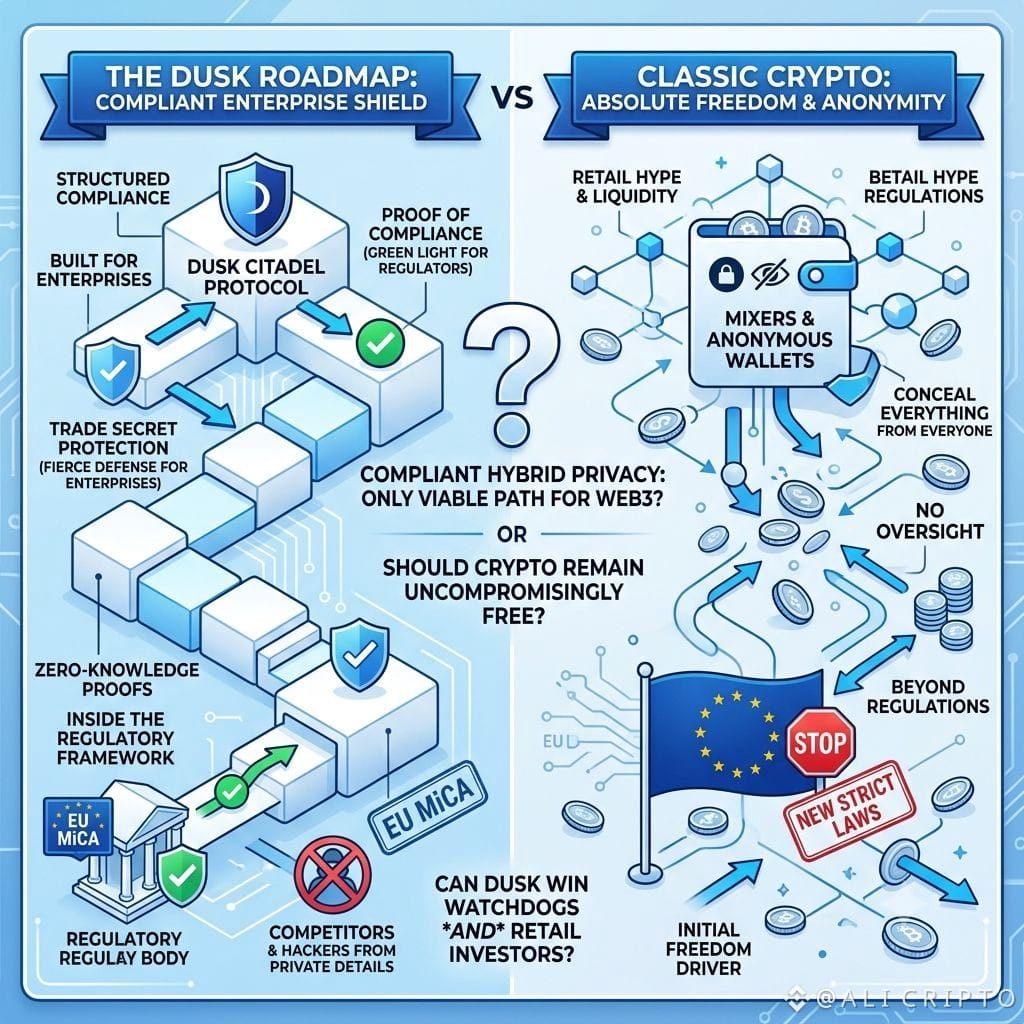
Today, on my way home, I found myself watching the vibrant chaos of the evening city, and amid that quiet, a thought surfaced that refused to fade. I turned it over in my mind for a while, and once I reached my desk, I decided to lay out the Dusk roadmap side by side with the EU's fresh wave of strict laws against mixers and anonymous wallets. Calmly, without the noise.
Let's be honest regulators are systematically dismantling classic privacy. With MiCA taking hold in Europe, projects designed to conceal everything from everyone are essentially being shut out. Against that backdrop, many are already writing Dusk off. But that's exactly where the majority gets it wrong.
Dusk was never built for tax evasion. It's a legitimate shield for enterprises. Their Citadel protocol solves an elegant dilemma: it offers regulators a clear "green light" (proof that a wallet is clean), while fiercely protecting trade secrets from competitors and hackers on public ledgers.
In other words, while others are still fighting the system, Dusk is building fortified corporate infrastructure within the system itself. They saw early on that the privacy of tomorrow isn't chaos it's structured compliance.
But here's where my inner skeptic kicks in.
How ready is the crypto community to embrace that reality? For many, crypto still represents absolute freedom, beyond oversight. Could Dusk, in its drive to win over European watchdogs, end up losing the retail investors who fuel the initial hype and liquidity?
What's your take is compliant hybrid privacy the only viable path forward for Web3, or should crypto hold its ground and remain uncompromisingly free?
@Dusk #dusk $DUSK
Let's be honest regulators are systematically dismantling classic privacy. With MiCA taking hold in Europe, projects designed to conceal everything from everyone are essentially being shut out. Against that backdrop, many are already writing Dusk off. But that's exactly where the majority gets it wrong.
Dusk was never built for tax evasion. It's a legitimate shield for enterprises. Their Citadel protocol solves an elegant dilemma: it offers regulators a clear "green light" (proof that a wallet is clean), while fiercely protecting trade secrets from competitors and hackers on public ledgers.
In other words, while others are still fighting the system, Dusk is building fortified corporate infrastructure within the system itself. They saw early on that the privacy of tomorrow isn't chaos it's structured compliance.
But here's where my inner skeptic kicks in.
How ready is the crypto community to embrace that reality? For many, crypto still represents absolute freedom, beyond oversight. Could Dusk, in its drive to win over European watchdogs, end up losing the retail investors who fuel the initial hype and liquidity?
What's your take is compliant hybrid privacy the only viable path forward for Web3, or should crypto hold its ground and remain uncompromisingly free?
@Dusk #dusk $DUSK