The part of Dusk's consensus I didn't expect to find interesting was how deliberately it separates producing a block from agreeing on it.
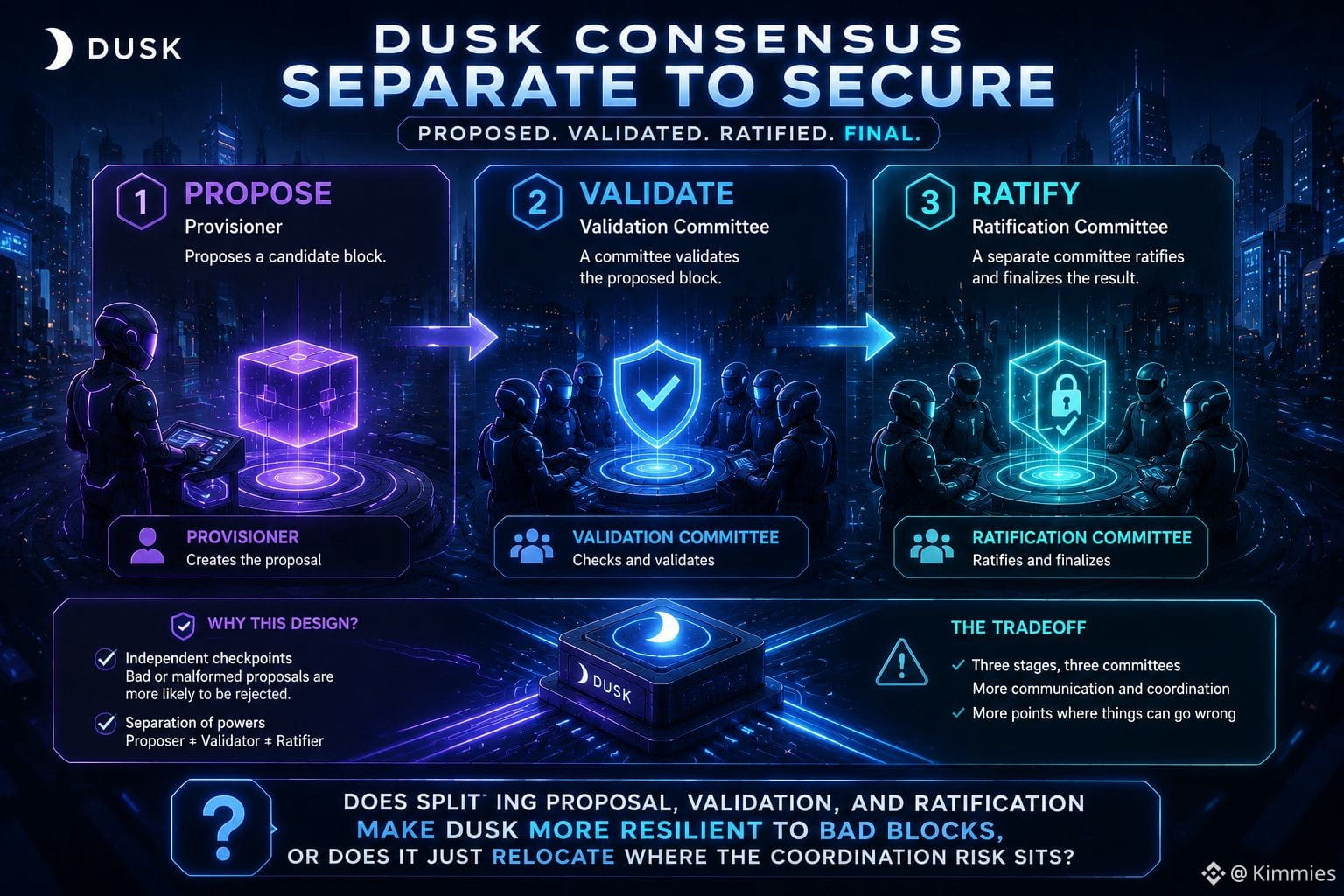
Succinct Attestation runs each round through three distinct steps. A provisioner proposes a candidate block. One committee validates it.
A separate committee ratifies that validation and finalizes the result. The provisioner who proposes the block isn't the same body deciding whether it counts.
I like that structure. It means a bad or malformed proposal has two independent checkpoints to get rejected at, instead of the act of proposing a block being treated as most of the acceptance itself.
But there's a tradeoff. Three separate stages means three separate committees have to communicate correctly in sequence, and each added stage is another place where coordination can go wrong, not just another place where fraud gets caught.
So does splitting proposal, validation, and ratification into distinct stages make Dusk meaningfully more resistant to bad blocks, or does it just relocate where the coordination risk sits?
#dusk $DUSK @Dusk $BMT $STAR
Succinct Attestation runs each round through three distinct steps. A provisioner proposes a candidate block. One committee validates it.
A separate committee ratifies that validation and finalizes the result. The provisioner who proposes the block isn't the same body deciding whether it counts.
I like that structure. It means a bad or malformed proposal has two independent checkpoints to get rejected at, instead of the act of proposing a block being treated as most of the acceptance itself.
But there's a tradeoff. Three separate stages means three separate committees have to communicate correctly in sequence, and each added stage is another place where coordination can go wrong, not just another place where fraud gets caught.
So does splitting proposal, validation, and ratification into distinct stages make Dusk meaningfully more resistant to bad blocks, or does it just relocate where the coordination risk sits?
#dusk $DUSK @Dusk $BMT $STAR