
The interesting question about blockchain privacy isn’t “Can we hide transactions?”
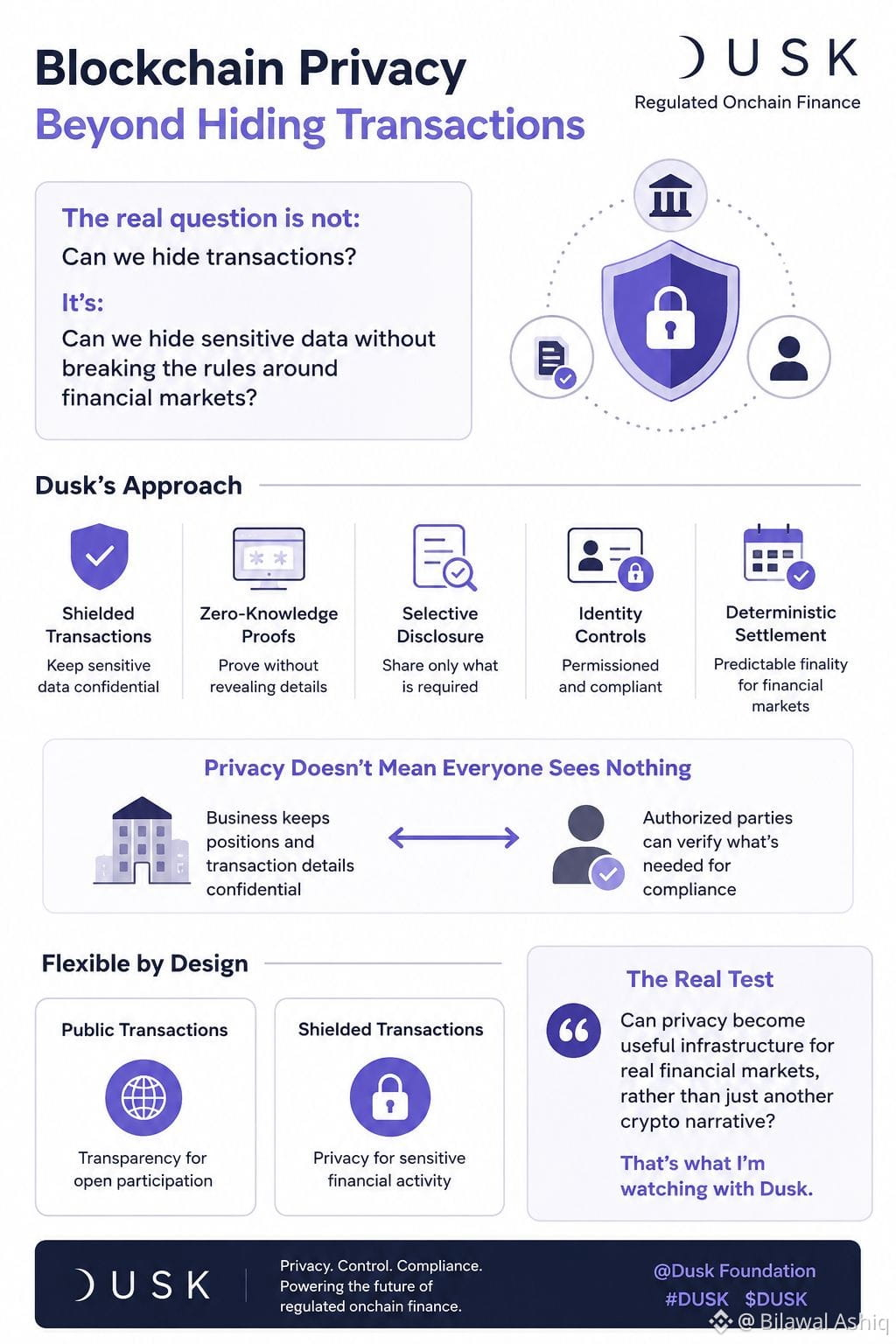
It’s “Can we hide sensitive data without breaking the rules around financial markets?”
That’s where Dusk gets more interesting to me.
Dusk is now positioning itself around regulated onchain finance, combining shielded transactions, zero-knowledge proofs, selective disclosure, identity controls, and deterministic settlement.
The important part is that privacy doesn’t have to mean everyone sees nothing.
A business could keep its positions and transaction details confidential, while an authorized party can still verify the information required for compliance.
Dusk also has both public and shielded transaction models, which makes the approach more flexible than simply making the whole network anonymous.
I think this is the real test for privacy-focused blockchains:
Can privacy become useful infrastructure for real financial markets, rather than just another crypto narrative?
That’s what I’m watching with Dusk.
@Dusk Foundation #dusk $DUSK
It’s “Can we hide sensitive data without breaking the rules around financial markets?”
That’s where Dusk gets more interesting to me.
Dusk is now positioning itself around regulated onchain finance, combining shielded transactions, zero-knowledge proofs, selective disclosure, identity controls, and deterministic settlement.
The important part is that privacy doesn’t have to mean everyone sees nothing.
A business could keep its positions and transaction details confidential, while an authorized party can still verify the information required for compliance.
Dusk also has both public and shielded transaction models, which makes the approach more flexible than simply making the whole network anonymous.
I think this is the real test for privacy-focused blockchains:
Can privacy become useful infrastructure for real financial markets, rather than just another crypto narrative?
That’s what I’m watching with Dusk.
@Dusk Foundation #dusk $DUSK