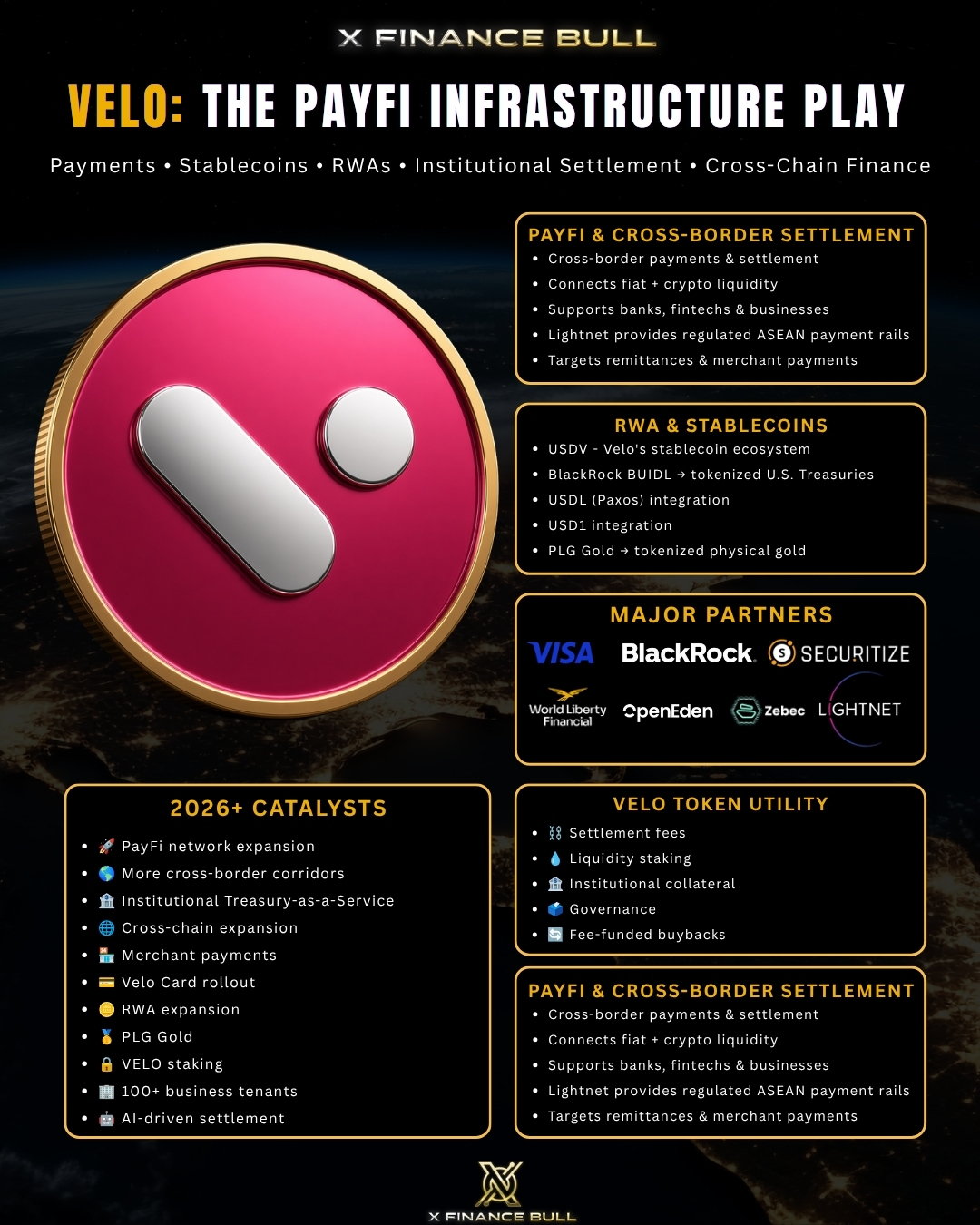
Look at the names already touching Velo’s infrastructure.
UOB Venture Management made a second strategic investment into Velo Labs.
Velo’s current strategic network includes Stellar, Visa, UOB, Seven Bank, CP Group, HashKey Capital, Hanwha, Copper and Cactus Custody.
Then you get into tokenized assets.
$VELO incorporated exposure to BlackRock BUIDL, tokenized by Securitize, into USDV’s reserve architecture.
Its joint venture with Lightnet and OpenEden is targeting tokenized U.S. Treasuries, corporate treasury services, stablecoin issuance and cross-border institutional settlement.
The initial markets include:
Singapore.
Thailand.
Philippines.
Indonesia.
And settlement is being designed around currencies including USD, THB, PHP, IDR, SGD and HKD.
That tells me Velo isn’t thinking small.
The plan is to connect blockchain liquidity with the currencies businesses actually use.
Then $VELO.US gets pulled further into that design.
Institutions are planned to lock VELO for netting infrastructure, settlement services and credit facilities.
Liquidity providers can stake VELO.
Network fees are designed to fund VELO buybacks.
And live VELO staking is on the roadmap as the network moves toward its Q4 2026–2027 expansion.
This is the kind of utility setup I like studying.
Not simply “who is buying the token?”
I want to know 👇
What happens when businesses actually need the token to access the financial infrastructure underneath them?
That’s the $VELO angle I’m watching. 😎