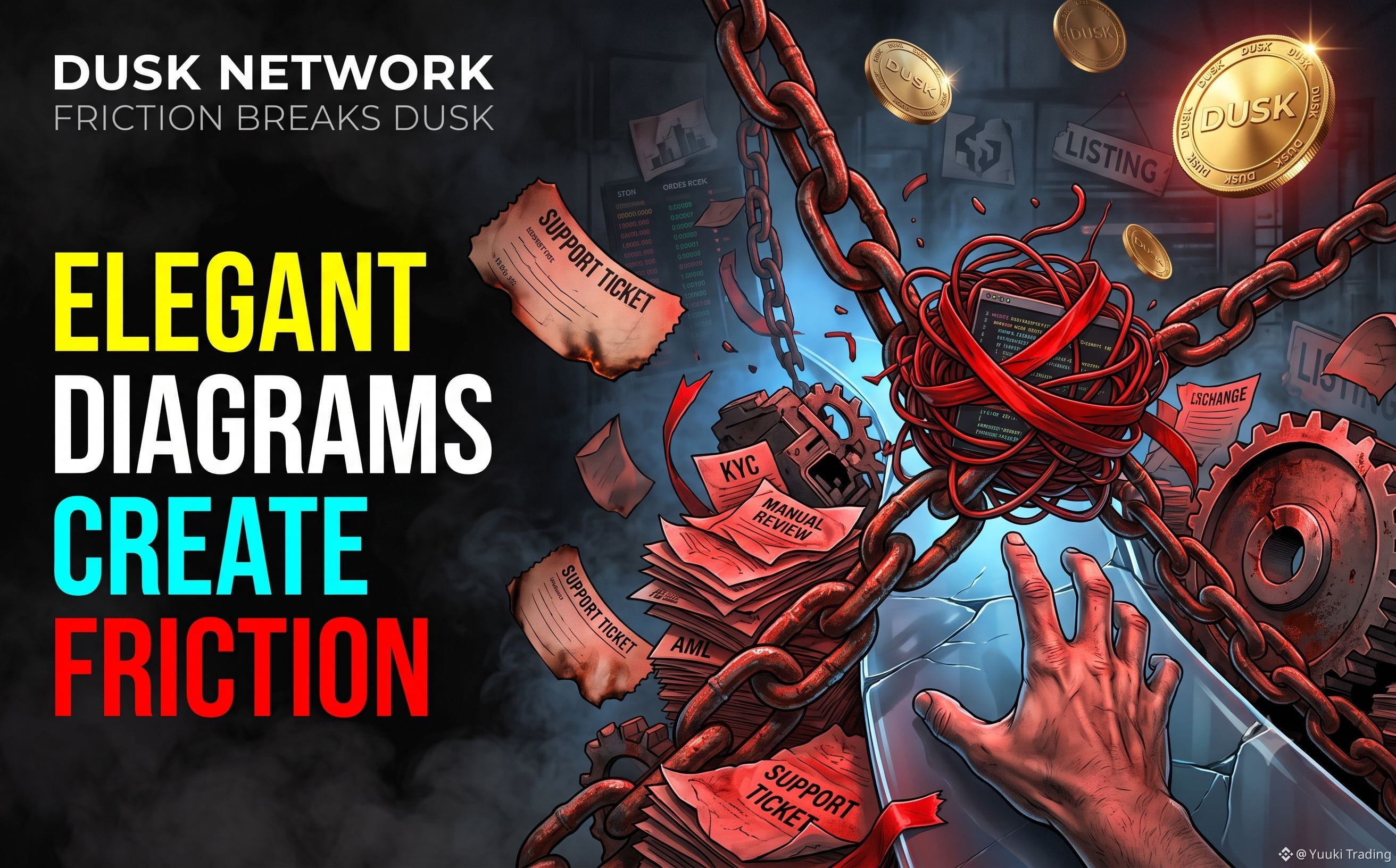
A few days ago I sat reviewing Dusk’s flow deposit/withdraw, paper covered in arrows... after connecting View Key, Moonlight account model, Validator KYC and Exchange Compliance, I finally realized the hardest part doesn’t lie in Privacy.
it lies in the Exception Path.
Transaction Metadata conceals Sender, Receiver, Amount; CASP still needs AML/CTF Due Diligence, Risk Assessment, Auditability, sometimes Selective Disclosure.
sounds elegant, doesn’t it?
only elegant on a diagram!
View Key granted with the wrong permissions, Manual Review moving slowly, Integration using a mismatched format... Support Ticket erupts immediately.
honestly, I used to look at 72 exchanges and feel reassured.
now I look at Market Depth before Listing Breadth.
if Liquidity Concentration is clustered around just a few venues, then 72 listings only make the screen look more crowded.
Thin Order Book is what worries me; Zombie Trading Pairs are even worse.
I built a case: 100 withdrawals, 18 cases enter Manual Review, Review Rate = 18/100 × 100% = 18%.
12 minutes per case means Operational Load = 216 minutes, or 3.6 hours.
no Exploit.
no Downtime.
just Compliance Friction... users don’t care!
MiCA Article 76 pulls Listing closer to White Paper and Risk Review; AMLR (EU) 2024/1624 puts Default Anonymity under scrutiny ahead of July 2027.
Delisting Record since 2024 makes me unwilling to treat Integration Risk as a side issue.
now I ask Dusk: is the Audit Trail clear, how does Liquidity react when a Monitoring Label appears, how many waves of selling can a Thin Market withstand when a Delisting Announcement drops, do Hedger and Order Book Obfuscation make the Compliance Workflow even more tangled?
my view is fairly stubborn: the best Privacy isn’t the one that hides the most, but the one that manages Disclosure precisely, without turning users into reluctant Compliance employees.
Dusk is making Privacy coexist with Regulation... or does greater sophistication only make the Exception Path longer?
#dusk $DUSK @Dusk
it lies in the Exception Path.
Transaction Metadata conceals Sender, Receiver, Amount; CASP still needs AML/CTF Due Diligence, Risk Assessment, Auditability, sometimes Selective Disclosure.
sounds elegant, doesn’t it?
only elegant on a diagram!
View Key granted with the wrong permissions, Manual Review moving slowly, Integration using a mismatched format... Support Ticket erupts immediately.
honestly, I used to look at 72 exchanges and feel reassured.
now I look at Market Depth before Listing Breadth.
if Liquidity Concentration is clustered around just a few venues, then 72 listings only make the screen look more crowded.
Thin Order Book is what worries me; Zombie Trading Pairs are even worse.
I built a case: 100 withdrawals, 18 cases enter Manual Review, Review Rate = 18/100 × 100% = 18%.
12 minutes per case means Operational Load = 216 minutes, or 3.6 hours.
no Exploit.
no Downtime.
just Compliance Friction... users don’t care!
MiCA Article 76 pulls Listing closer to White Paper and Risk Review; AMLR (EU) 2024/1624 puts Default Anonymity under scrutiny ahead of July 2027.
Delisting Record since 2024 makes me unwilling to treat Integration Risk as a side issue.
now I ask Dusk: is the Audit Trail clear, how does Liquidity react when a Monitoring Label appears, how many waves of selling can a Thin Market withstand when a Delisting Announcement drops, do Hedger and Order Book Obfuscation make the Compliance Workflow even more tangled?
my view is fairly stubborn: the best Privacy isn’t the one that hides the most, but the one that manages Disclosure precisely, without turning users into reluctant Compliance employees.
Dusk is making Privacy coexist with Regulation... or does greater sophistication only make the Exception Path longer?
#dusk $DUSK @Dusk