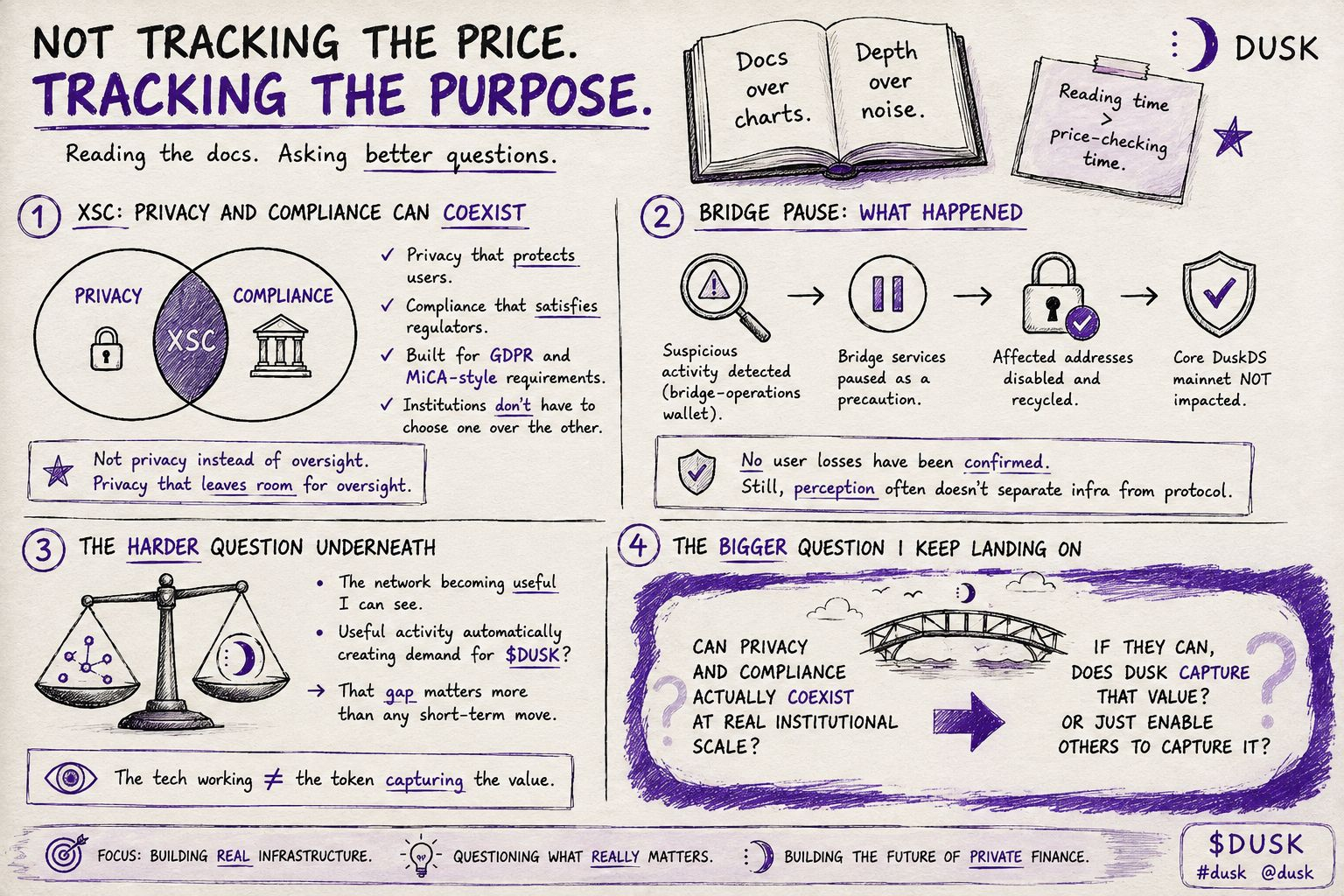
Spent today reading @Dusk documentation instead of tracking the token, and realized the reading time has quietly outpaced the price-checking time by a lot lately. That shift is probably worth noticing on its own.
What's actually held my attention is how XSC handles the tension between privacy and compliance for tokenized securities — not privacy instead of oversight, privacy that still leaves room for GDPR and MiCA-style requirements to function. Institutions don't want to give up regulatory visibility for privacy's sake, and XSC seems built around accepting that constraint rather than fighting it. I find that balance more convincing than a pure-privacy pitch would be.
Harder to look past is the bridge pause from mid-August — the team detected suspicious activity tied to a bridge-operations wallet, paused bridge services as a precaution, disabled and recycled the affected addresses, and confirmed the core DuskDS mainnet itself wasn't impacted. No user losses have been confirmed. Still, I keep coming back to the same uncomfortable pattern: when something goes wrong anywhere in an ecosystem, most people don't naturally separate "bridge infrastructure" from "the protocol" — the whole thing gets viewed with suspicion together, fair or not.
Then there's the harder open question underneath all of it. I can see how the network itself becomes genuinely useful. I'm less convinced that useful network activity automatically translates into real demand for $DUSK specifically — that gap between "the tech works" and "the token captures the value" matters more to me than any short-term move.
The bigger question I keep landing on: can privacy and compliance actually coexist at real institutional scale? And if they can, does DUSK end up being the thing that captures that value, or just the infrastructure that made it possible for someone else to capture it?
#dusk @Dusk $TAC $TMX
What's actually held my attention is how XSC handles the tension between privacy and compliance for tokenized securities — not privacy instead of oversight, privacy that still leaves room for GDPR and MiCA-style requirements to function. Institutions don't want to give up regulatory visibility for privacy's sake, and XSC seems built around accepting that constraint rather than fighting it. I find that balance more convincing than a pure-privacy pitch would be.
Harder to look past is the bridge pause from mid-August — the team detected suspicious activity tied to a bridge-operations wallet, paused bridge services as a precaution, disabled and recycled the affected addresses, and confirmed the core DuskDS mainnet itself wasn't impacted. No user losses have been confirmed. Still, I keep coming back to the same uncomfortable pattern: when something goes wrong anywhere in an ecosystem, most people don't naturally separate "bridge infrastructure" from "the protocol" — the whole thing gets viewed with suspicion together, fair or not.
Then there's the harder open question underneath all of it. I can see how the network itself becomes genuinely useful. I'm less convinced that useful network activity automatically translates into real demand for $DUSK specifically — that gap between "the tech works" and "the token captures the value" matters more to me than any short-term move.
The bigger question I keep landing on: can privacy and compliance actually coexist at real institutional scale? And if they can, does DUSK end up being the thing that captures that value, or just the infrastructure that made it possible for someone else to capture it?
#dusk @Dusk $TAC $TMX