The Dusk story I find most interesting is the attempt to combine privacy with auditability. At first those ideas can sound like opposites. If data is private how can anyone verify what happened?
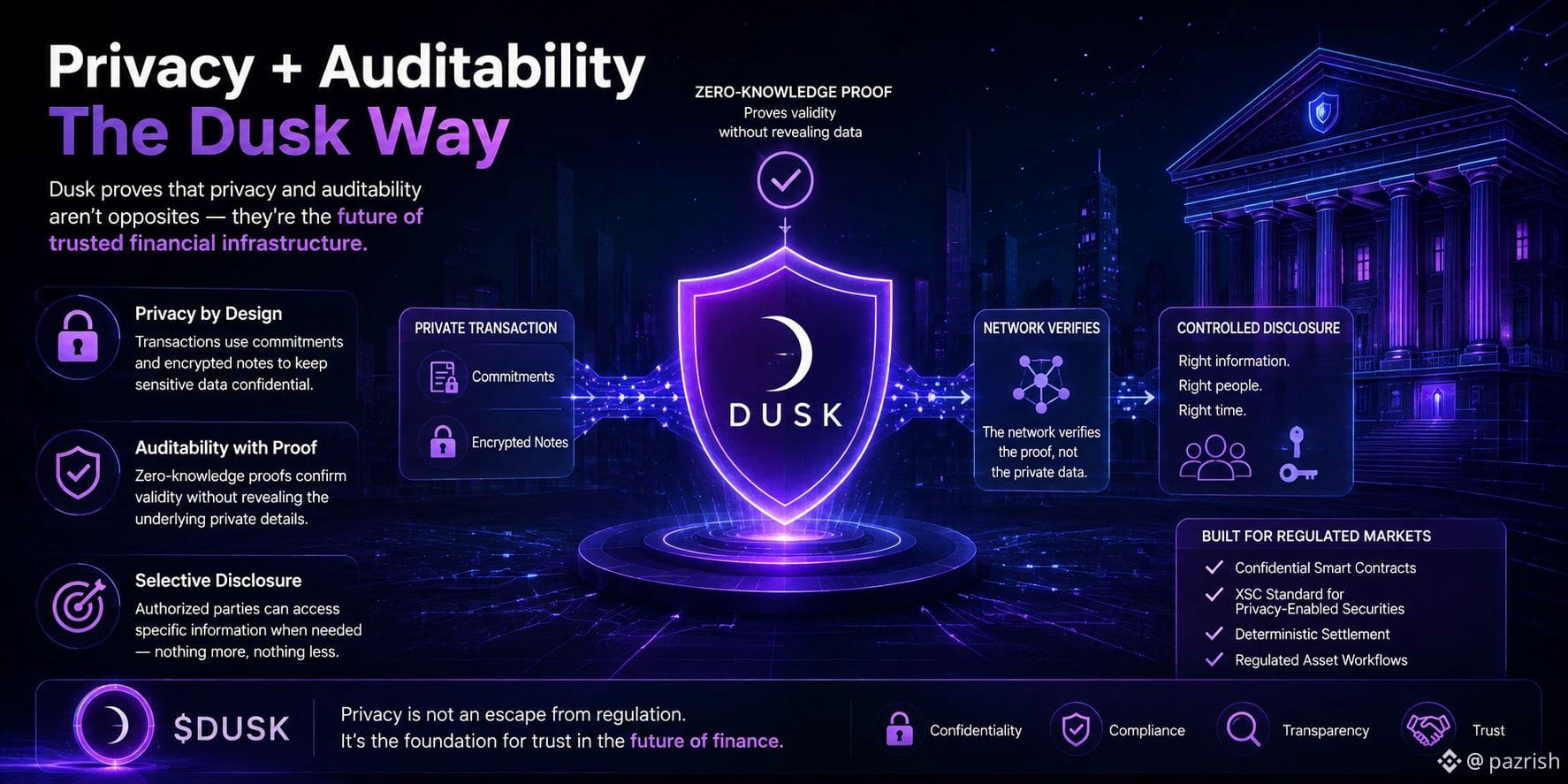
Dusk's architecture approaches the problem with zero-knowledge proofs and selective disclosure. The network can verify that a transaction or contract action follows the required rules without making every sensitive detail public. When additional information is required controlled disclosure can provide the right visibility.
The whitepaper's Phoenix design is a good technical example. Transactions use commitments and encrypted notes while a zero-knowledge proof demonstrates that the transaction is valid. The network verifies the proof rather than simply reading all private data.
For financial markets this distinction is important. Institutions may need confidentiality around balances, counterparties, or transfers but regulators and authorized parties still need ways to verify compliance.
That is also the thinking behind Dusk's confidential smart contracts and XSC standard for privacy-enabled securities. The goal is not to make financial activity unaccountable. It is to make privacy compatible with verifiable rules.
Dusk's current infrastructure pushes this idea further with deterministic settlement and regulated asset workflows.
After reading the technical material I think this is the strongest research angle for @Dusk . Privacy is not presented as an escape from regulation it is being designed as part of financial infrastructure.
That makes $DUSK worth studying from a technology perspective, especially as tokenized markets continue to develop. #dusk
Dusk's architecture approaches the problem with zero-knowledge proofs and selective disclosure. The network can verify that a transaction or contract action follows the required rules without making every sensitive detail public. When additional information is required controlled disclosure can provide the right visibility.
The whitepaper's Phoenix design is a good technical example. Transactions use commitments and encrypted notes while a zero-knowledge proof demonstrates that the transaction is valid. The network verifies the proof rather than simply reading all private data.
For financial markets this distinction is important. Institutions may need confidentiality around balances, counterparties, or transfers but regulators and authorized parties still need ways to verify compliance.
That is also the thinking behind Dusk's confidential smart contracts and XSC standard for privacy-enabled securities. The goal is not to make financial activity unaccountable. It is to make privacy compatible with verifiable rules.
Dusk's current infrastructure pushes this idea further with deterministic settlement and regulated asset workflows.
After reading the technical material I think this is the strongest research angle for @Dusk . Privacy is not presented as an escape from regulation it is being designed as part of financial infrastructure.
That makes $DUSK worth studying from a technology perspective, especially as tokenized markets continue to develop. #dusk