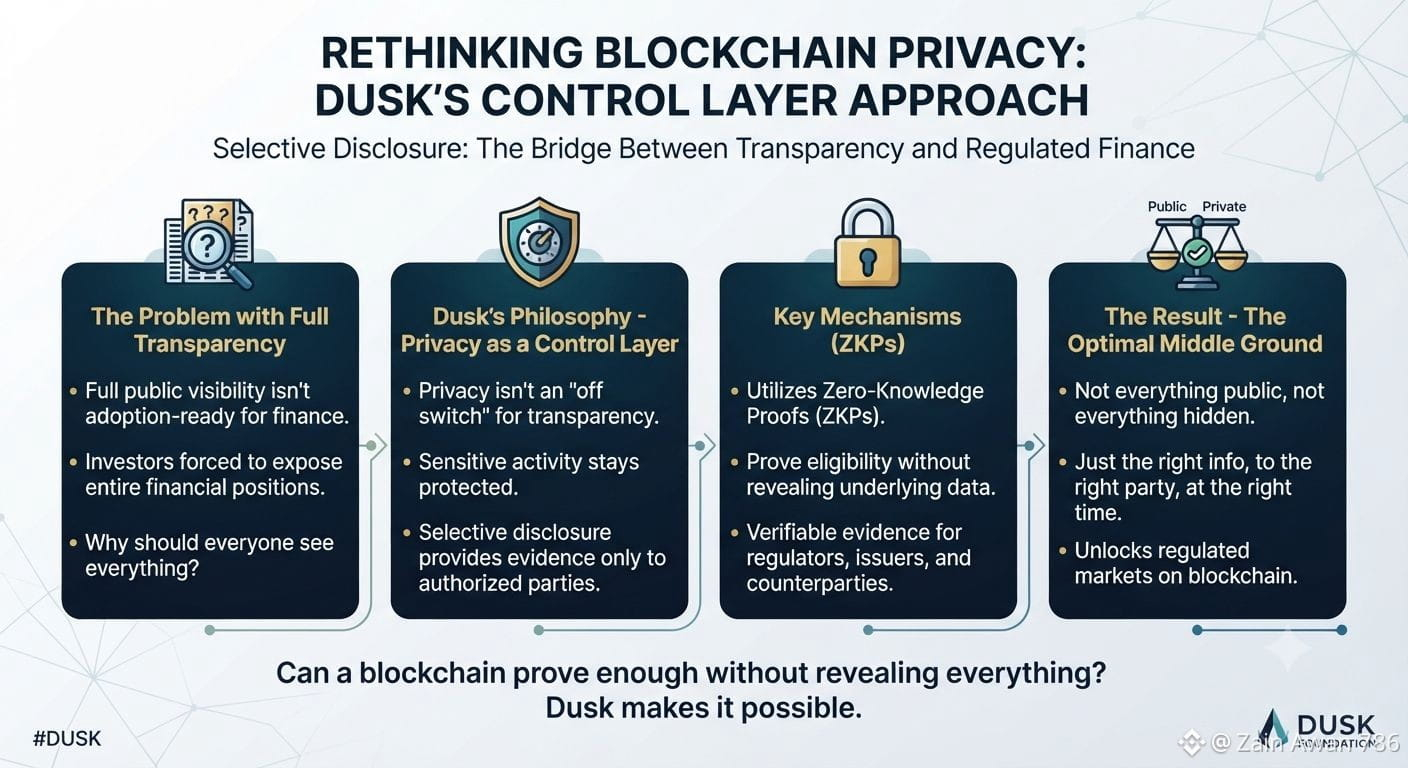
I started looking at blockchain privacy differently after digging deeper into Dusk.
Maybe the real problem isn’t that financial data is private.
Maybe the problem is who gets to see it.
Think about a regulated market.
An investor shouldn’t have to expose their entire financial position just to prove they’re eligible.
A regulator may need evidence.
An issuer may need to verify ownership.
A counterparty may need proof that something happened.
But why should everyone else see everything?
That’s the part that caught my attention with @Dusk Foundation.
Dusk treats privacy less like an “off switch” for transparency and more like a control layer.
Sensitive activity can stay protected, while zero-knowledge proofs and selective disclosure can provide verifiable evidence to the parties that actually need it.
And that creates a much more interesting middle ground:
Not everything public.
Not everything hidden.
Just the right information, to the right party, at the right time.
For regulated finance, I think that distinction is huge.
Because forcing every financial workflow into full public visibility isn’t necessarily adoption-ready.
The better question is:
Can a blockchain prove enough without revealing everything?
That’s where Dusk’s approach gets interesting to me.
Is selective disclosure the missing bridge between blockchain transparency and real financial privacy?
$DUSK #dusk
Maybe the real problem isn’t that financial data is private.
Maybe the problem is who gets to see it.
Think about a regulated market.
An investor shouldn’t have to expose their entire financial position just to prove they’re eligible.
A regulator may need evidence.
An issuer may need to verify ownership.
A counterparty may need proof that something happened.
But why should everyone else see everything?
That’s the part that caught my attention with @Dusk Foundation.
Dusk treats privacy less like an “off switch” for transparency and more like a control layer.
Sensitive activity can stay protected, while zero-knowledge proofs and selective disclosure can provide verifiable evidence to the parties that actually need it.
And that creates a much more interesting middle ground:
Not everything public.
Not everything hidden.
Just the right information, to the right party, at the right time.
For regulated finance, I think that distinction is huge.
Because forcing every financial workflow into full public visibility isn’t necessarily adoption-ready.
The better question is:
Can a blockchain prove enough without revealing everything?
That’s where Dusk’s approach gets interesting to me.
Is selective disclosure the missing bridge between blockchain transparency and real financial privacy?
$DUSK #dusk