#dusk $DUSK @Dusk
Been digging into Dusk Network's setup lately and one detail kept pulling my attention more than the usual "privacy chain" pitch. It's the way Piecrust, their WASM based VM, handles the expensive stuff.
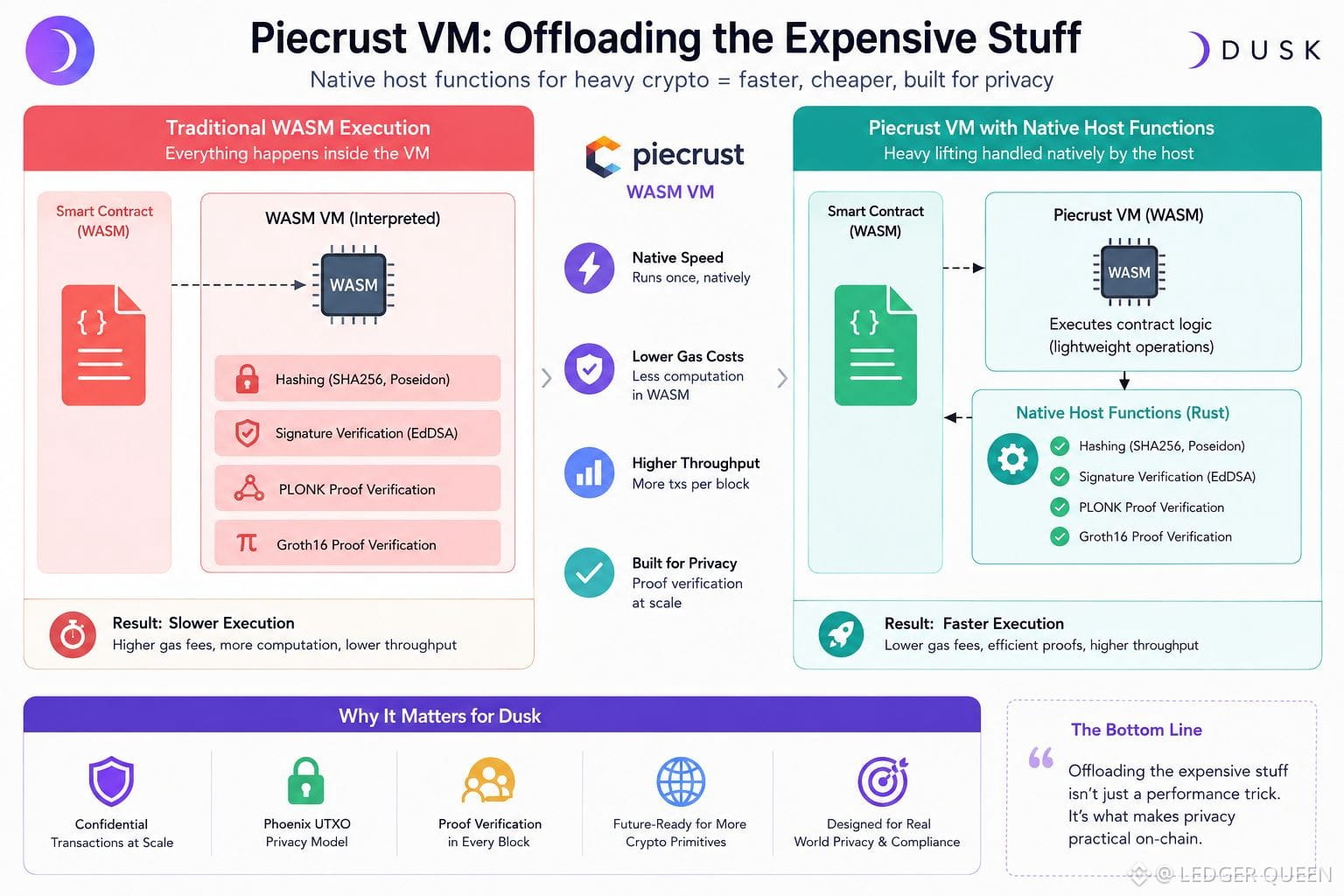
Here's the thing about smart contract execution that people don't talk about enough. Every instruction costs real computation, and on most chains, if a contract needs to hash something or verify a proof, it does that work inside the VM itself, line by line, in WASM bytecode. That's fine for simple logic. It gets brutal once you're dealing with zero knowledge proofs, which is basically Dusk's whole reason for existing. What caught my attention was Piecrust's approach of pushing that heavy lifting, hashing, signature checks, PLONK and Groth16 proof validation, out to native host functions instead of making the contract compute it in WASM. The host runs it once, natively, and hands the result back.
I keep wondering how much this actually matters in practice versus on paper. But the logic tracks. Native code for cryptographic operations is just faster than WASM interpreting the same math, sometimes by a wide margin depending on the operation. For a chain built around confidential transactions and Phoenix's UTXO privacy model, where proof verification isn't optional but constant, that gap adds up fast across every block.
What still feels unresolved to me is how this scales once contract complexity grows beyond the current use cases. Native host functions solve today's bottleneck, but I'm not fully convinced it stays elegant as more custom cryptographic primitives get requested. Anyone actually building on Piecrust seeing friction there yet?
$ONG
$AMP
Been digging into Dusk Network's setup lately and one detail kept pulling my attention more than the usual "privacy chain" pitch. It's the way Piecrust, their WASM based VM, handles the expensive stuff.
Here's the thing about smart contract execution that people don't talk about enough. Every instruction costs real computation, and on most chains, if a contract needs to hash something or verify a proof, it does that work inside the VM itself, line by line, in WASM bytecode. That's fine for simple logic. It gets brutal once you're dealing with zero knowledge proofs, which is basically Dusk's whole reason for existing. What caught my attention was Piecrust's approach of pushing that heavy lifting, hashing, signature checks, PLONK and Groth16 proof validation, out to native host functions instead of making the contract compute it in WASM. The host runs it once, natively, and hands the result back.
I keep wondering how much this actually matters in practice versus on paper. But the logic tracks. Native code for cryptographic operations is just faster than WASM interpreting the same math, sometimes by a wide margin depending on the operation. For a chain built around confidential transactions and Phoenix's UTXO privacy model, where proof verification isn't optional but constant, that gap adds up fast across every block.
What still feels unresolved to me is how this scales once contract complexity grows beyond the current use cases. Native host functions solve today's bottleneck, but I'm not fully convinced it stays elegant as more custom cryptographic primitives get requested. Anyone actually building on Piecrust seeing friction there yet?
$ONG
$AMP