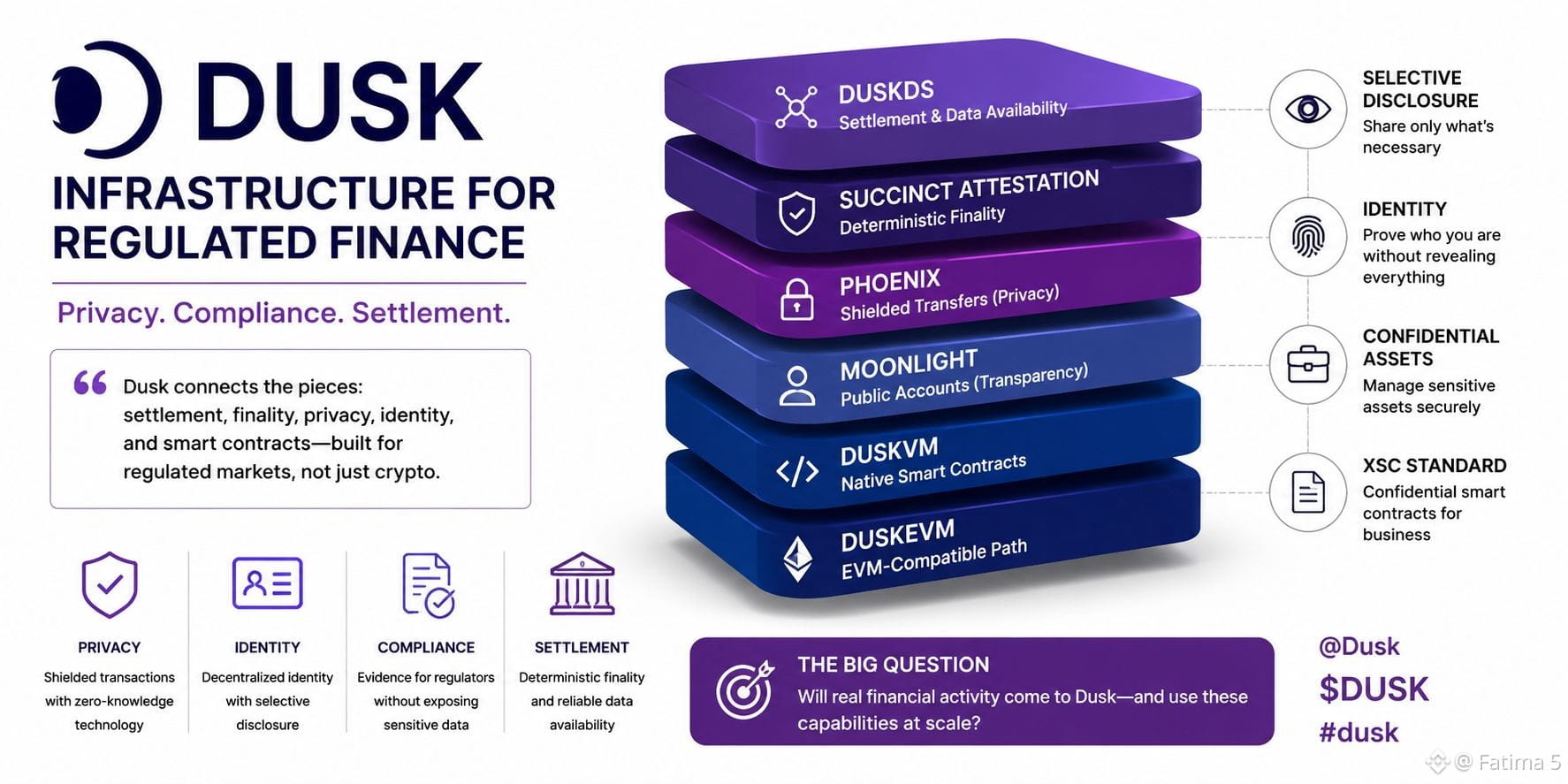
After thirteen days of research my biggest takeaway is that Dusk is a bet on infrastructure not just privacy. The pieces connect DuskDS provides settlement and data availability Succinct Attestation targets deterministic finality, Phoenix supports shielded transfers Moonlight supports public accounts DuskVM provides native smart contracts and DuskEVM offers an EVM compatible path.
Around those primitives sit selective disclosure, identity, confidential assets and the XSC standard for business-oriented confidential smart contracts.
That architecture makes sense to me because regulated finance has conflicting requirements. Markets want transparency, but institutions cannot expose every position or business relationship. Regulators need evidence, but evidence does not always require publishing the entire underlying dataset. Investors need programmable ownership, but transfer rules can be legally constrained.
Dusk is attempting to put those requirements into one environment.
I am not turning this into a price prediction for $DUSK . The more important research question is whether real financial activity will arrive and use these capabilities at scale. The platform has meaningful technical components, but adoption remains the test.
For @Dusk the thesis is compelling if privacy compliance and settlement can reinforce each other instead of becoming separate layers.
After studying the architecture and use cases would you bet on Dusk as serious regulated market infrastructure or will public blockchains solve these requirements another way? #dusk
Around those primitives sit selective disclosure, identity, confidential assets and the XSC standard for business-oriented confidential smart contracts.
That architecture makes sense to me because regulated finance has conflicting requirements. Markets want transparency, but institutions cannot expose every position or business relationship. Regulators need evidence, but evidence does not always require publishing the entire underlying dataset. Investors need programmable ownership, but transfer rules can be legally constrained.
Dusk is attempting to put those requirements into one environment.
I am not turning this into a price prediction for $DUSK . The more important research question is whether real financial activity will arrive and use these capabilities at scale. The platform has meaningful technical components, but adoption remains the test.
For @Dusk the thesis is compelling if privacy compliance and settlement can reinforce each other instead of becoming separate layers.
After studying the architecture and use cases would you bet on Dusk as serious regulated market infrastructure or will public blockchains solve these requirements another way? #dusk