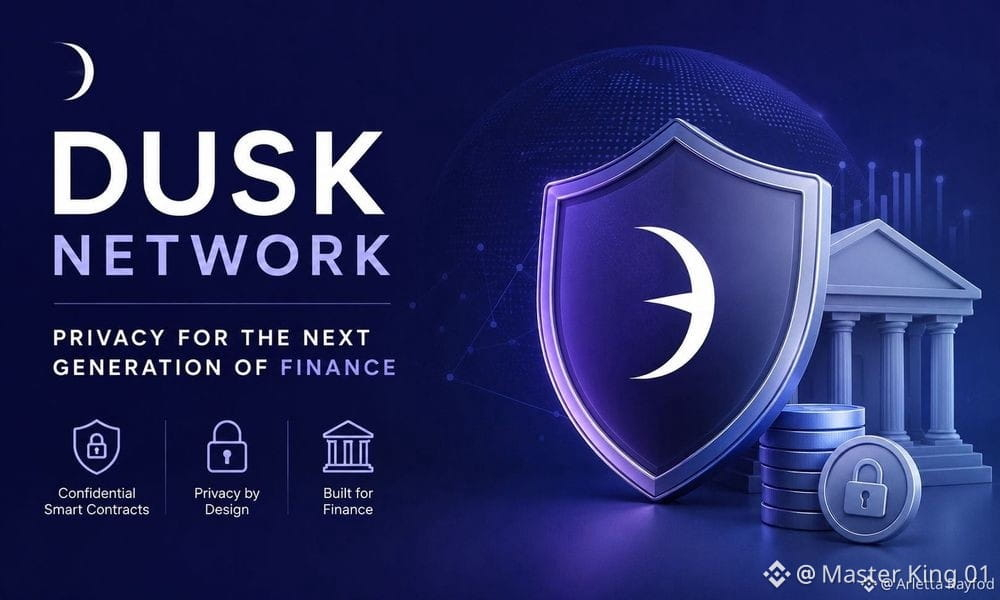
#dusk $DUSK @Dusk I’ve been looking more closely at @Dusk, and what stands out to me is that it isn’t trying to make privacy useful only for crypto-native users.
The bigger idea is financial infrastructure.
Dusk is a Layer-1 built around privacy for financial applications, with the Confidential Security Contract (XSC) standard and confidential smart contracts at the core. That matters because real financial markets need something blockchains have historically struggled to provide: transparency where it helps, but confidentiality where it is necessary.
Think about regulated assets, securities, institutional transactions, and financial data. Institutions cannot simply put every sensitive detail on a completely public ledger. At the same time, they need auditability, regulatory controls, and verifiable ownership.
That’s where Dusk’s approach becomes interesting.
The combination of privacy and compliance is arguably more important than privacy alone. The goal is not to hide everything—it’s to enable controlled confidentiality while still allowing the right information to be verified by the right parties.
DuskEV adds another important layer to the story. EVM compatibility can make it easier for developers and existing Ethereum tooling to interact with the ecosystem, potentially lowering the friction involved in building financial applications on Dusk.
What I find particularly interesting is the institutional angle.
If blockchain infrastructure is eventually going to support regulated financial products at scale, networks will need to solve problems beyond speed and cheap transactions. Identity, compliance, confidentiality, settlement, and interoperability all become critical.
That’s the market Dusk appears to be targeting.
I’m not looking at Dusk simply as another L1 or another privacy narrative. I’m more interested in whether its technology can become useful infrastructure for financial markets where confidentiality and compliance have to coexist.
The bigger idea is financial infrastructure.
Dusk is a Layer-1 built around privacy for financial applications, with the Confidential Security Contract (XSC) standard and confidential smart contracts at the core. That matters because real financial markets need something blockchains have historically struggled to provide: transparency where it helps, but confidentiality where it is necessary.
Think about regulated assets, securities, institutional transactions, and financial data. Institutions cannot simply put every sensitive detail on a completely public ledger. At the same time, they need auditability, regulatory controls, and verifiable ownership.
That’s where Dusk’s approach becomes interesting.
The combination of privacy and compliance is arguably more important than privacy alone. The goal is not to hide everything—it’s to enable controlled confidentiality while still allowing the right information to be verified by the right parties.
DuskEV adds another important layer to the story. EVM compatibility can make it easier for developers and existing Ethereum tooling to interact with the ecosystem, potentially lowering the friction involved in building financial applications on Dusk.
What I find particularly interesting is the institutional angle.
If blockchain infrastructure is eventually going to support regulated financial products at scale, networks will need to solve problems beyond speed and cheap transactions. Identity, compliance, confidentiality, settlement, and interoperability all become critical.
That’s the market Dusk appears to be targeting.
I’m not looking at Dusk simply as another L1 or another privacy narrative. I’m more interested in whether its technology can become useful infrastructure for financial markets where confidentiality and compliance have to coexist.