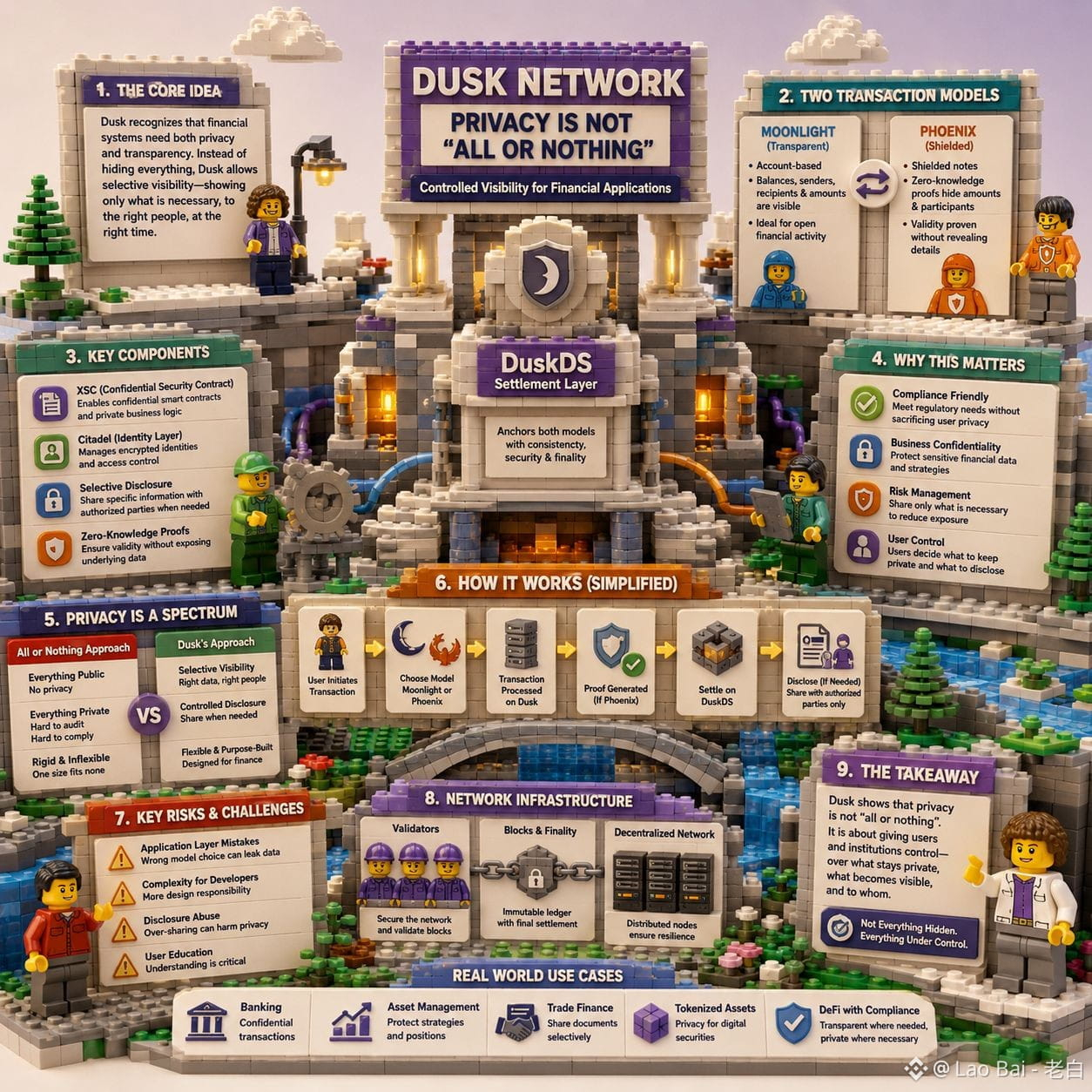
#dusk $DUSK @Dusk One thing caught my attention while digging through Dusk’s design. the protocol doesn’t treat private as meaning every byte must disappear.
At first, that sounds like a weakness. But for financial infrastructure total opacity can be just as awkward as total transparency. Think of a bank vault: you protect the contents not the entire building. Dusk applies a similar idea different transaction data can require different visibility.
Under the hood, the distinction matters. Moonlight supports transparent account based activity while privacy oriented flows use shielded notes and zero knowledge proofs to let the network verify validity without exposing the underlying sensitive details. The goal is not simply hiding data, but controlling what can be proven publicly.
What I’ll watch from here is practical usage: confidential transaction volume, proof-generation latency, finalization time, and selective disclosure activity. The real edge isn't everything is hidden. It’s whether Dusk can make visibility a programmable part of financial infrastructure.
At first, that sounds like a weakness. But for financial infrastructure total opacity can be just as awkward as total transparency. Think of a bank vault: you protect the contents not the entire building. Dusk applies a similar idea different transaction data can require different visibility.
Under the hood, the distinction matters. Moonlight supports transparent account based activity while privacy oriented flows use shielded notes and zero knowledge proofs to let the network verify validity without exposing the underlying sensitive details. The goal is not simply hiding data, but controlling what can be proven publicly.
What I’ll watch from here is practical usage: confidential transaction volume, proof-generation latency, finalization time, and selective disclosure activity. The real edge isn't everything is hidden. It’s whether Dusk can make visibility a programmable part of financial infrastructure.