Spent way too long last night digging through Dusk’s architecture docs. Not gonna lie, my brain kept snagging on one thing.
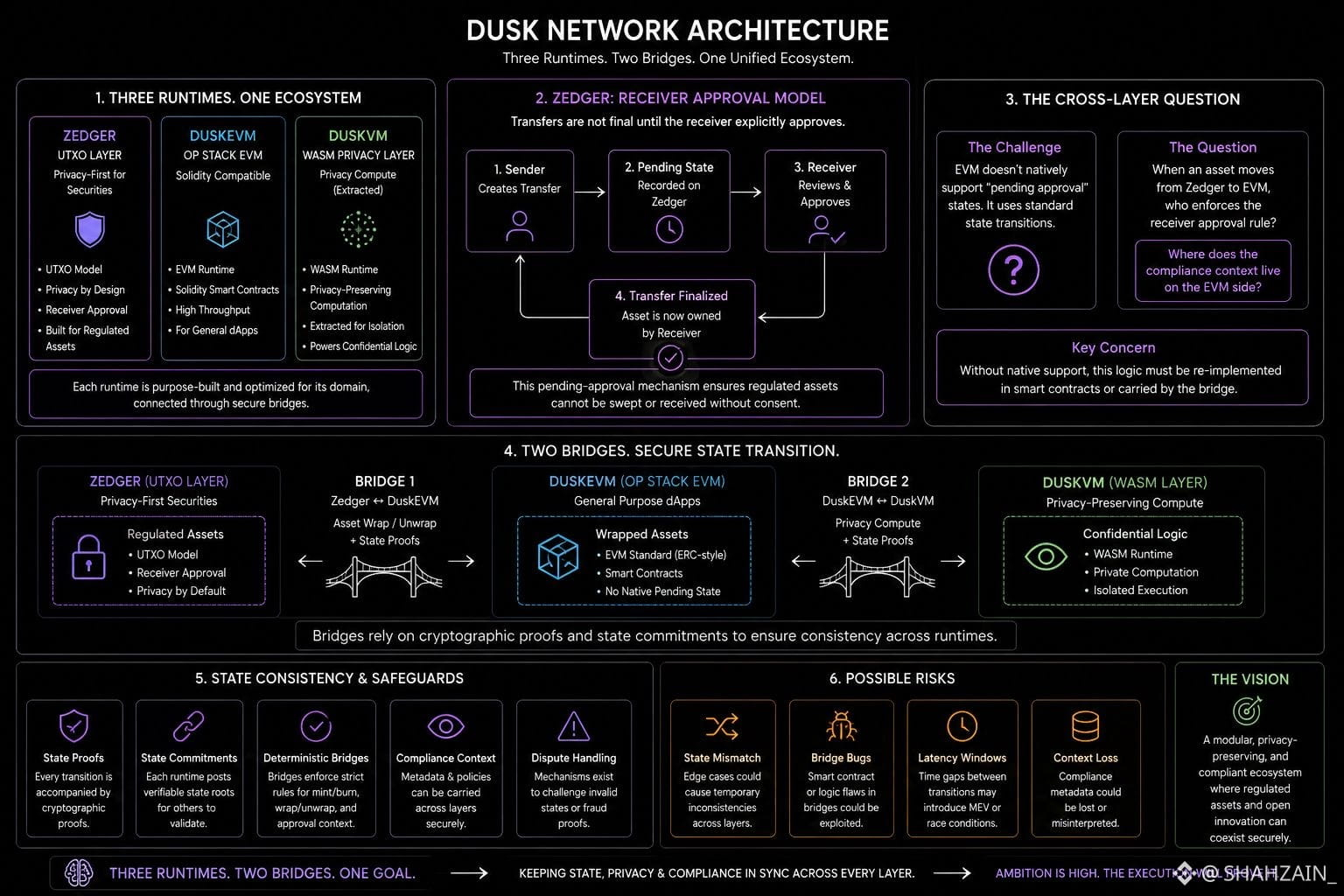
They’ve got Zedger (UTXO-style, privacy-first for securities) and DuskEVM (OP Stack EVM for Solidity devs). On paper, it’s clean—settlement logic stays separate from application logic.
But Zedger has this specific, pretty cool feature: the receiver has to explicitly approve a transfer before it actually finalizes. Huge for regulated assets. Your security token can't just get swept into a random wallet.
Now imagine you wrap that asset and bring it over to the EVM side. EVM doesn't have that "pending approval" state natively—it’s just standard state transitions.
So who enforces the rule when it’s on the other side?
The public docs don’t really detail the bridge mechanics here. Maybe they carry that compliance context over, but honestly, that feels like you’re just rebuilding Zedger’s logic inside Solidity anyway. So why keep them separate?
That’s probably why DuskVM (the WASM privacy layer) is being extracted out as its own thing—to keep the truly regulated stuff isolated from the wild west of EVM.
Three runtimes. Two bridges. It’s ambitious, but I’m just sitting here wondering if those seams are actually airtight. Feels like there could be some weird state inconsistencies when an asset jumps layers.
Not trying to FUD—I actually like the approach. Just genuinely curious if anyone knows how they plan to keep that cross-layer state sync tight in practice.
@Dusk #dusk #DUSK $DUSK
They’ve got Zedger (UTXO-style, privacy-first for securities) and DuskEVM (OP Stack EVM for Solidity devs). On paper, it’s clean—settlement logic stays separate from application logic.
But Zedger has this specific, pretty cool feature: the receiver has to explicitly approve a transfer before it actually finalizes. Huge for regulated assets. Your security token can't just get swept into a random wallet.
Now imagine you wrap that asset and bring it over to the EVM side. EVM doesn't have that "pending approval" state natively—it’s just standard state transitions.
So who enforces the rule when it’s on the other side?
The public docs don’t really detail the bridge mechanics here. Maybe they carry that compliance context over, but honestly, that feels like you’re just rebuilding Zedger’s logic inside Solidity anyway. So why keep them separate?
That’s probably why DuskVM (the WASM privacy layer) is being extracted out as its own thing—to keep the truly regulated stuff isolated from the wild west of EVM.
Three runtimes. Two bridges. It’s ambitious, but I’m just sitting here wondering if those seams are actually airtight. Feels like there could be some weird state inconsistencies when an asset jumps layers.
Not trying to FUD—I actually like the approach. Just genuinely curious if anyone knows how they plan to keep that cross-layer state sync tight in practice.
@Dusk #dusk #DUSK $DUSK