

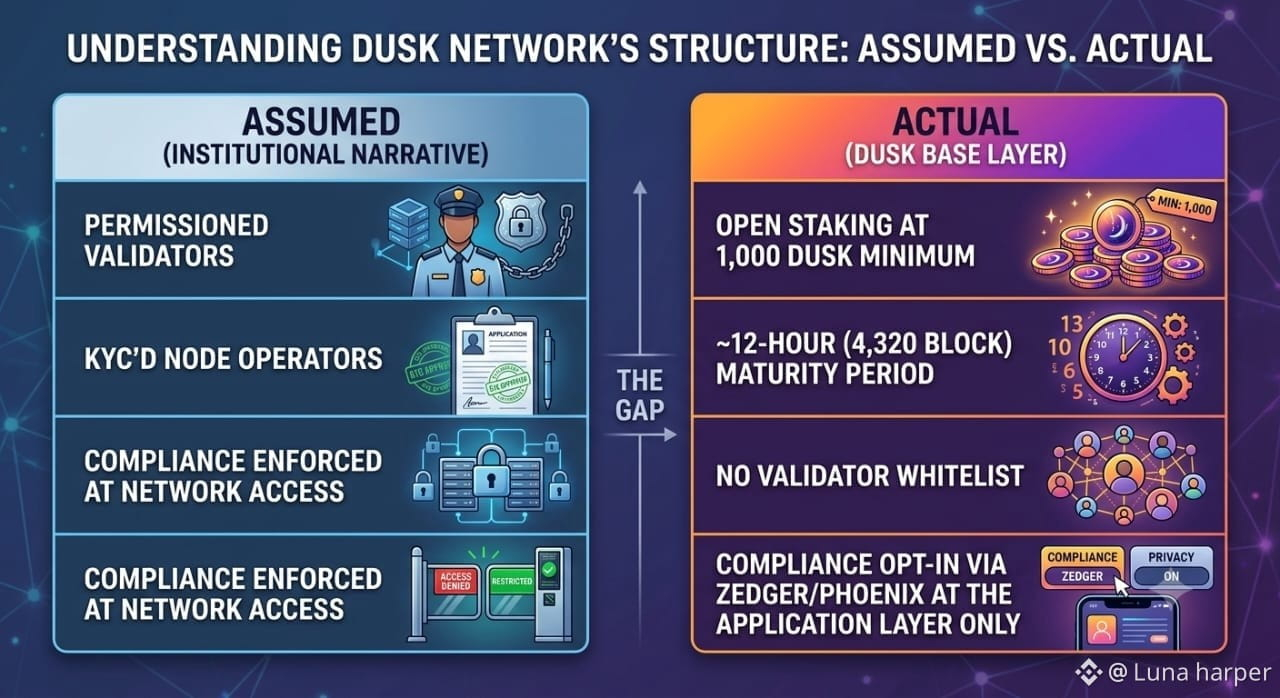
I was checking Dusk's staking mechanics last week and one detail stuck with me. Dusk $DUSK #Dusk @Dusk sells itself on regulated finance, institutional rails, that kind of framing. So I expected the network layer to feel gatekept somehow. It doesn't. The minimum to run a provisioner node and vote in consensus is 1,000 DUSK, and once staked it matures in about twelve hours, roughly 4,320 blocks, before it's active. That's a fully open, permissionless bar, no whitelist, no KYC to help secure the chain. Meanwhile the actual compliance tooling, Zedger for confidential asset issuance, Phoenix for private transactions, sits entirely at the application layer, separate from who gets to validate blocks. That split runs opposite to how I pictured an "institutional-grade" chain working. Most projects chasing the RWA narrative lean toward permissioned validator sets tied to KYC'd operators. Dusk kept those two things apart on purpose. What I keep sitting with is that this only pays off if issuers actually opt into the compliance layer, since nothing at the base layer forces it. Right now that's still mostly potential, not measured usage. Open consensus paired with optional compliance is a bet on behavior, not architecture. Not sure yet if that split is the smarter design or just the harder one to prove out.

厳選トピックで世界の暗号資産トレーダーの仲間入り
⚡️ 暗号資産に関する最新かつ有益な情報が見つかります。
💬 世界最大の暗号資産取引所から信頼されています。
👍 認証を受けたクリエイターから、有益なインサイトを得られます。
メール / 電話番号