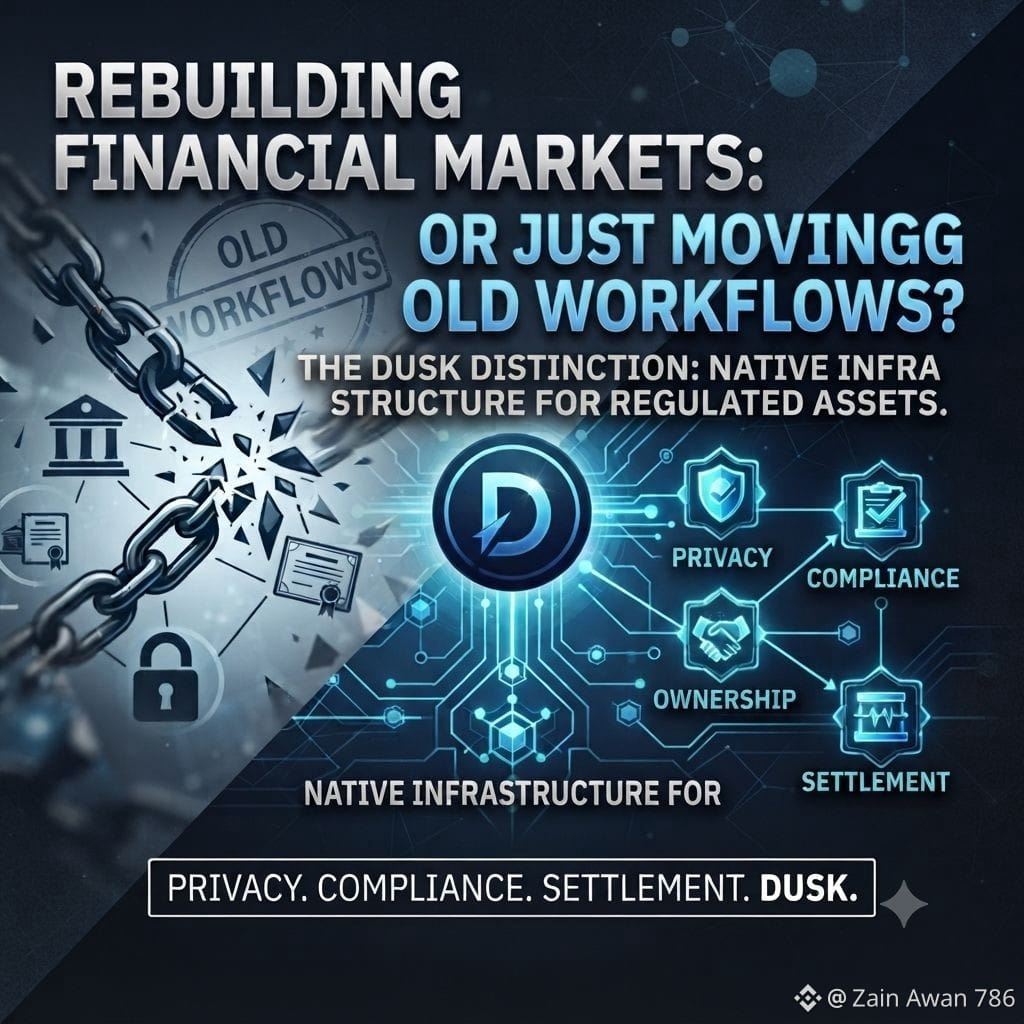
Are we really building new financial markets, or just putting old workflows on a blockchain?
A token can move onchain, but the real financial system around it still has to function:
• Who is allowed to invest?
• How is ownership recorded?
• What happens on transfer?
•How is sensitive data handled?
• And how does settlement execute?
This is where @Dusk Foundation stands out.
Dusk isn’t just another place to deploy tokens. It builds base infrastructure for regulated markets—baking native privacy, strict compliance, controlled ownership, and deterministic settlement straight into the protocol.
If a token is onchain, but its eligibility and settlement still rely on legacy systems, we haven’t rebuilt the market. We've only moved the asset.
That’s what the RWA conversation misses. The real challenge isn’t getting an asset onto a blockchain—it's making its entire lifecycle work there.
Are we finally moving from simple asset tokenization to rebuilding the financial infrastructure around them?
$DUSK #dusk
A token can move onchain, but the real financial system around it still has to function:
• Who is allowed to invest?
• How is ownership recorded?
• What happens on transfer?
•How is sensitive data handled?
• And how does settlement execute?
This is where @Dusk Foundation stands out.
Dusk isn’t just another place to deploy tokens. It builds base infrastructure for regulated markets—baking native privacy, strict compliance, controlled ownership, and deterministic settlement straight into the protocol.
If a token is onchain, but its eligibility and settlement still rely on legacy systems, we haven’t rebuilt the market. We've only moved the asset.
That’s what the RWA conversation misses. The real challenge isn’t getting an asset onto a blockchain—it's making its entire lifecycle work there.
Are we finally moving from simple asset tokenization to rebuilding the financial infrastructure around them?
$DUSK #dusk