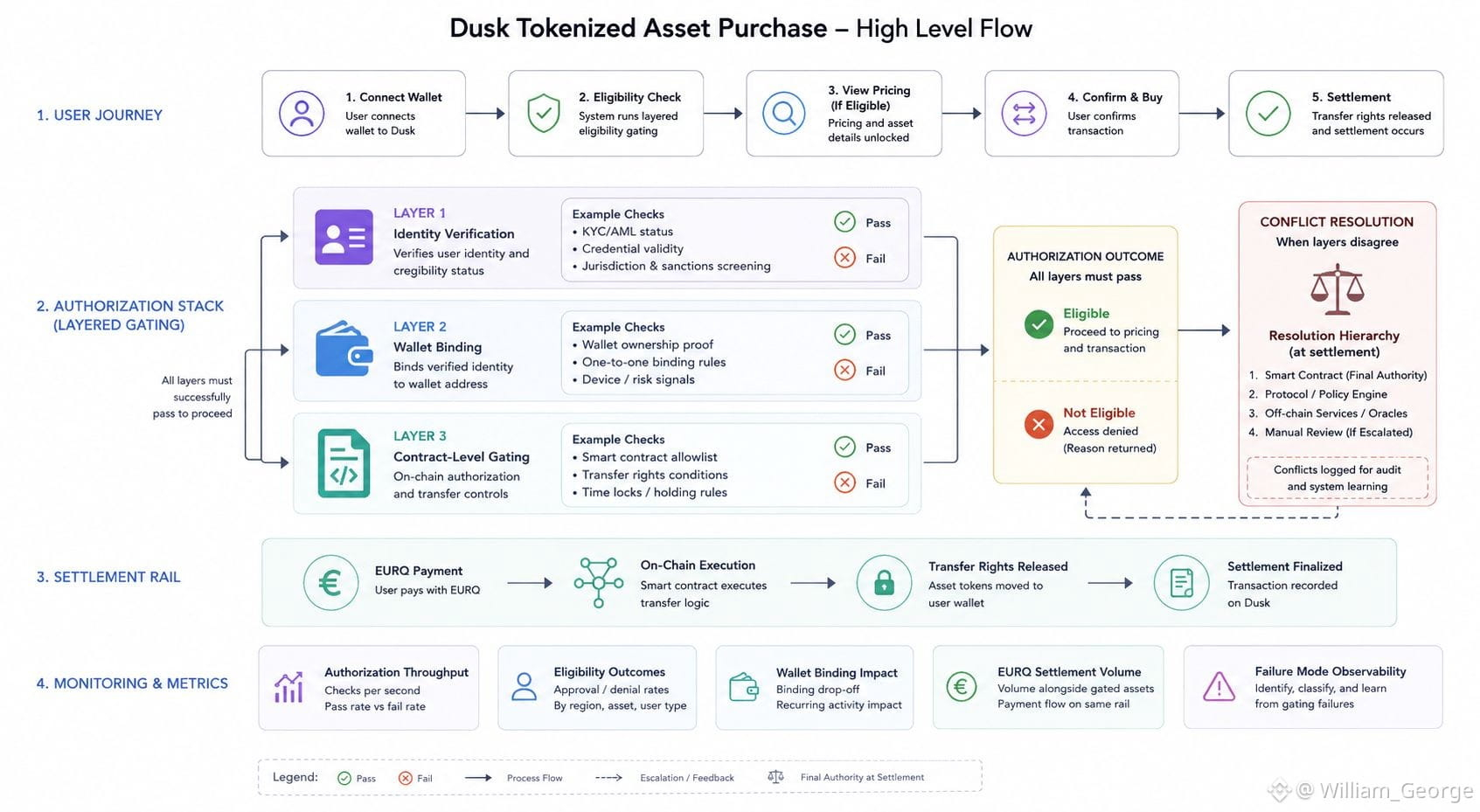

I noticed something odd while testing a wallet flow on Dusk last week. I assumed connecting and buying a tokenized asset would feel like any DeFi swap, fast, permissionless, done in one click. Instead the interface paused me at an eligibility step before I could even view pricing, and that pause is what stuck with me.
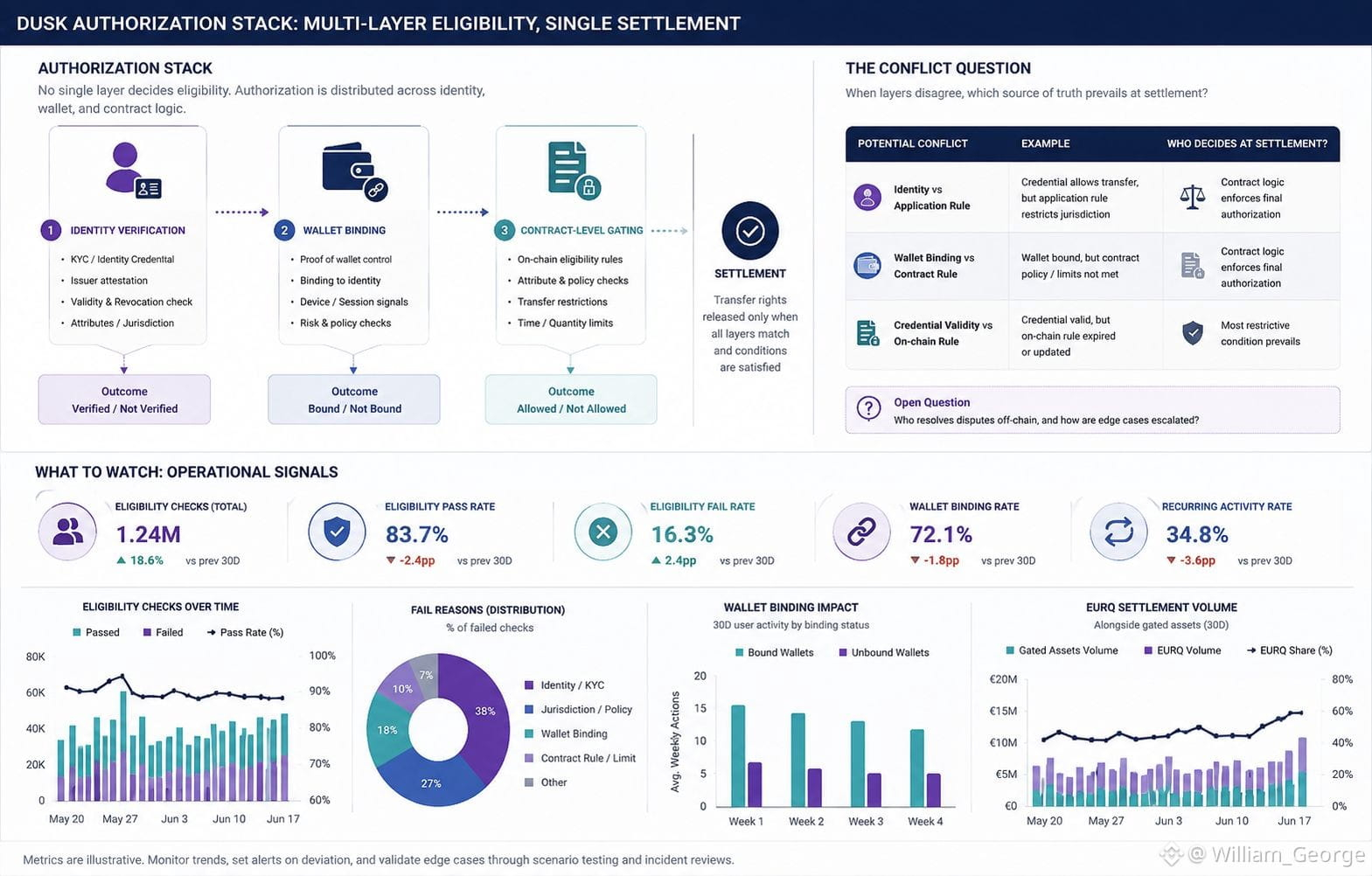
Digging further, I realized this wasn't a single permission check but several stacked together: identity verification, a wallet binding step, and contract-level gating that only released transfer rights once both conditions matched. No single layer decided eligibility alone, the authorization was distributed across the stack itself.
That distinction reframed how I think about "compliant" versus "gated." Most traders treat those as the same thing, but here compliance is the outcome while gating is the mechanism, and the mechanism itself has multiple independent checkpoints that could theoretically disagree with each other.
Which raises a real operational question for me: if a credential says one thing and an application-level rule says another, which one wins at settlement, and who resolves that conflict in practice. I don't have a clean answer, and I'm not sure the system has fully stress-tested that edge case yet.
Going forward I'm watching authorization throughput, how often eligibility checks fail versus pass, whether wallet-binding creates friction that suppresses recurring activity, and how EURQ settlement volume behaves alongside these gated assets, since payment flow and access flow now sit on the same rail.
I keep coming back to one open thought: does layering eligibility across identity, wallet, and contract logic make the system more resilient under stress, or does it just make failure modes harder to predict until one actually happens.
@Dusk #dusk $DUSK
Digging further, I realized this wasn't a single permission check but several stacked together: identity verification, a wallet binding step, and contract-level gating that only released transfer rights once both conditions matched. No single layer decided eligibility alone, the authorization was distributed across the stack itself.
That distinction reframed how I think about "compliant" versus "gated." Most traders treat those as the same thing, but here compliance is the outcome while gating is the mechanism, and the mechanism itself has multiple independent checkpoints that could theoretically disagree with each other.
Which raises a real operational question for me: if a credential says one thing and an application-level rule says another, which one wins at settlement, and who resolves that conflict in practice. I don't have a clean answer, and I'm not sure the system has fully stress-tested that edge case yet.
Going forward I'm watching authorization throughput, how often eligibility checks fail versus pass, whether wallet-binding creates friction that suppresses recurring activity, and how EURQ settlement volume behaves alongside these gated assets, since payment flow and access flow now sit on the same rail.
I keep coming back to one open thought: does layering eligibility across identity, wallet, and contract logic make the system more resilient under stress, or does it just make failure modes harder to predict until one actually happens.
@Dusk #dusk $DUSK