most networking layers get skipped over because they dont sound like they matter, but kadcast is doing something specificaly different from what most chains use.
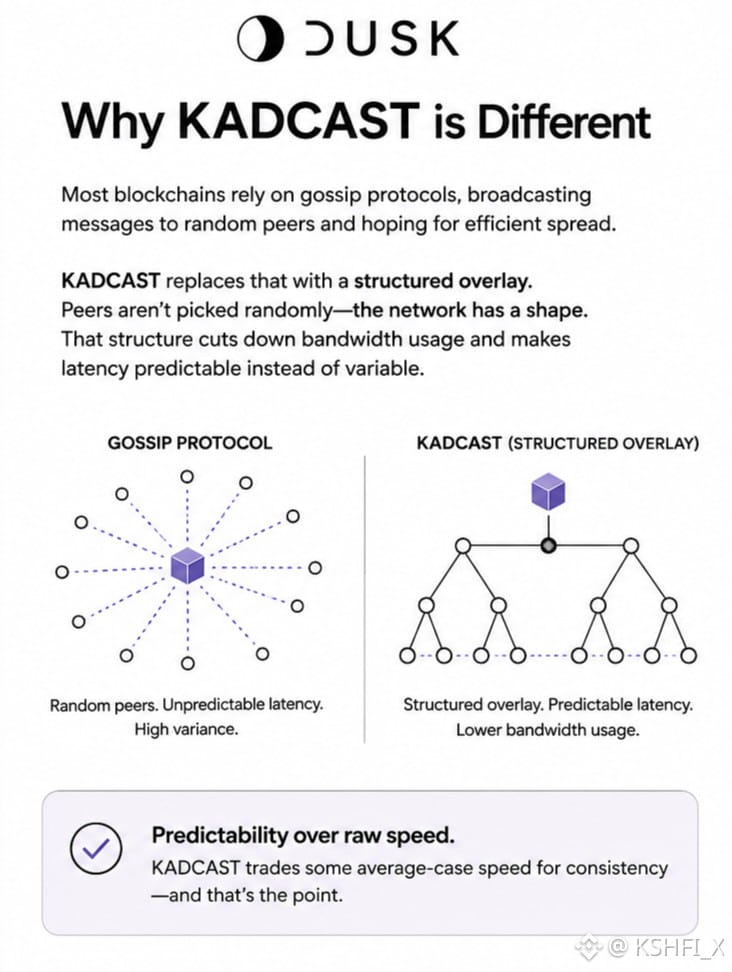
most blockchains rely on gossip protocols, where a message just gets broadcast to a random set of peers and hopes it spreads eficiently. kadcast replaces that.
with an structured overlay instead, peers arent picked randomly, the network has an actual shape to it. that.
structure is what cuts down bandwidth usage and makes latency predictable instead of variable.
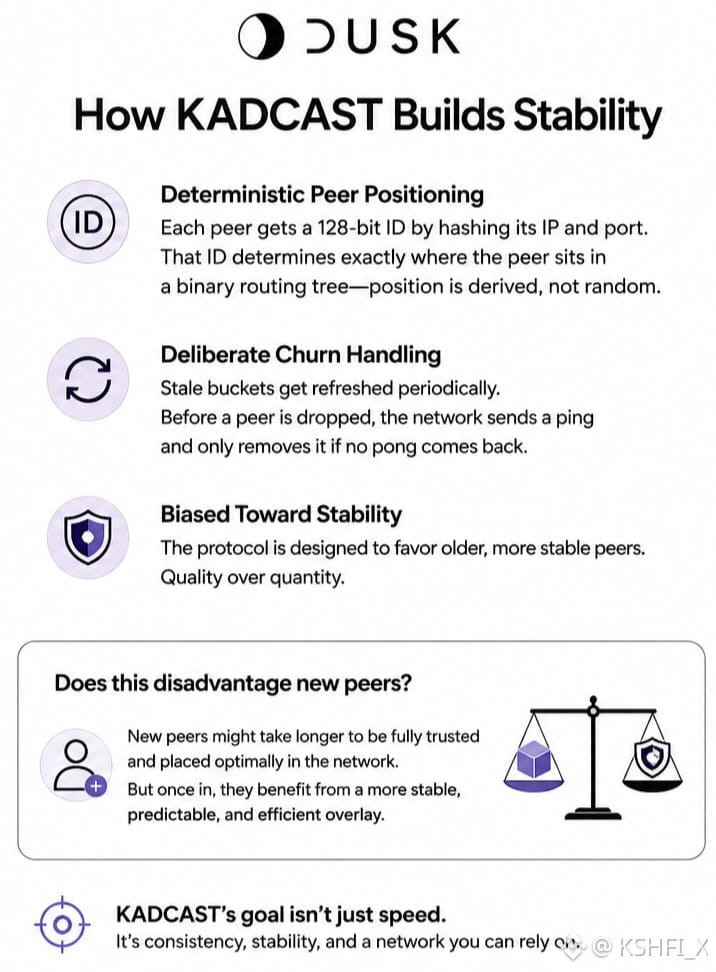
according to dusk's own kadcast repository, each peer.
gets a 128 bit id generated by hashing its port and ip together, and that id determines exactly where the peer sits in a binary routing tree. position isnt assigned.
randomly either, its derived directly from the hash.
what stands out is predictability seems to be the actual goal here, not just raw speed. a random gossip.
network might propagate fast on average but with high variance, while a structured overlay trades some of that average case speed for consistency.
turns out churn is handled deliberately too. stale buckets get refreshed periodically, and before a peer gets droped the network sends a ping and only.
removes it if the pong never comes back. the repo states outright that this makes the protocol biased toward older, more stable peers...
if the network favors long lived peers by design, does that create any disadvantage for a brand new peer trying to join for the first time??
#dusk @Dusk $DUSK
most blockchains rely on gossip protocols, where a message just gets broadcast to a random set of peers and hopes it spreads eficiently. kadcast replaces that.
with an structured overlay instead, peers arent picked randomly, the network has an actual shape to it. that.
structure is what cuts down bandwidth usage and makes latency predictable instead of variable.
according to dusk's own kadcast repository, each peer.
gets a 128 bit id generated by hashing its port and ip together, and that id determines exactly where the peer sits in a binary routing tree. position isnt assigned.
randomly either, its derived directly from the hash.
what stands out is predictability seems to be the actual goal here, not just raw speed. a random gossip.
network might propagate fast on average but with high variance, while a structured overlay trades some of that average case speed for consistency.
turns out churn is handled deliberately too. stale buckets get refreshed periodically, and before a peer gets droped the network sends a ping and only.
removes it if the pong never comes back. the repo states outright that this makes the protocol biased toward older, more stable peers...
if the network favors long lived peers by design, does that create any disadvantage for a brand new peer trying to join for the first time??
#dusk @Dusk $DUSK