I used to think the biggest advantage of blockchain was simple: put everything on a public ledger and let everyone verify it.
The more I looked at real financial markets, the more I questioned that idea.
Imagine a company moving millions, a fund changing its position, or an institution settling a trade. Do they really want every detail visible to everyone forever? Probably not. But hiding everything creates another problem: how do you prove that the rules were followed?
That’s the part of @DuskNetwork that caught my attention.
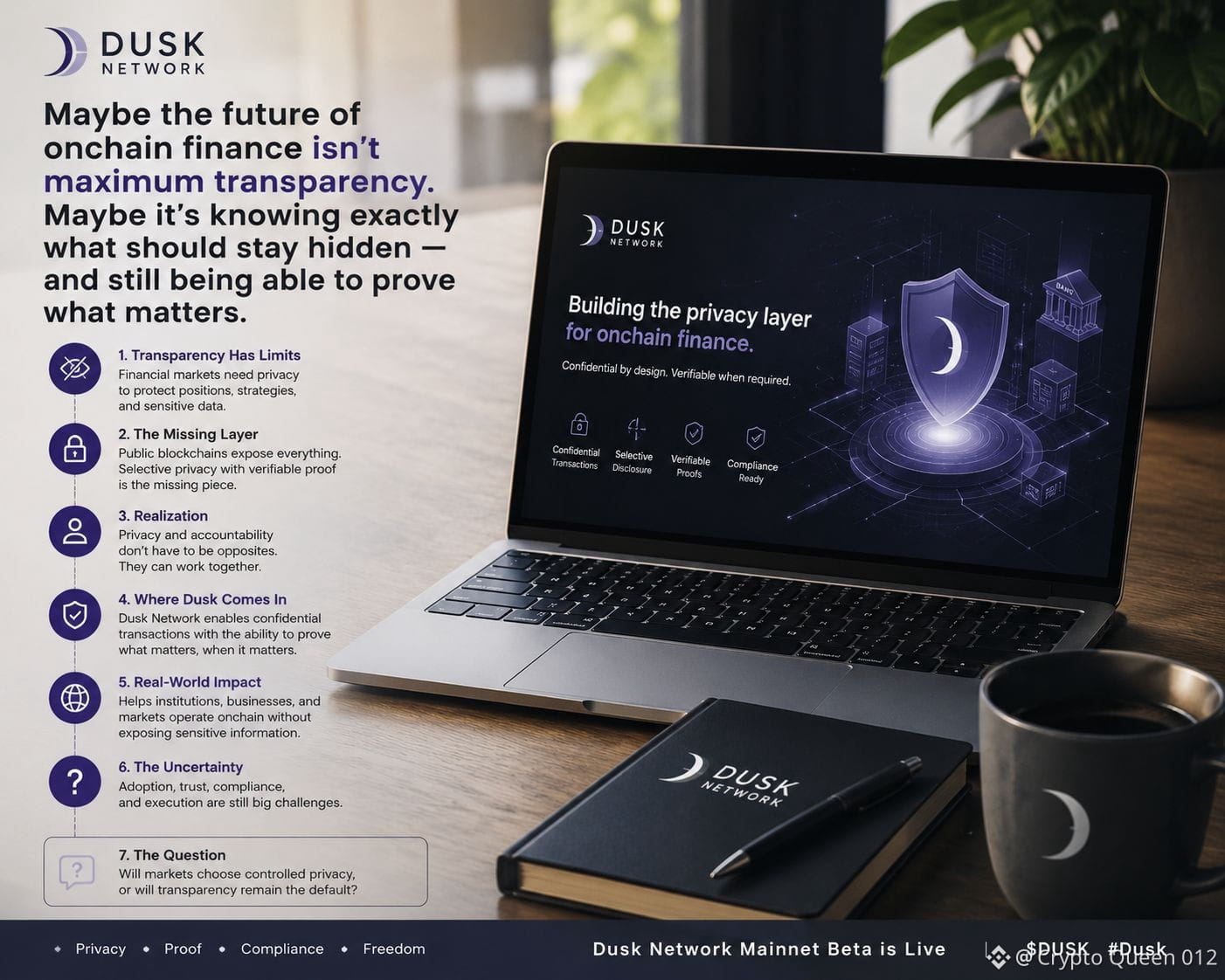
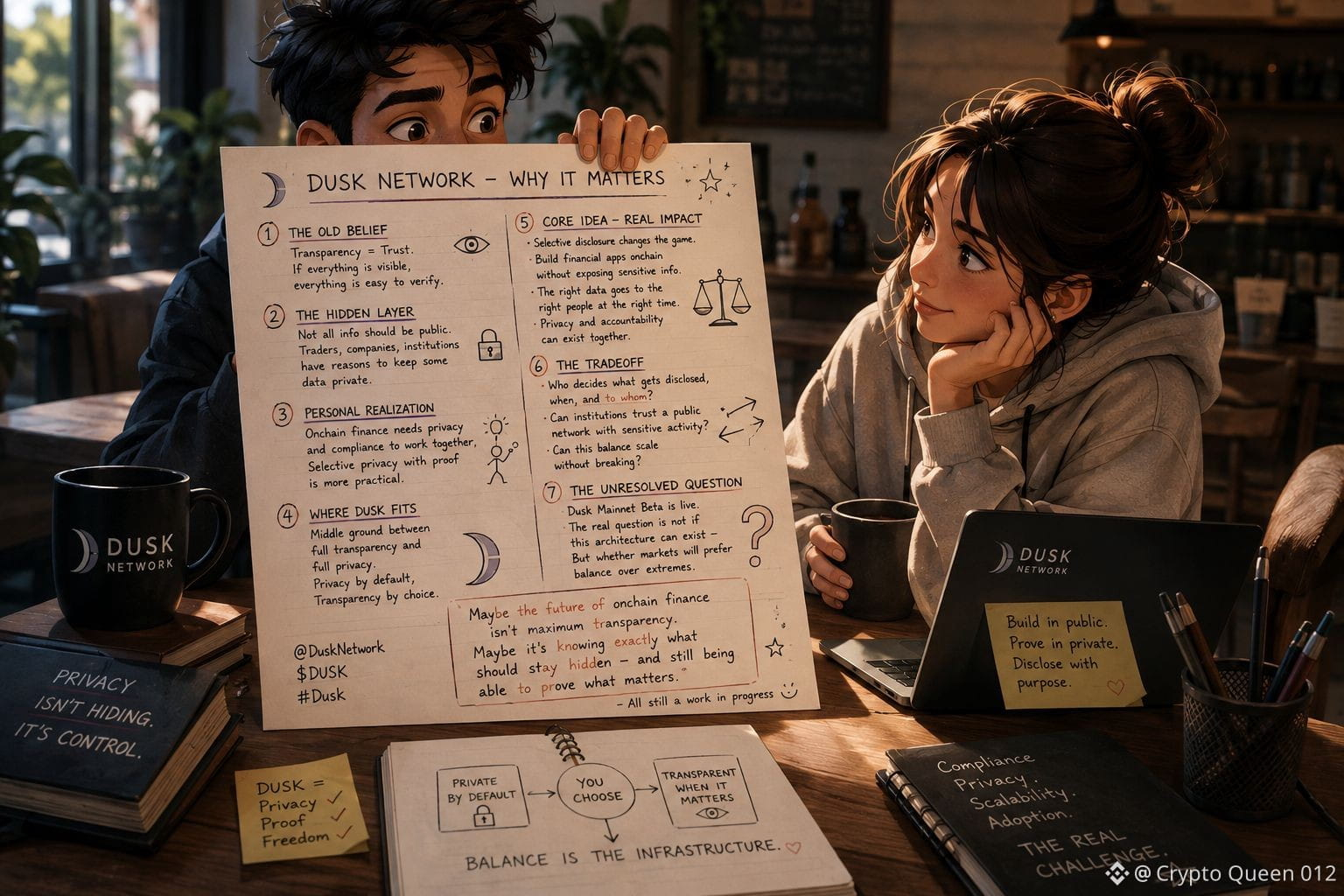
The interesting idea isn’t just putting “privacy” on a blockchain. It’s trying to find a middle ground where financial activity can stay confidential while the information that actually matters can still be verified when needed.
That sounds much more useful to me than simply making everything private.
But there’s a catch.
The technology can work and the market can still reject it. Institutions have compliance requirements, existing systems, legal processes and, above all, trust issues. Getting real financial activity onto a new network is a completely different challenge from proving that the infrastructure works.
With Dusk Network Mainnet Beta, this is becoming something that can be tested rather than just discussed.
I’m curious whether markets will eventually see controlled privacy as necessary infrastructure, or whether public blockchains will keep pushing toward maximum transparency.
Maybe the real breakthrough isn’t choosing privacy over transparency.
Maybe it’s deciding where each one actually belongs.
@Dusk $DUSK #dusk
The more I looked at real financial markets, the more I questioned that idea.
Imagine a company moving millions, a fund changing its position, or an institution settling a trade. Do they really want every detail visible to everyone forever? Probably not. But hiding everything creates another problem: how do you prove that the rules were followed?
That’s the part of @DuskNetwork that caught my attention.
The interesting idea isn’t just putting “privacy” on a blockchain. It’s trying to find a middle ground where financial activity can stay confidential while the information that actually matters can still be verified when needed.
That sounds much more useful to me than simply making everything private.
But there’s a catch.
The technology can work and the market can still reject it. Institutions have compliance requirements, existing systems, legal processes and, above all, trust issues. Getting real financial activity onto a new network is a completely different challenge from proving that the infrastructure works.
With Dusk Network Mainnet Beta, this is becoming something that can be tested rather than just discussed.
I’m curious whether markets will eventually see controlled privacy as necessary infrastructure, or whether public blockchains will keep pushing toward maximum transparency.
Maybe the real breakthrough isn’t choosing privacy over transparency.
Maybe it’s deciding where each one actually belongs.
@Dusk $DUSK #dusk