
Fahmi_
952 投稿

Fahmi_
取引を発注
超高頻度トレーダー
11か月
92 フォロー
7.7K+ フォロワー
1.9K+ いいね
投稿
ポートフォリオ
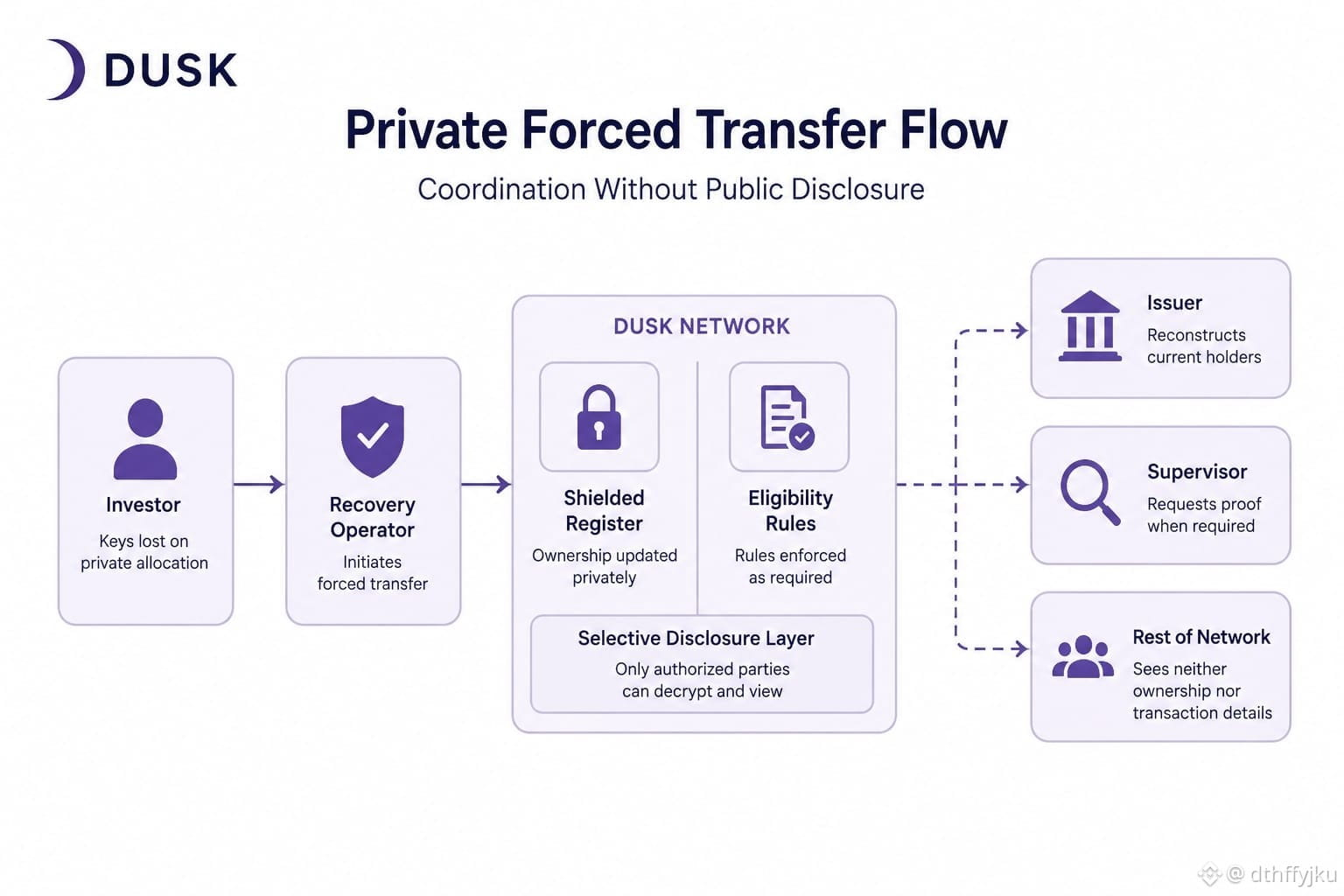
#dusk $DUSK @Dusk 今朝、強制移転の申請がキューに滞留しているのを見ていました。投資家は、プライベートの持分割当に関する鍵を失ってしまいました。リカバリー(復旧)オペレーターが移動を押し出したのです。通常のチェーンなら秒単位でエクスプローラーが点灯するはずです――新しいアドレス、金額、そして全ての履歴の痕跡まで。しかしここでは残高が動いたのに、公開側は静かなままでした。許可された領域の外からは何も見えません。
その沈黙はいまも私の目に焼き付いています。ほとんどのシステムでは、透明性がデフォルトの協調レイヤーです。全員が見られるから全員が検証できる。プライベート企業はそのやり方では運用できません。所有関係のグラフは競争データであり、規制上のリスクであり、場合によっては個人的な危険でもあります。だからプロトコルはデフォルトを反転させます。登録情報は保護されたまま。適格性のルールは引き続き作動します。必要な復号経路を持つ当事者だけが、必要な範囲のビューを得られる。発行者は現在の保有者を再構成します。監督者は必要に応じて証明を要求する。ネットワークの残りは何も見えません。
挙動は小さなところで変わります。移転エージェントは、あらゆるリカバリーを潜在的な開示イベントとして扱うのをやめます。投資家は、セカンダリー売却で自分のポジションサイズのどれだけが漏れるかを計算しなくなります。強制移転のルート自体は機能するので、鍵は回収され、裁判所の命令もきちんと届きます。公開の掲示板なしで協調が行われるのです。
同時にプライベートの発行が増えていくときに、この仕組みが持続するかはわかりません。選択的開示の経路は、負荷の下でも締め付けておく必要があります。リカバリーオペレーターには、過剰に可視性を要求しないための明確なインセンティブが要ります。次のリカバリーサイクルと、その後に続くセカンダリー移転を見守るつもりです。
その沈黙はいまも私の目に焼き付いています。ほとんどのシステムでは、透明性がデフォルトの協調レイヤーです。全員が見られるから全員が検証できる。プライベート企業はそのやり方では運用できません。所有関係のグラフは競争データであり、規制上のリスクであり、場合によっては個人的な危険でもあります。だからプロトコルはデフォルトを反転させます。登録情報は保護されたまま。適格性のルールは引き続き作動します。必要な復号経路を持つ当事者だけが、必要な範囲のビューを得られる。発行者は現在の保有者を再構成します。監督者は必要に応じて証明を要求する。ネットワークの残りは何も見えません。
挙動は小さなところで変わります。移転エージェントは、あらゆるリカバリーを潜在的な開示イベントとして扱うのをやめます。投資家は、セカンダリー売却で自分のポジションサイズのどれだけが漏れるかを計算しなくなります。強制移転のルート自体は機能するので、鍵は回収され、裁判所の命令もきちんと届きます。公開の掲示板なしで協調が行われるのです。
同時にプライベートの発行が増えていくときに、この仕組みが持続するかはわかりません。選択的開示の経路は、負荷の下でも締め付けておく必要があります。リカバリーオペレーターには、過剰に可視性を要求しないための明確なインセンティブが要ります。次のリカバリーサイクルと、その後に続くセカンダリー移転を見守るつもりです。
翻訳参照
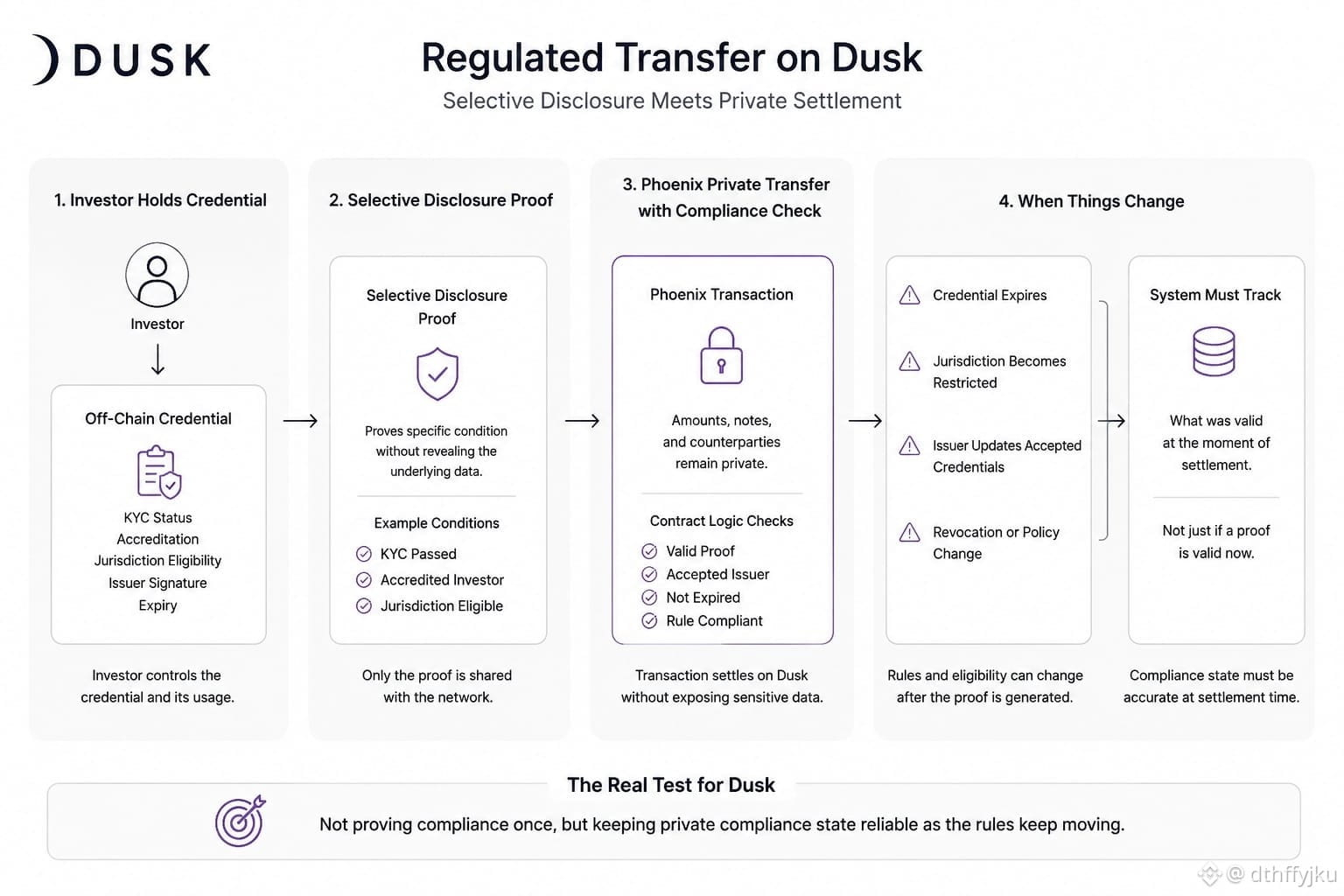
#dusk $DUSK @Dusk I noticed the awkward part while thinking through a regulated transfer: the investor had already passed the eligibility check, but the underlying credential could change before settlement. That small gap matters more than the initial proof.
It made me look at Dusk differently. The useful part of selective disclosure isn't simply that an investor can hide their identity. It's that the network can verify a specific condition without dragging the rest of the investor's financial history into the transaction. KYC status, accreditation, or jurisdiction eligibility can sit behind a credential, while the chain only receives the proof needed for that particular rule.
Phoenix handles a different piece. The transaction itself can keep amounts, notes, and counterparties private, while contract logic checks whether the transfer is permitted. So privacy and compliance aren't really fighting over the same data.
But the messy part starts when something changes. A credential expires. A jurisdiction becomes restricted. An issuer changes which credentials it accepts. Now the system has to know not only whether a proof was valid, but what was valid when settlement actually happened.
That feels like the harder test for Dusk. Not proving compliance once, but keeping private compliance state reliable as the rules keep moving.
It made me look at Dusk differently. The useful part of selective disclosure isn't simply that an investor can hide their identity. It's that the network can verify a specific condition without dragging the rest of the investor's financial history into the transaction. KYC status, accreditation, or jurisdiction eligibility can sit behind a credential, while the chain only receives the proof needed for that particular rule.
Phoenix handles a different piece. The transaction itself can keep amounts, notes, and counterparties private, while contract logic checks whether the transfer is permitted. So privacy and compliance aren't really fighting over the same data.
But the messy part starts when something changes. A credential expires. A jurisdiction becomes restricted. An issuer changes which credentials it accepts. Now the system has to know not only whether a proof was valid, but what was valid when settlement actually happened.
That feels like the harder test for Dusk. Not proving compliance once, but keeping private compliance state reliable as the rules keep moving.
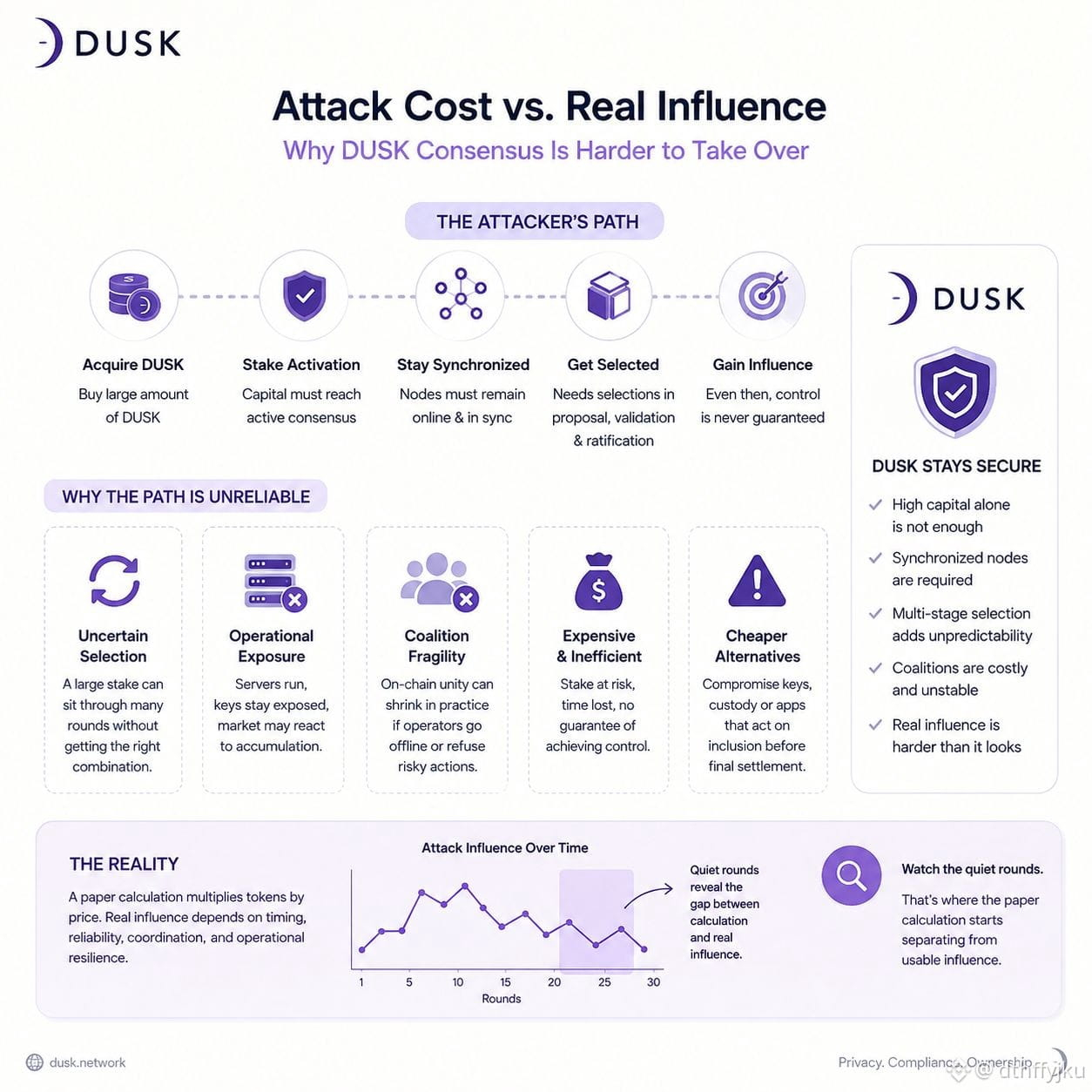
#dusk $DUSK @Dusk 私は、プロビジョナーが候補ブロックをブロードキャストできずに失敗し、リトライしてから1ラウンド後に返ってくるのを見つけました。大ごとにはなりませんでした。夕暮れは動き続けましたが、その出来事で私の攻撃コスト見積もりが不完全に見えるようになりました。私は、購入したステークがそのまま支配に直結するかのように、DUSKの目標額に市場価格を掛けていました。でも、それほどきれいには振る舞いません。資本はアクティブなコンセンサスに到達する必要があり、ノードは同期したままでいる必要があり、攻撃者はさらに、提案・検証・確定(ratification)にまたがって有用な選択肢を手にする必要があります。大きな敵対的ポジションであっても、必要な組み合わせが得られないまま数ラウンドをやり過ごすことがありえます。待機中もサーバーは動き続けます。鍵は露出したままです。市場はすでに、積み上げに反応しているかもしれません。そして、オンチェーン上で統一して見えるコアリションも、1人のオペレーターがオフラインになったり、自分たちのステークの一部を燃やしてしまう可能性のある行動を拒否したりすると、実際にはずっと小さくなりえます。いまは、合理的な攻撃者がこのルートを最後まで完走するとは、以前より確信が持てません。オペレーターの鍵、保管(custody)システム、または最終決済前のインクルージョンに反応するアプリケーションを侵害できれば、より安い撹乱で済むかもしれません。コンセンサスは保たれたまま、別の誰かが誤った状態に基づいて行動することもありえます。長く不均一な選択ウィンドウの間、プロビジョナーの集中したグループが稼働するのを観察したいです。特に静かなラウンドこそ、論文の計算が「使える影響力」と分岐し始める場所なのだと思います。
翻訳参照
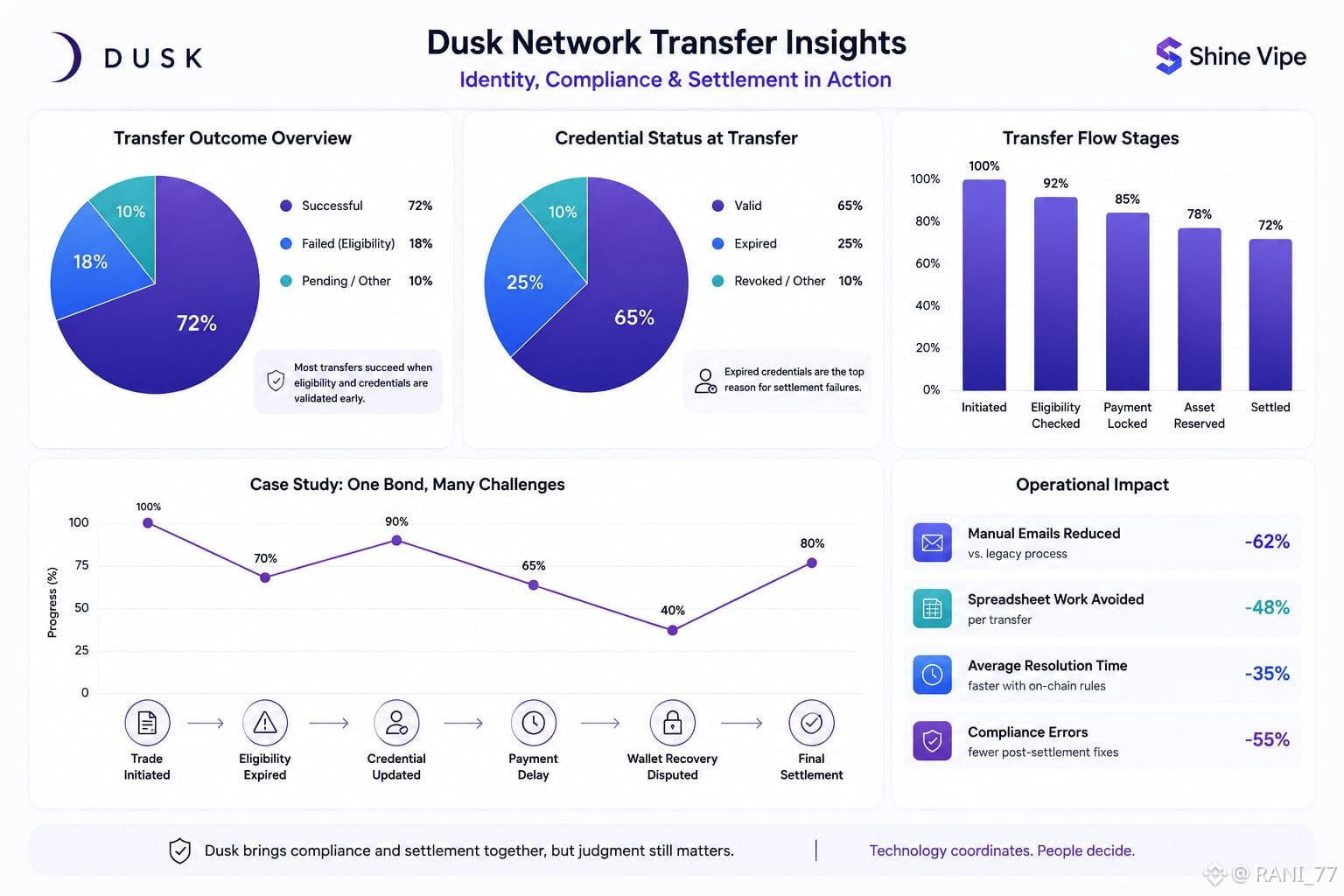
#dusk $DUSK @Dusk I noticed the problem when a transfer failed just before settlement because the buyer’s eligibility credential had expired. The asset was valid, the payment was ready, and both parties expected the trade to close. Still, Dusk rejected it. My first reaction was that the wallet binding had introduced another point of friction. That was probably too simple. Letting the transfer pass would have pushed the compliance problem somewhere else, most likely onto an operations team trying to repair the ownership record afterward. The ledger was certain. The people were not. What interested me was how the failed transfer changed everyone’s behavior: the venue checked eligibility earlier, the investor updated the credential, and the issuer had to decide how much authority it should retain over freezes and recovery. That last part still feels uncomfortable. Recovery powers are useful when a key is lost or a court order arrives, but somebody controls those powers, and a poorly defined intervention can become a larger risk than the original failure. Dusk can coordinate identity conditions, restricted transfers, selective disclosure, and final settlement, but those mechanics do not remove judgment. They move it closer to the transaction. I would want to watch one tokenized bond survive an expired credential, a delayed payment leg, and a disputed wallet recovery—preferably during the same reporting period—and see how much work still escapes into emails and spreadsheets.
翻訳参照
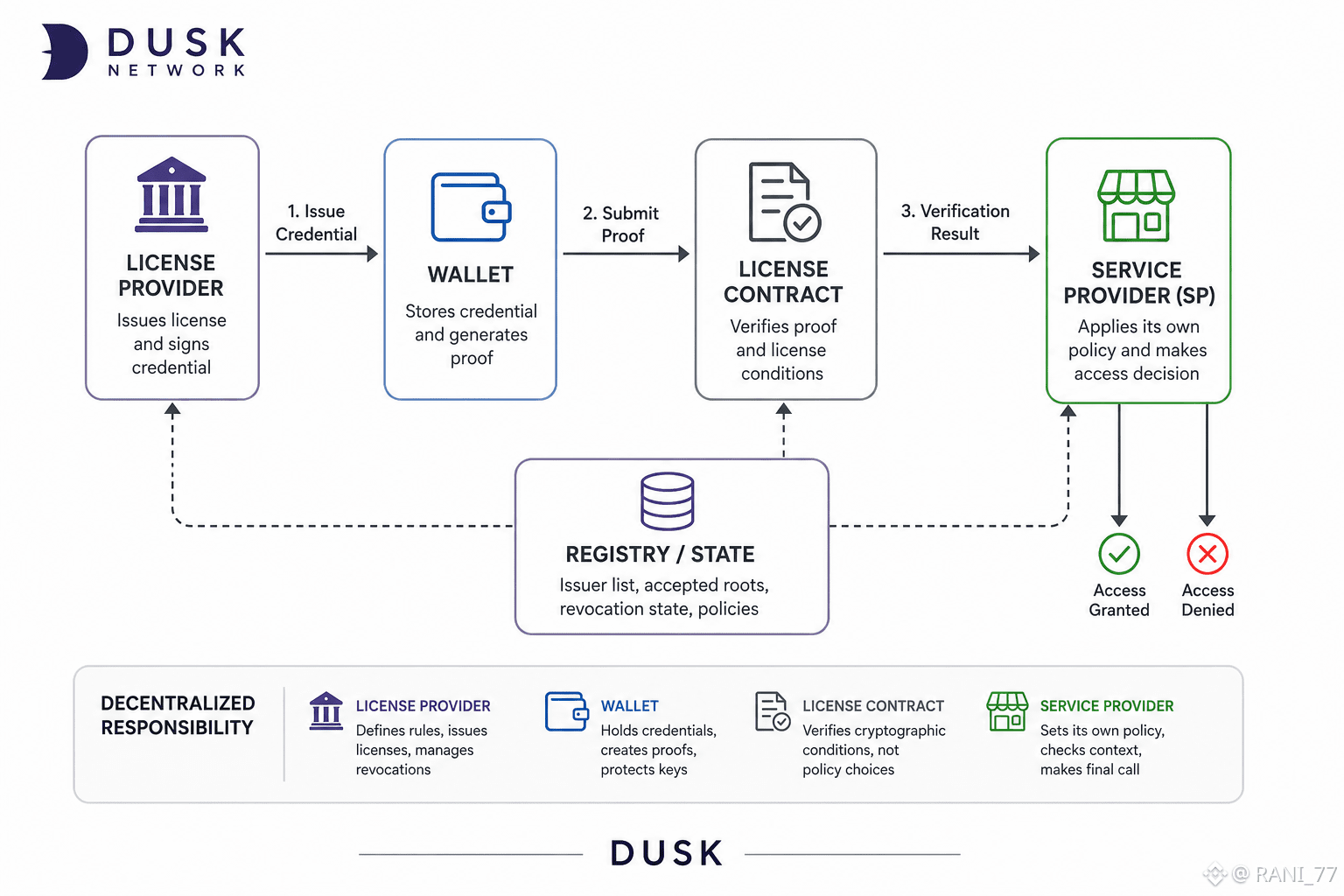
#dusk $DUSK I noticed the awkward part when a license proof passed but the service still had a reason to refuse it. At first I treated that like a coordination bug. The credential had been issued, the hidden license belonged to an accepted registry state, and the contract could verify the proof. What else was left? Quite a bit, apparently. Dusk’s License Contract can establish that the cryptographic conditions around a license are sound, but it does not force every Service Provider to trust the same issuer or accept the same policy. I had been treating verification as the end of the process. It clearly isn’t. An SP can still care whether the issuer is acceptable, whether the root is recent enough, or whether that particular session should be usable again. That shifts responsibility around more than I expected. Some of it sits with the License Provider, some with the contract, then the wallet carries part of it, and eventually the SP makes its own call. Useful separation, maybe, but it also creates places where state can drift. A proof could still be correct while policy has already moved somewhere else. What I would watch next is what happens when issuer rules, revocation state, and accepted roots start changing quickly across several services. That is probably where this design stops looking tidy.@Dusk
翻訳参照
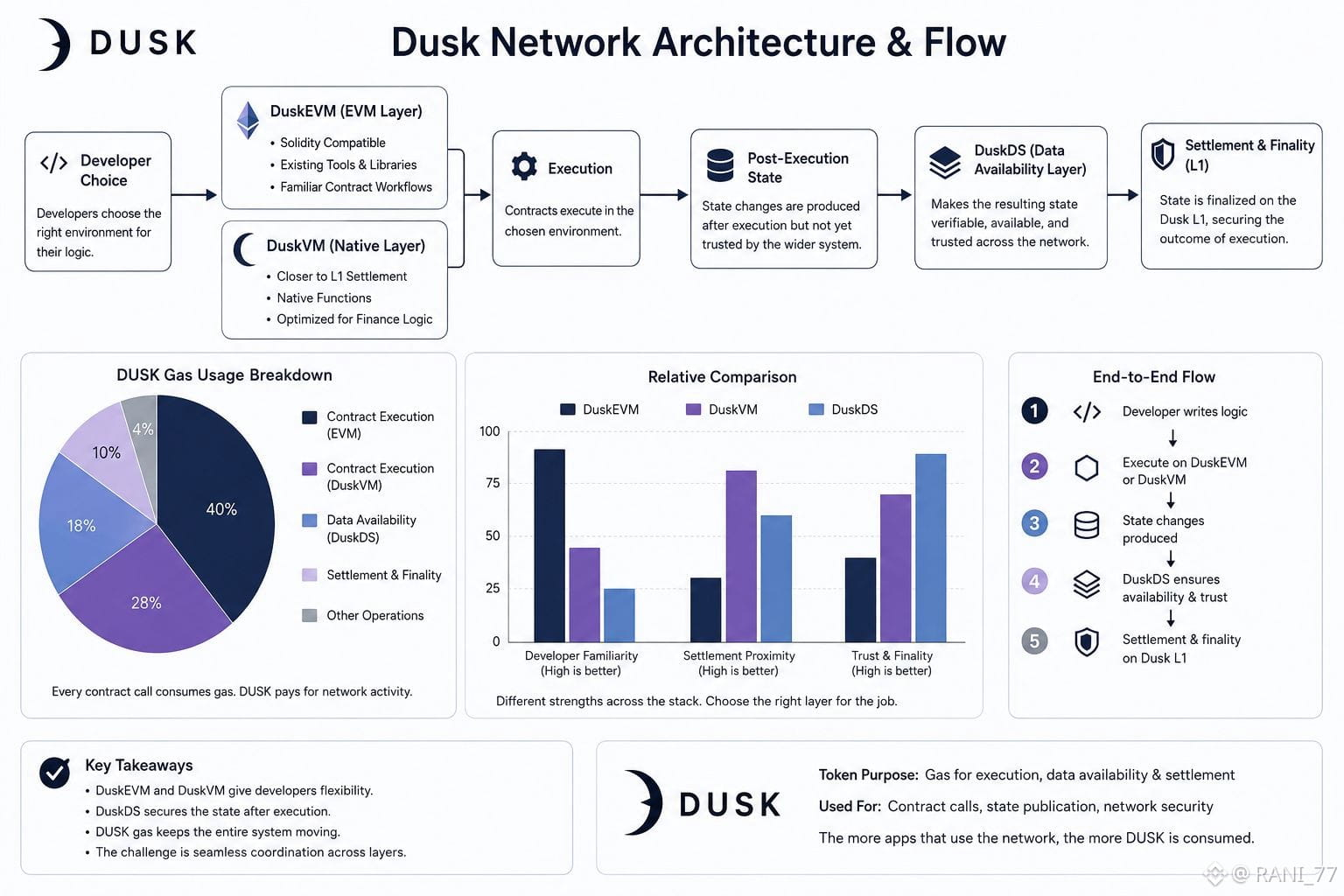
#dusk $DUSK $HEMI $COW @Dusk I was looking at a contract flow that worked fine on the EVM side until one part of the logic needed to sit closer to settlement. Nothing had failed exactly, but the design suddenly felt less obvious. That is where Dusk started making more sense to me. DuskEVM gives developers the familiar route Solidity, existing tooling, normal contract workflows but not every financial function necessarily belongs there. Some logic may fit better on DuskVM, closer to the native L1 environment. The choice sounds flexible, but it also creates another coordination surface. Two execution environments mean more decisions, more integration work, and probably more places for assumptions to drift. I kept coming back to the moment after execution when the contract has done its job but the resulting state still needs to become something the wider system can trust. DuskDS matters there more than it does in a clean architecture diagram. DUSK also stops looking like an abstract utility token once repeated contract calls start consuming gas; somebody has to keep paying for that activity. Maybe the architecture works well at small scale. The real test will be whether applications can keep moving between familiar EVM logic, native functions, and settlement without developers spending more time coordinating the stack than building the finance on top of it.
翻訳参照
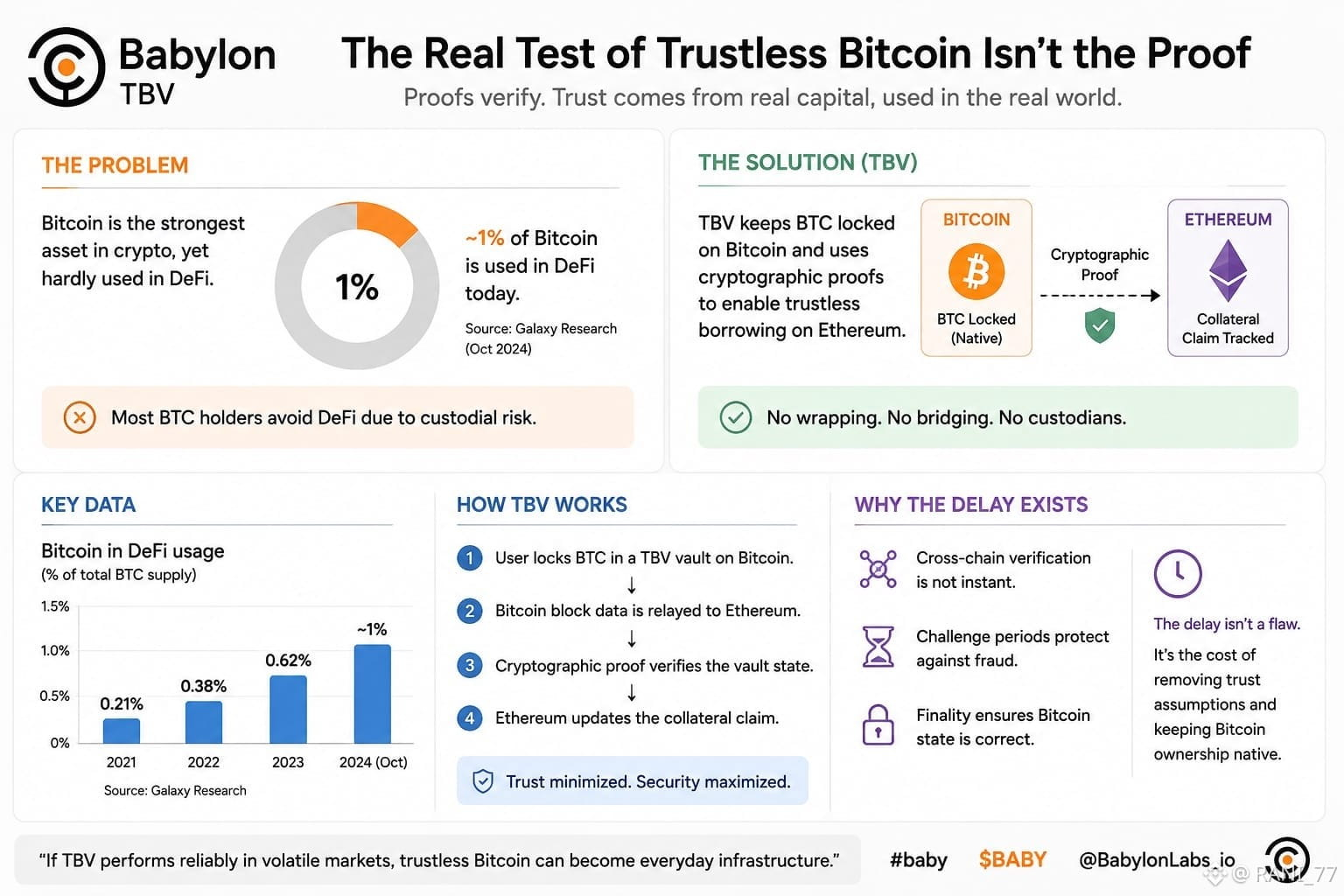
I keep asking myself: what really proves Trustless Bitcoin works if cryptographic proofs already verify every vault? The answer isn't the proof itself. The real test begins after verification, when real users trust the system with meaningful capital. TBV keeps BTC locked on Bitcoin instead of wrapping or bridging it, while Ethereum tracks a cryptographic claim about that collateral. That shifts trust away from custodians and toward verifiable cryptography, Bitcoin, Ethereum, and the application layer. Around only 1% of Bitcoin is used in DeFi today, largely because many holders reject custodial risk. TBV directly targets that problem by keeping ownership native while enabling borrowing through cryptographic verification rather than intermediaries. Proofs, however, are never instant. They depend on cross-chain verification, challenge periods, and finality before collateral state is fully recognized. That delay isn't a flaw it's the cost of reducing trust assumptions instead of hiding them behind convenience. If the system continues performing reliably during volatile markets, users may accept waiting because security matters more than speed. I think that moment will reveal whether trustless Bitcoin becomes everyday infrastructure or simply another clever design admired mostly by builders. #baby
$BABY @BabylonLabs_io
$BABY @BabylonLabs_io
翻訳参照
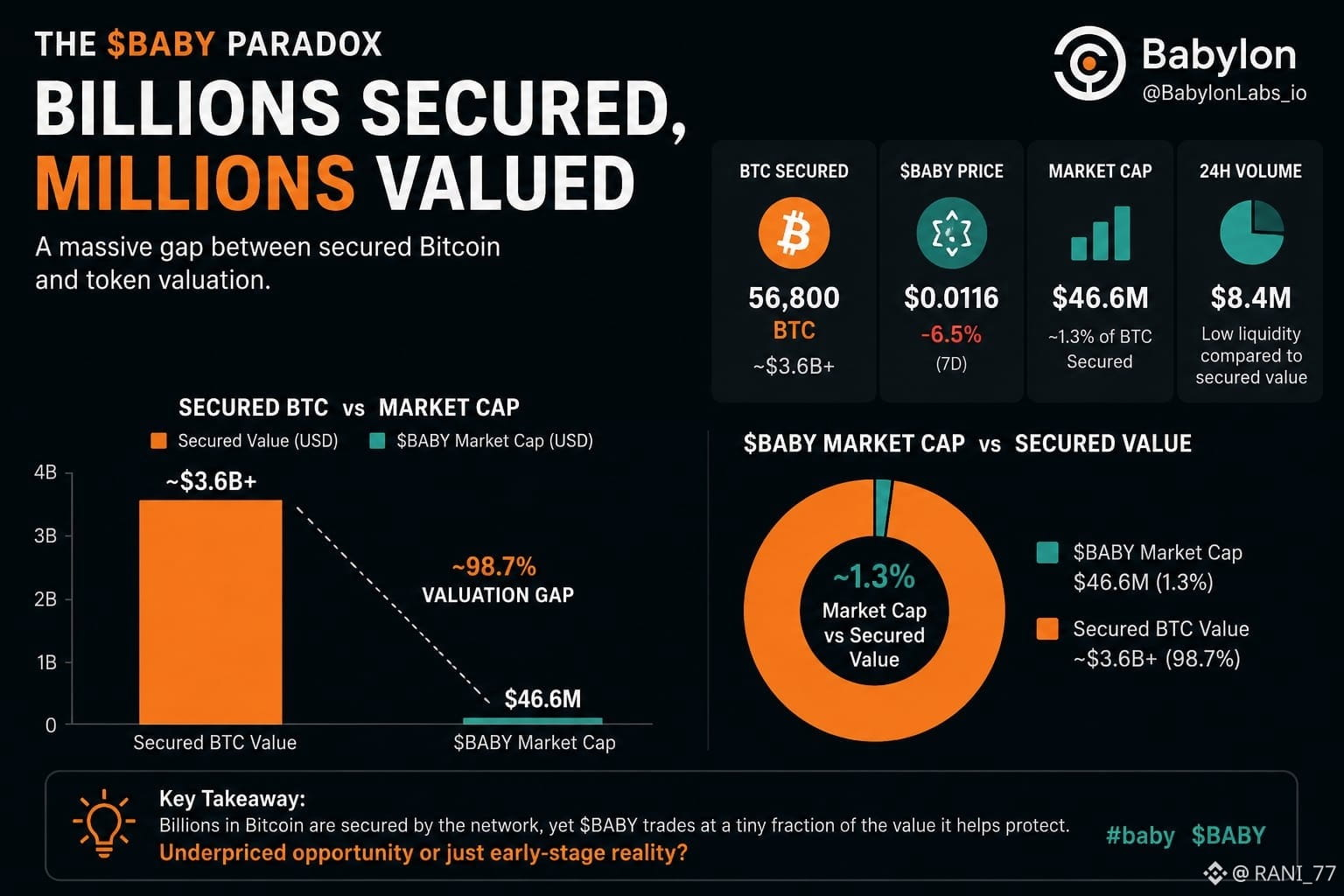
I still can't get past this: 56,800 BTC are helping secure a system while the token tied to governing it sits around $46.6M in market value. That disconnect is far more interesting to me than another price chart.
The market snapshot says $BABY traded near $0.0116, down 6.5% over the week, with roughly $8.4M in 24 hour volume. Yet the vaults are still securing about 56,800 BTC. When I compare billions in protected Bitcoin against a valuation measured in tens of millions, I see a gap that's difficult to ignore.
The problem isn't that the underlying design appears broken. Bitcoin stays on its native chain through Taproot instead of being wrapped somewhere else, so users aren't relying on a synthetic version of BTC just to put their capital to work. At the same time, protocols can benefit from productive Bitcoin while borrowers gain access to real liquidity. That changes the conversation from trusting bridges to using Bitcoin without giving up its native security model.
What fascinates me is that governance value and secured value are telling completely different stories. A token responsible for decisions around infrastructure protecting billions can still trade as if the market barely notices. That's not proof the token is mispriced, but it does raise a question about whether investors are valuing current sentiment more than long-term network importance.
I keep coming back to the same thought: if this system continues expanding while protecting more Bitcoin, does the market eventually close that valuation gap, or is this simply how early infrastructure gets priced? #baby $BABY @BabylonLabs_io
The market snapshot says $BABY traded near $0.0116, down 6.5% over the week, with roughly $8.4M in 24 hour volume. Yet the vaults are still securing about 56,800 BTC. When I compare billions in protected Bitcoin against a valuation measured in tens of millions, I see a gap that's difficult to ignore.
The problem isn't that the underlying design appears broken. Bitcoin stays on its native chain through Taproot instead of being wrapped somewhere else, so users aren't relying on a synthetic version of BTC just to put their capital to work. At the same time, protocols can benefit from productive Bitcoin while borrowers gain access to real liquidity. That changes the conversation from trusting bridges to using Bitcoin without giving up its native security model.
What fascinates me is that governance value and secured value are telling completely different stories. A token responsible for decisions around infrastructure protecting billions can still trade as if the market barely notices. That's not proof the token is mispriced, but it does raise a question about whether investors are valuing current sentiment more than long-term network importance.
I keep coming back to the same thought: if this system continues expanding while protecting more Bitcoin, does the market eventually close that valuation gap, or is this simply how early infrastructure gets priced? #baby $BABY @BabylonLabs_io
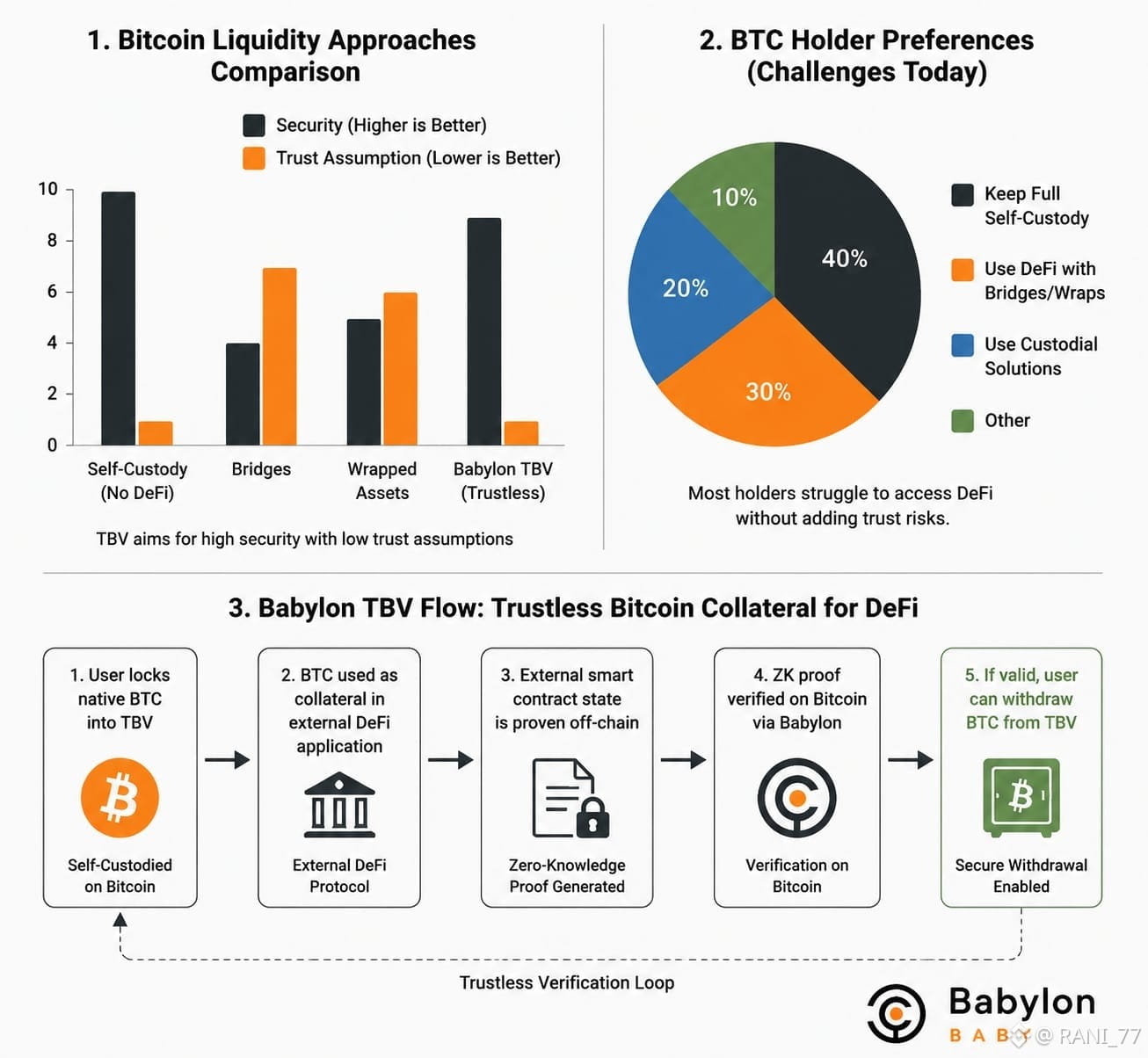
私はDeFiにおけるビットコインの最大の課題はセキュリティではなく、互換性だと考えています。ビットコインの最も強い特徴である保守的なセキュリティモデルは、同時に、ほとんどのBTCを生産的な金融アプリケーションから切り離したままにしてきました。重要なのは、保有者が、ビットコインを担保として使うことで価値の源である原則を犠牲にせずに済むのか、という点です。
$BABY そしてBabylonの信頼不要なビットコイン・ボールト(TBV)は、別のアプローチを提示します。現在、多くのBTC保有者は、完全なセルフカストディを維持するか、ブリッジ、ラップド資産、カストディアル・システムを通じて追加のリスクを受け入れるかの選択を迫られています。これらの方法は流動性を生みますが、ビットコイン本来の設計にはない、新たな信頼の前提も導入してしまいます。
TBVは、そのビットコインを外部のDeFiアプリケーションに接続しつつ、ネイティブBTCをセルフカストディ型のオンチェーン・ボールトにロックできるようにすることで、枠組みを変えます。重要な革新は、単にBTCを別の場所で使えるようにすることではありません。外部スマートコントラクトの状態に関するゼロ知識証明が、Babylonの暗号学的メカニズムによってビットコイン上で検証された後にのみ、引き出しを許可する「検証レイヤー」を作ることです。
私の見解では、Babylonの競争上の優位性は、信頼を検証に置き換える点にあります。ラッピングやブリッジはビットコインを別の環境へ移し、ユーザーに接続を信じさせます。TBVは、その接続そのものを検証可能にしようとします。これは、機関による約束ではなく暗号学的な証拠によってセキュリティ関係が強制されるため、よりクリーンな協調(コーディネーション)のモデルになります。
ただし、革新だけでは導入(アダプション)を保証できません。@BabylonLabs_io に対する本当の試金石は実行力です。つまり、このアーキテクチャがスケールでき、アプリケーションを惹きつけ、テクノロジーの物語を超えて$BABY に対する持続可能な需要を生み出せることを証明できるかどうかです。
ビットコインのユーティリティの未来は、BTCをより柔軟にすることよりも、ビットコインとのやり取りをより信頼できるものにすることに、より左右されるかもしれません。Babylonは、この検証による優位性を、長く続くエコシステム上の優位性へと転換できるでしょうか?
#baby
$BABY そしてBabylonの信頼不要なビットコイン・ボールト(TBV)は、別のアプローチを提示します。現在、多くのBTC保有者は、完全なセルフカストディを維持するか、ブリッジ、ラップド資産、カストディアル・システムを通じて追加のリスクを受け入れるかの選択を迫られています。これらの方法は流動性を生みますが、ビットコイン本来の設計にはない、新たな信頼の前提も導入してしまいます。
TBVは、そのビットコインを外部のDeFiアプリケーションに接続しつつ、ネイティブBTCをセルフカストディ型のオンチェーン・ボールトにロックできるようにすることで、枠組みを変えます。重要な革新は、単にBTCを別の場所で使えるようにすることではありません。外部スマートコントラクトの状態に関するゼロ知識証明が、Babylonの暗号学的メカニズムによってビットコイン上で検証された後にのみ、引き出しを許可する「検証レイヤー」を作ることです。
私の見解では、Babylonの競争上の優位性は、信頼を検証に置き換える点にあります。ラッピングやブリッジはビットコインを別の環境へ移し、ユーザーに接続を信じさせます。TBVは、その接続そのものを検証可能にしようとします。これは、機関による約束ではなく暗号学的な証拠によってセキュリティ関係が強制されるため、よりクリーンな協調(コーディネーション)のモデルになります。
ただし、革新だけでは導入(アダプション)を保証できません。@BabylonLabs_io に対する本当の試金石は実行力です。つまり、このアーキテクチャがスケールでき、アプリケーションを惹きつけ、テクノロジーの物語を超えて$BABY に対する持続可能な需要を生み出せることを証明できるかどうかです。
ビットコインのユーティリティの未来は、BTCをより柔軟にすることよりも、ビットコインとのやり取りをより信頼できるものにすることに、より左右されるかもしれません。Babylonは、この検証による優位性を、長く続くエコシステム上の優位性へと転換できるでしょうか?
#baby
翻訳参照
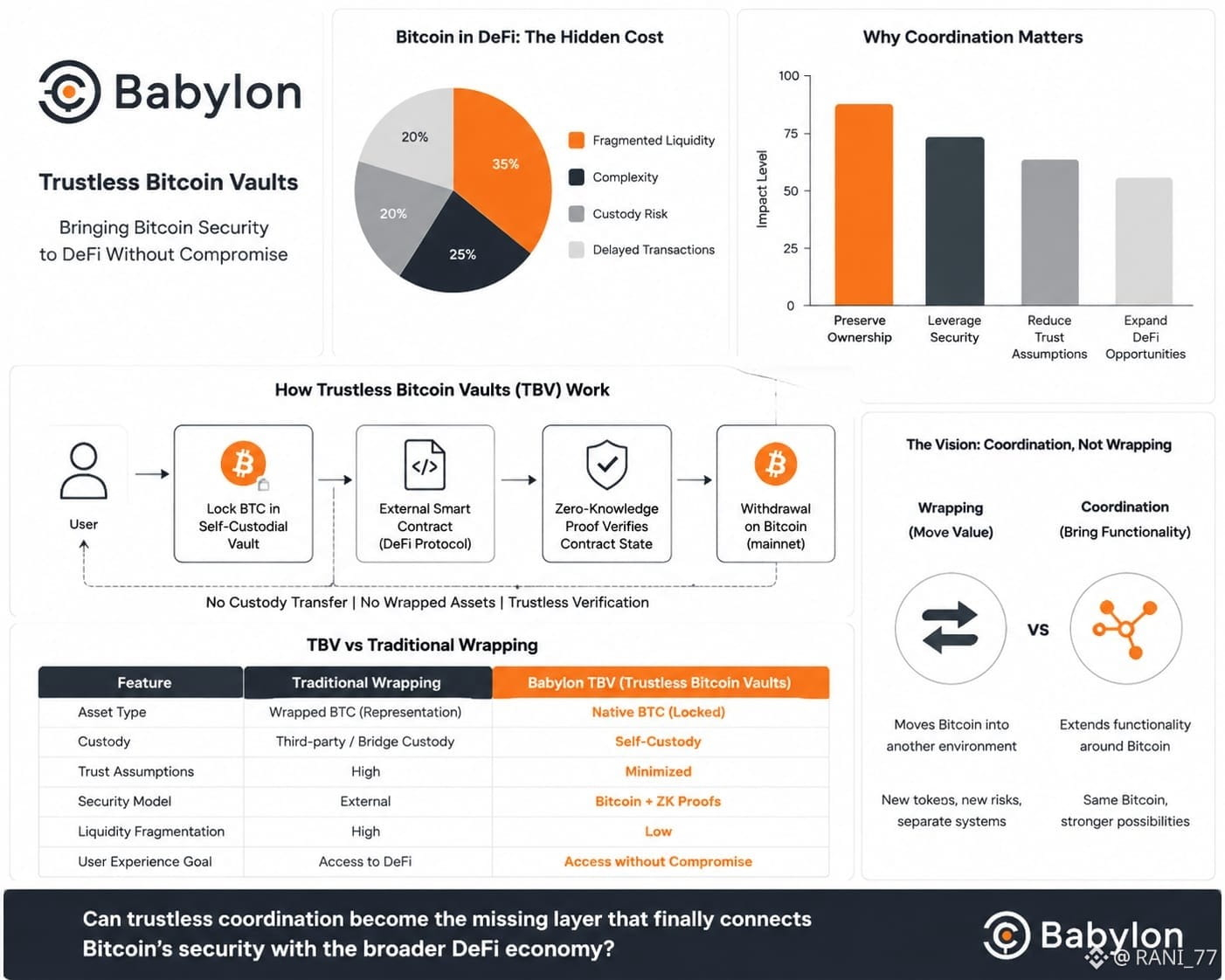
i believe the biggest challenge for Bitcoin in DeFi is not demand, but the hidden cost of participation. Every time BTC moves into another ecosystem, users often exchange simplicity for complexity: fragmented liquidity, multiple platforms to manage, delayed transactions, and additional layers of custody risk.
The problem is that Bitcoin holders are forced into an unnecessary choice. They can preserve the strength of native BTC ownership through self-custody, or they can move assets elsewhere to access financial opportunities. Traditional wrapping and bridging methods solve access, but they often introduce new trust assumptions and create separate representations of Bitcoin rather than extending Bitcoin’s own security model.
Babylon’s Trustless Bitcoin Vaults (TBV) present a different framework. Instead of transforming BTC into a wrapped asset, TBV allows users to lock native Bitcoin in self-custodial on-chain vaults while using it as productive collateral. The key innovation is that withdrawals depend on verifying the state of external smart contracts through zero-knowledge proofs on Bitcoin, reducing the need for centralized intermediaries or custodial control.
In my view, the real utility behind $BABY is not simply making Bitcoin more active; it is creating coordination between Bitcoin’s security and external financial systems. The difference is important: wrapping moves Bitcoin’s value into another environment, while coordination attempts to bring functionality around Bitcoin without sacrificing ownership.
However, adoption will depend on whether this model can achieve enough simplicity for everyday users. Strong technology alone is not enough if the user experience remains complicated.
@BabylonLabs_io is exploring a direction where Bitcoin utility may expand without weakening its core principles.
The question is: can trustless coordination become the missing layer that finally connects Bitcoin’s security with the broader DeFi economy?
#baby $BABY
The problem is that Bitcoin holders are forced into an unnecessary choice. They can preserve the strength of native BTC ownership through self-custody, or they can move assets elsewhere to access financial opportunities. Traditional wrapping and bridging methods solve access, but they often introduce new trust assumptions and create separate representations of Bitcoin rather than extending Bitcoin’s own security model.
Babylon’s Trustless Bitcoin Vaults (TBV) present a different framework. Instead of transforming BTC into a wrapped asset, TBV allows users to lock native Bitcoin in self-custodial on-chain vaults while using it as productive collateral. The key innovation is that withdrawals depend on verifying the state of external smart contracts through zero-knowledge proofs on Bitcoin, reducing the need for centralized intermediaries or custodial control.
In my view, the real utility behind $BABY is not simply making Bitcoin more active; it is creating coordination between Bitcoin’s security and external financial systems. The difference is important: wrapping moves Bitcoin’s value into another environment, while coordination attempts to bring functionality around Bitcoin without sacrificing ownership.
However, adoption will depend on whether this model can achieve enough simplicity for everyday users. Strong technology alone is not enough if the user experience remains complicated.
@BabylonLabs_io is exploring a direction where Bitcoin utility may expand without weakening its core principles.
The question is: can trustless coordination become the missing layer that finally connects Bitcoin’s security with the broader DeFi economy?
#baby $BABY
翻訳参照
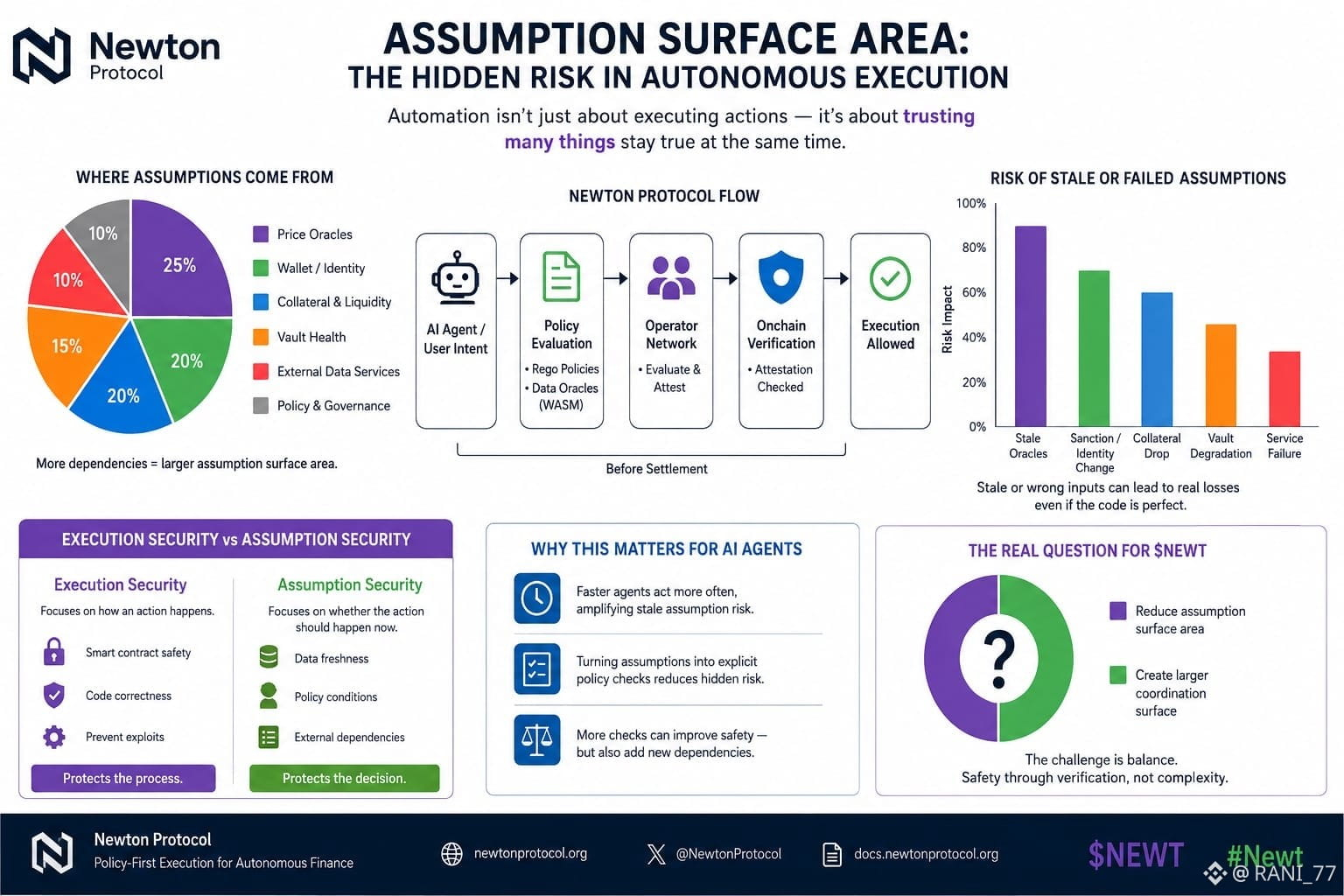
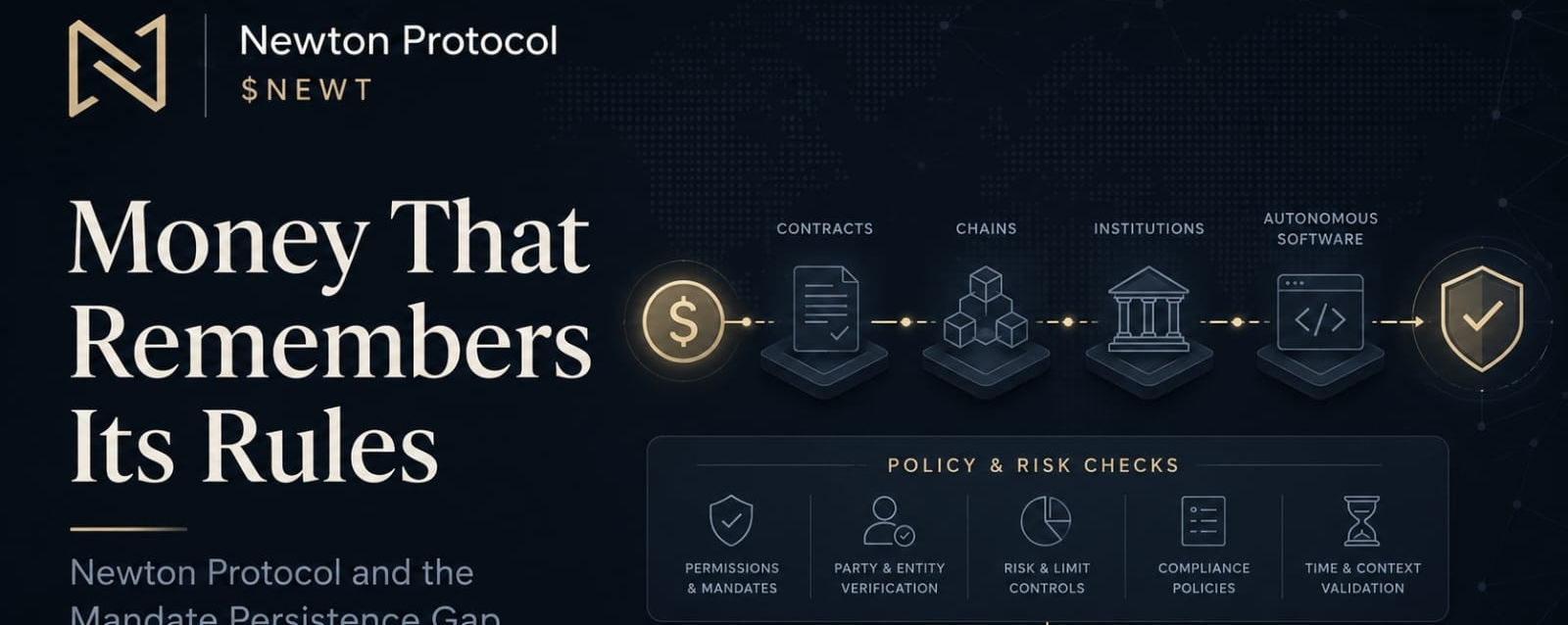
I think the most dangerous part of autonomous execution is not the action an agent takes. It is the number of assumptions that must remain true for that action to be safe.
In DeFi, automation often depends on more than price. A strategy may assume an oracle is fresh, a wallet is not sanctioned, collateral is liquid, a vault remains healthy, and an external data service responds correctly. Each dependency expands what I call the “assumption surface area.” The code can execute exactly as designed and still produce a bad outcome because one underlying condition changed quietly.
That is where @NewtonProtocol Mainnet Beta becomes interesting. Newton places policy evaluation before settlement. A proposed transaction is checked against programmable rules and relevant data, then operators produce a cryptographic attestation that the destination contract can verify onchain before allowing execution.
execution security protects how an action happens; assumption security tests whether the action should happen under current conditions.
This matters for AI agents because intelligence does not remove dependency risk. In fact, faster agents may amplify it by acting repeatedly on stale or incomplete assumptions. Newton can narrow that risk by turning important assumptions into explicit, enforceable policy conditions rather than leaving them buried inside strategy logic or dashboards.
Still, I am slightly skeptical of any system that appears to make automation “safe” by adding more data sources. Every oracle, policy update, operator decision, and integration creates another potential failure point. Newton’s real strength will depend on whether builders keep policies minimal, data fresh, and evaluation reliable under stress.
For $NEWT the long-term question is not simply whether more transactions use Newton. It is whether Newton can reduce assumption surface area without creating a larger coordination surface of its own.
Can autonomous finance become safer by checking more conditions, or does every new safeguard introduce another assumption that must be trusted? #Newt
In DeFi, automation often depends on more than price. A strategy may assume an oracle is fresh, a wallet is not sanctioned, collateral is liquid, a vault remains healthy, and an external data service responds correctly. Each dependency expands what I call the “assumption surface area.” The code can execute exactly as designed and still produce a bad outcome because one underlying condition changed quietly.
That is where @NewtonProtocol Mainnet Beta becomes interesting. Newton places policy evaluation before settlement. A proposed transaction is checked against programmable rules and relevant data, then operators produce a cryptographic attestation that the destination contract can verify onchain before allowing execution.
execution security protects how an action happens; assumption security tests whether the action should happen under current conditions.
This matters for AI agents because intelligence does not remove dependency risk. In fact, faster agents may amplify it by acting repeatedly on stale or incomplete assumptions. Newton can narrow that risk by turning important assumptions into explicit, enforceable policy conditions rather than leaving them buried inside strategy logic or dashboards.
Still, I am slightly skeptical of any system that appears to make automation “safe” by adding more data sources. Every oracle, policy update, operator decision, and integration creates another potential failure point. Newton’s real strength will depend on whether builders keep policies minimal, data fresh, and evaluation reliable under stress.
For $NEWT the long-term question is not simply whether more transactions use Newton. It is whether Newton can reduce assumption surface area without creating a larger coordination surface of its own.
Can autonomous finance become safer by checking more conditions, or does every new safeguard introduce another assumption that must be trusted? #Newt
翻訳参照
I think the most dangerous AI agent on a blockchain is not the one that makes a bad prediction. It is the one that can act on that prediction without proving the action was still permitted.
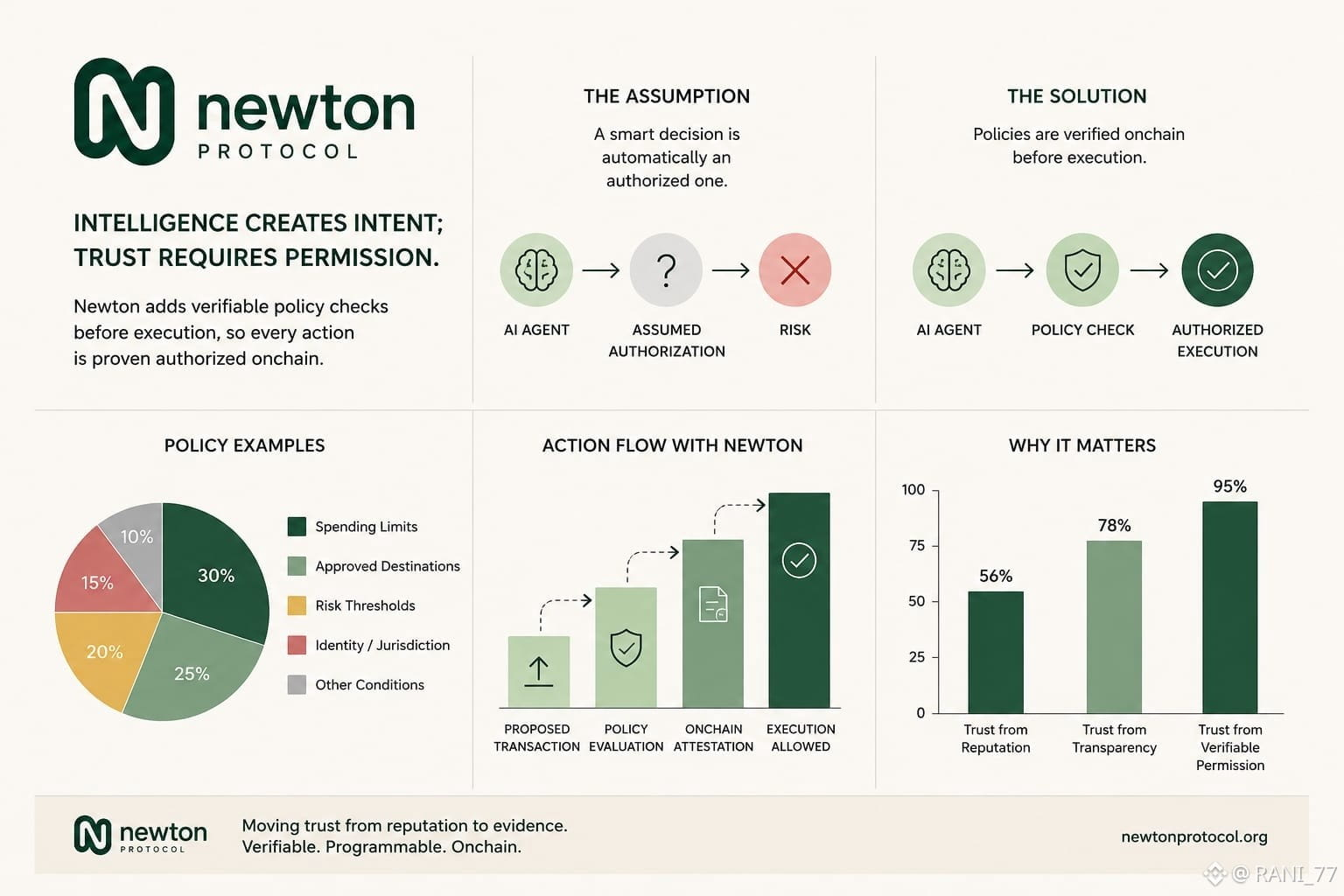
That creates a useful distinction: execution security versus mandate security. Execution security asks whether a transaction followed the contract’s code. Mandate security asks whether it respected the user’s current rules, such as exposure limits, approved markets, collateral standards, identity conditions, or changing risk signals.
DeFi automation often handles the first question better than the second. A valid signature can confirm that an agent had access, but it cannot prove that the transaction remained appropriate when settlement occurred. As agents become faster and more autonomous, that gap becomes more serious.
@NewtonProtocol ’s Mainnet Beta approaches the problem by adding programmable policy checks before settlement. An agent may propose a transaction, but the relevant conditions are evaluated before capital moves. When the action satisfies the policy, Newton produces an onchain attestation that the destination contract can verify. When it fails, execution can be blocked.
I see this as the difference between giving software a key and giving it a key with enforceable boundaries. That is a more practical security model for autonomous finance.
Still, the architecture must prove that stronger controls do not create excessive latency, cost, or integration complexity. $NEWT will ultimately matter only if developers and vault managers use these checks repeatedly, not merely because the concept sounds responsible.
As blockchain AI grows, should security focus less on whether agents can execute correctly and more on whether they can continuously prove they are still authorized to act? #Newt $LAB
That creates a useful distinction: execution security versus mandate security. Execution security asks whether a transaction followed the contract’s code. Mandate security asks whether it respected the user’s current rules, such as exposure limits, approved markets, collateral standards, identity conditions, or changing risk signals.
DeFi automation often handles the first question better than the second. A valid signature can confirm that an agent had access, but it cannot prove that the transaction remained appropriate when settlement occurred. As agents become faster and more autonomous, that gap becomes more serious.
@NewtonProtocol ’s Mainnet Beta approaches the problem by adding programmable policy checks before settlement. An agent may propose a transaction, but the relevant conditions are evaluated before capital moves. When the action satisfies the policy, Newton produces an onchain attestation that the destination contract can verify. When it fails, execution can be blocked.
I see this as the difference between giving software a key and giving it a key with enforceable boundaries. That is a more practical security model for autonomous finance.
Still, the architecture must prove that stronger controls do not create excessive latency, cost, or integration complexity. $NEWT will ultimately matter only if developers and vault managers use these checks repeatedly, not merely because the concept sounds responsible.
As blockchain AI grows, should security focus less on whether agents can execute correctly and more on whether they can continuously prove they are still authorized to act? #Newt $LAB
オンチェーン自動化において最も危険な前提は、「賢明な判断が自動的に承認されたものになる」ということだと思います。
AIエージェントは、バンクをリバランスし、流動性をルーティングし、人間よりも速く反応できます。しかしスピードは制御上の問題を生みます。エージェントは、破損したデータに従ったり、指令を誤読したり、エクスポージャー限度を超えたり、ユーザーが承認するつもりのなかった契約とやり取りしてしまうことがあります。取引が確定した後は、透明性によって何が起きたかは説明できます。しかし、その行為が行われるべきだったことを証明するわけではありません。
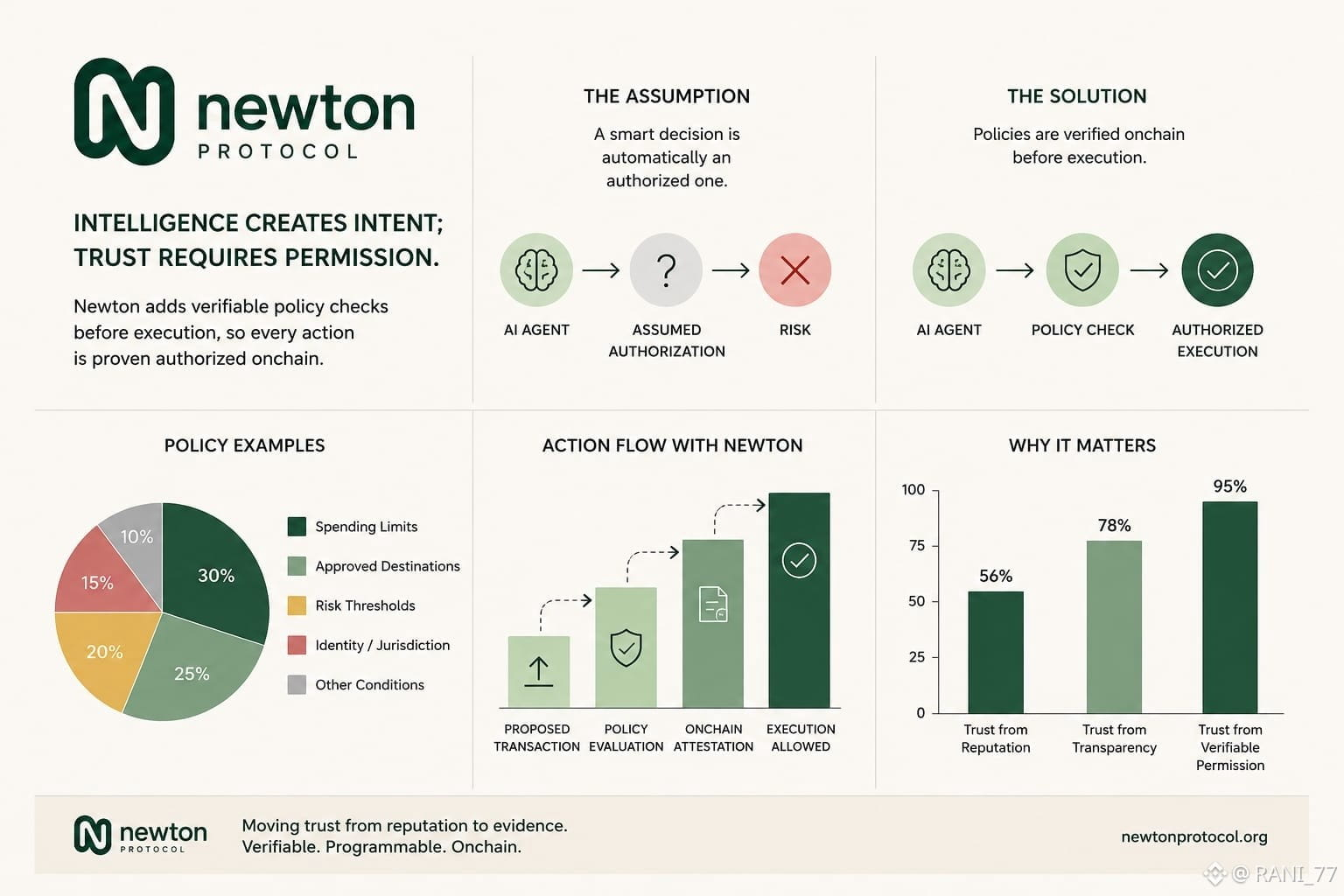
私のフレームワークはシンプルです。知性が意図を生み、信頼は許可を必要とする。
そのギャップこそが、<t-2/>@NewtonProtocol のメインネット・ベータが解決するよう設計されています。実行の前に、提案されたトランザクションはプログラム可能なポリシーに照らして評価されます。これらのポリシーは、アイデンティティ、管轄、支出限度、承認済みの宛先、またはリスク閾値の周りに条件を定義できます。行為がルールを満たすなら、ニュートンはオンチェーンのアテステーション(検証可能な証明)を生成し、決済前に宛先コントラクトがそれを検証できます。
これにより、信頼が評判から証拠へと移ります。ユーザーは、AIエージェント、バンクマネージャー、またはアプリケーションがその範囲(マンダート)内に留まったままでいると仮定する必要がなくなります。資本が移動する前に、各アクションが宣言されたポリシーを通過したことを確認できるのです。
私は、単にエージェントを賢くすることよりも、こちらのほうがより意味があると感じています。より良い知性はリターンを改善するかもしれませんが、検証可能な境界こそが、重大な資本が自動化されたシステム内に留まるかどうかを左右し得ます。
とはいえ、メインネット・ベータは現実のストレス下で自らを証明する必要があります。ポリシーの品質、オペレーターのパフォーマンス、データの正確性、統合時の摩擦、そして開発者の採用は、建築の優美さよりも重要になるでしょう。
$NEWT がネットワークを支える可能性はあっても、本当の試金石は、ニュートンが「任意のセキュリティ層」ではなく、依存されるインフラ・アプリケーションになれるかどうかです。
オンチェーン・ファイナンスは、より賢いエージェントによって定義されるのか。それとも、そうしたエージェントが行動する許可を得ていたというより強い証明によって定義されるのか?
#Newt $LAB
AIエージェントは、バンクをリバランスし、流動性をルーティングし、人間よりも速く反応できます。しかしスピードは制御上の問題を生みます。エージェントは、破損したデータに従ったり、指令を誤読したり、エクスポージャー限度を超えたり、ユーザーが承認するつもりのなかった契約とやり取りしてしまうことがあります。取引が確定した後は、透明性によって何が起きたかは説明できます。しかし、その行為が行われるべきだったことを証明するわけではありません。
私のフレームワークはシンプルです。知性が意図を生み、信頼は許可を必要とする。
そのギャップこそが、<t-2/>@NewtonProtocol のメインネット・ベータが解決するよう設計されています。実行の前に、提案されたトランザクションはプログラム可能なポリシーに照らして評価されます。これらのポリシーは、アイデンティティ、管轄、支出限度、承認済みの宛先、またはリスク閾値の周りに条件を定義できます。行為がルールを満たすなら、ニュートンはオンチェーンのアテステーション(検証可能な証明)を生成し、決済前に宛先コントラクトがそれを検証できます。
これにより、信頼が評判から証拠へと移ります。ユーザーは、AIエージェント、バンクマネージャー、またはアプリケーションがその範囲(マンダート)内に留まったままでいると仮定する必要がなくなります。資本が移動する前に、各アクションが宣言されたポリシーを通過したことを確認できるのです。
私は、単にエージェントを賢くすることよりも、こちらのほうがより意味があると感じています。より良い知性はリターンを改善するかもしれませんが、検証可能な境界こそが、重大な資本が自動化されたシステム内に留まるかどうかを左右し得ます。
とはいえ、メインネット・ベータは現実のストレス下で自らを証明する必要があります。ポリシーの品質、オペレーターのパフォーマンス、データの正確性、統合時の摩擦、そして開発者の採用は、建築の優美さよりも重要になるでしょう。
$NEWT がネットワークを支える可能性はあっても、本当の試金石は、ニュートンが「任意のセキュリティ層」ではなく、依存されるインフラ・アプリケーションになれるかどうかです。
オンチェーン・ファイナンスは、より賢いエージェントによって定義されるのか。それとも、そうしたエージェントが行動する許可を得ていたというより強い証明によって定義されるのか?
#Newt $LAB
ログインして、さらにコンテンツを読む