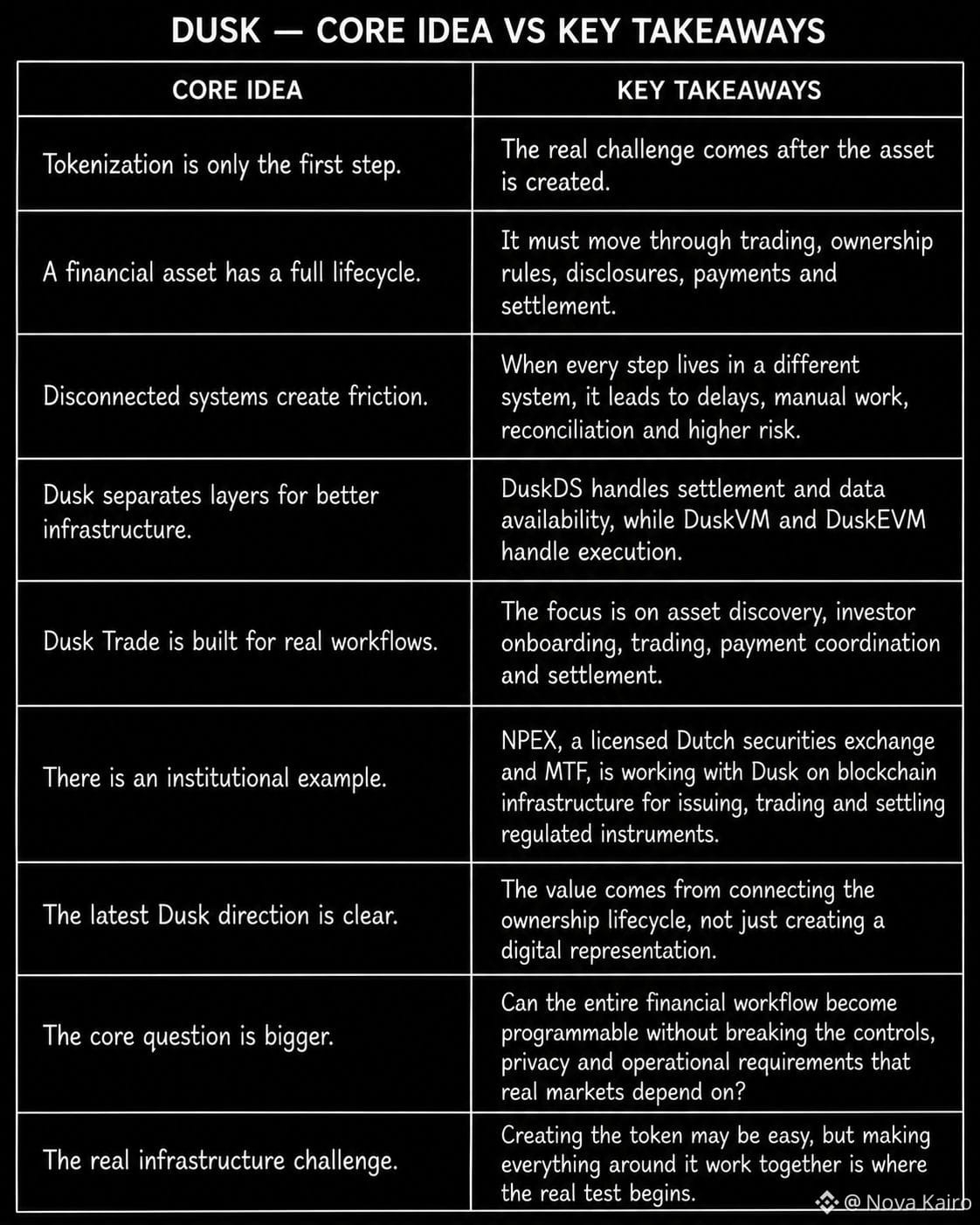
#dusk $DUSK @Dusk A token can exist onchain and still leave the financial system mostly unchanged.
That’s the part of Dusk I think is easy to miss.
Take a regulated SME security. Getting the instrument onto a blockchain is only one step. Investors still need to be onboarded, eligibility needs to be handled, ownership needs to be recorded, trades need to happen, disclosures need to reach the right parties, and the asset and payment legs eventually need to settle.
If every one of those steps still depends on separate systems and reconciliation, the token itself hasn’t fixed the bigger problem.
This is why Dusk’s current direction caught my attention.
Its base architecture separates settlement and data availability through DuskDS from execution through DuskVM and DuskEVM. On top of that, Dusk Trade is being developed around practical workflows such as asset discovery, investor onboarding, trading, payment coordination and settlement.
There’s also a concrete market example behind the thesis.
NPEX, a licensed Dutch securities exchange operating an MTF, has been working with Dusk on blockchain-based infrastructure for issuing, trading and settling regulated financial instruments.
And Dusk’s latest material makes the same distinction I find interesting: tokenization becomes more useful when it connects the ownership lifecycle instead of simply creating a digital representation of an asset.
So I’m starting to look at Dusk less as a place to “put RWAs onchain” and more as a bet on something harder:
Can the financial workflow itself become programmable?
Because the real breakthrough may not be creating the token.
It may be removing the pile of disconnected processes that the token was supposed to replace.
That’s the part of Dusk I think is easy to miss.
Take a regulated SME security. Getting the instrument onto a blockchain is only one step. Investors still need to be onboarded, eligibility needs to be handled, ownership needs to be recorded, trades need to happen, disclosures need to reach the right parties, and the asset and payment legs eventually need to settle.
If every one of those steps still depends on separate systems and reconciliation, the token itself hasn’t fixed the bigger problem.
This is why Dusk’s current direction caught my attention.
Its base architecture separates settlement and data availability through DuskDS from execution through DuskVM and DuskEVM. On top of that, Dusk Trade is being developed around practical workflows such as asset discovery, investor onboarding, trading, payment coordination and settlement.
There’s also a concrete market example behind the thesis.
NPEX, a licensed Dutch securities exchange operating an MTF, has been working with Dusk on blockchain-based infrastructure for issuing, trading and settling regulated financial instruments.
And Dusk’s latest material makes the same distinction I find interesting: tokenization becomes more useful when it connects the ownership lifecycle instead of simply creating a digital representation of an asset.
So I’m starting to look at Dusk less as a place to “put RWAs onchain” and more as a bet on something harder:
Can the financial workflow itself become programmable?
Because the real breakthrough may not be creating the token.
It may be removing the pile of disconnected processes that the token was supposed to replace.