I went down a bit of a rabbit hole with Dusk, and one thing kept pulling me back in.
Dusk isn’t treating privacy as a simple “hide the transaction” feature.
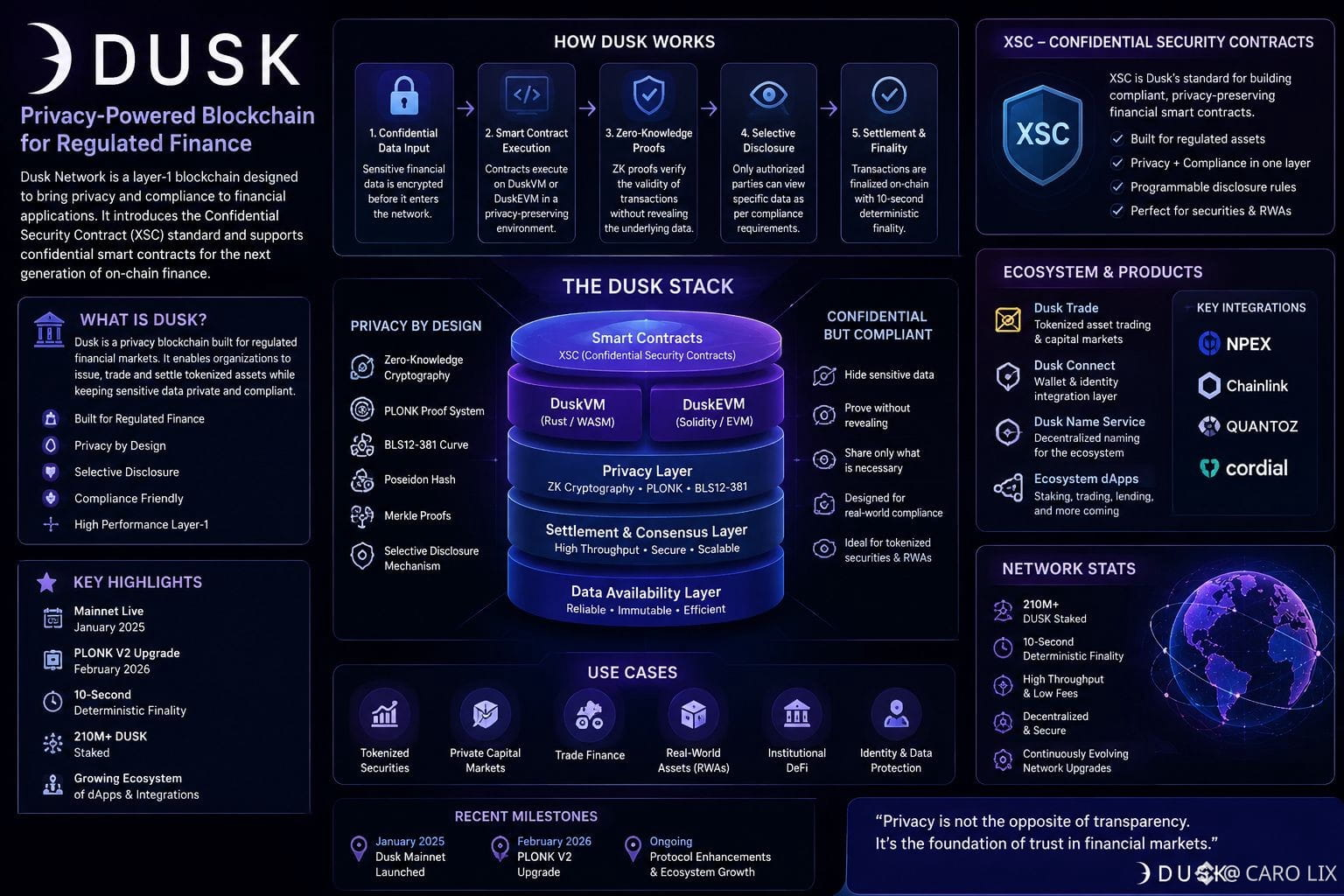
It’s building a Layer-1 specifically around financial applications, where some information needs to stay private while other information still needs to be verified.
That led me to its XSC standard — Confidential Security Contracts.
The idea is pretty interesting: smart contracts can handle confidential financial data while still supporting the kind of verification and disclosure that regulated markets need.
Then I looked under the hood.
Dusk uses zero-knowledge cryptography and its own DuskVM for Rust/WASM contracts. It also has DuskEVM, giving Solidity developers a familiar path into the network.
That combination caught my attention because Dusk isn’t forcing everything into one development environment.
The deeper I went, the more the pieces started connecting.
Privacy.
Smart contracts.
Asset settlement.
Selective disclosure.
And tokenized financial assets.
Dusk mainnet went live in January 2025, and the network has continued upgrading its privacy and execution stack since then. PLONK V2 was another upgrade I found worth watching because it strengthens the zero-knowledge side of the protocol.
There’s also an ecosystem forming around the core network, including Dusk Trade, Dusk Connect and integrations aimed at bringing real financial assets and workflows onchain.
That’s the part I’m most curious about.
A privacy chain is easy to describe.
Building one that can actually fit the needs of financial markets is much harder.
After digging through Dusk’s docs and ecosystem, I’m less interested in the headline and more interested in whether developers and institutions actually keep building on it.
That’s what I’ll be watching next.
$BEAT
#dusk $DUSK @Dusk
$TRUMP
Dusk isn’t treating privacy as a simple “hide the transaction” feature.
It’s building a Layer-1 specifically around financial applications, where some information needs to stay private while other information still needs to be verified.
That led me to its XSC standard — Confidential Security Contracts.
The idea is pretty interesting: smart contracts can handle confidential financial data while still supporting the kind of verification and disclosure that regulated markets need.
Then I looked under the hood.
Dusk uses zero-knowledge cryptography and its own DuskVM for Rust/WASM contracts. It also has DuskEVM, giving Solidity developers a familiar path into the network.
That combination caught my attention because Dusk isn’t forcing everything into one development environment.
The deeper I went, the more the pieces started connecting.
Privacy.
Smart contracts.
Asset settlement.
Selective disclosure.
And tokenized financial assets.
Dusk mainnet went live in January 2025, and the network has continued upgrading its privacy and execution stack since then. PLONK V2 was another upgrade I found worth watching because it strengthens the zero-knowledge side of the protocol.
There’s also an ecosystem forming around the core network, including Dusk Trade, Dusk Connect and integrations aimed at bringing real financial assets and workflows onchain.
That’s the part I’m most curious about.
A privacy chain is easy to describe.
Building one that can actually fit the needs of financial markets is much harder.
After digging through Dusk’s docs and ecosystem, I’m less interested in the headline and more interested in whether developers and institutions actually keep building on it.
That’s what I’ll be watching next.
$BEAT
#dusk $DUSK @Dusk
$TRUMP