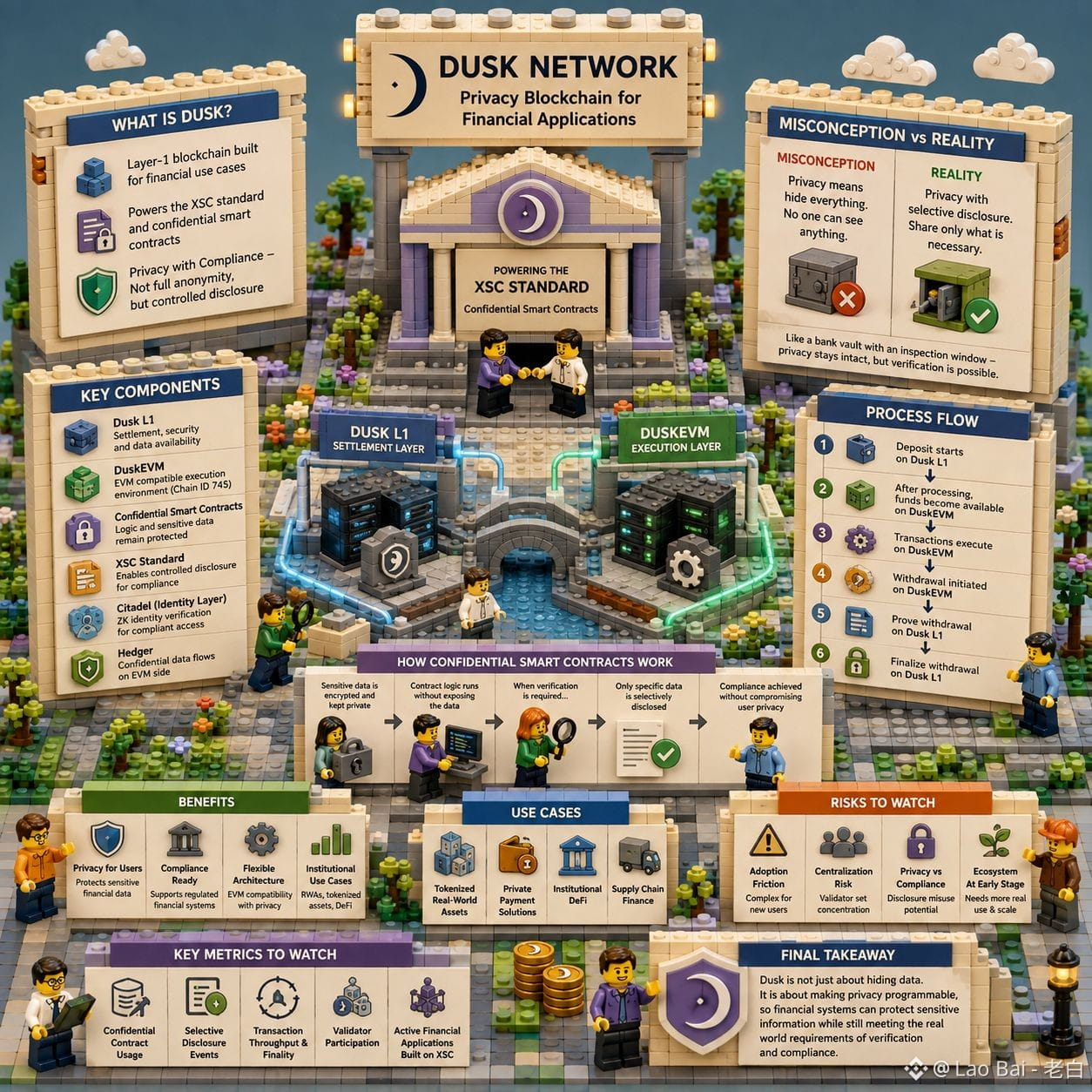
#dusk $DUSK @Dusk One thing I noticed while digging through Dusk’s privacy model: it doesn’t treat privacy as a simple on/off setting. That sounds minor, but for financial applications it changes the entire design problem.
Most people hear “privacy blockchain” and imagine a black box where everything disappears. That can actually be a weakness for regulated finance. It’s like sending a sealed package through a bank—protecting the contents is useful, but someone still needs a legitimate way to verify what matters.
Dusk’s XSC approach puts confidential smart contracts at the center, allowing sensitive logic and data to remain protected while supporting selective disclosure when compliance requires it. The important distinction is that privacy becomes part of the contract design rather than something added around transactions.
I’d watch confidential contract activity, disclosure frequency, transaction finality, validator participation, and real application deployments. Privacy is easy to advertise; programmable privacy that institutions actually use is much harder.
Most people hear “privacy blockchain” and imagine a black box where everything disappears. That can actually be a weakness for regulated finance. It’s like sending a sealed package through a bank—protecting the contents is useful, but someone still needs a legitimate way to verify what matters.
Dusk’s XSC approach puts confidential smart contracts at the center, allowing sensitive logic and data to remain protected while supporting selective disclosure when compliance requires it. The important distinction is that privacy becomes part of the contract design rather than something added around transactions.
I’d watch confidential contract activity, disclosure frequency, transaction finality, validator participation, and real application deployments. Privacy is easy to advertise; programmable privacy that institutions actually use is much harder.