
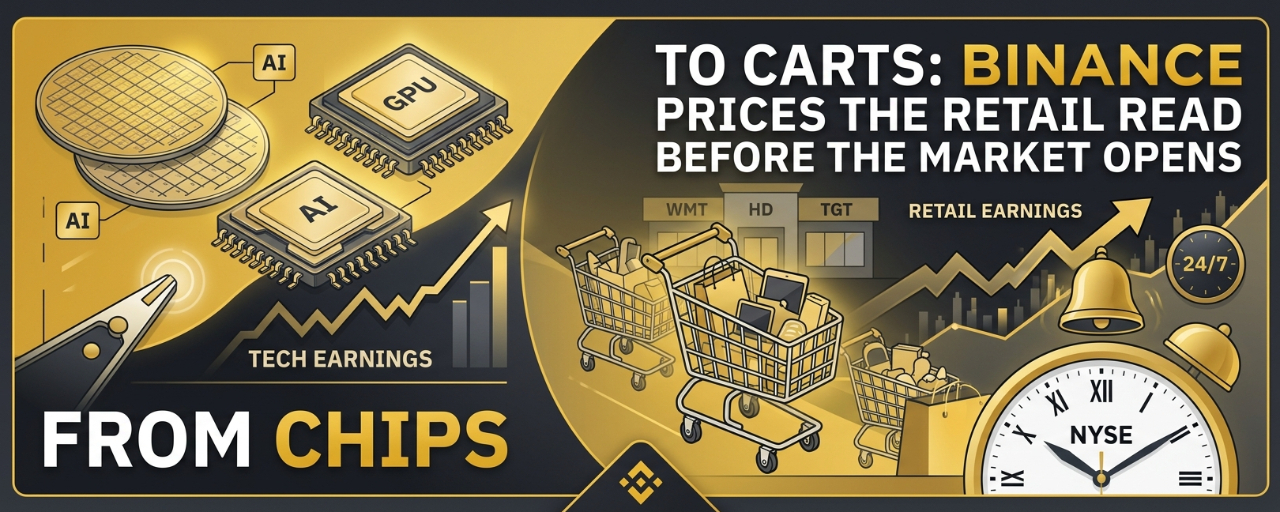
For much of 2026, AI and semiconductor stocks have dominated the market conversation. But as major retailers report earnings, attention is shifting from chips to carts and from AI infrastructure to the health of the everyday consumer.
Companies such as Walmart (WMT), Home Depot (HD), and Target (TGT) can provide a different window into the economy. Their earnings don't just tell investors how individual businesses are performing. They can also reveal how consumers are spending, where prices are rising, and how changing household behavior could influence expectations for inflation, interest rates, and economic growth. The interesting part is that traders don't have to wait for traditional markets to open to start expressing those views.
With Binance's 24/7 market infrastructure and tokenized stock products, market participants can react to new information outside conventional equity-market hours.
The Market Is Moving From AI to the Consumer
AI has been one of the defining investment themes of the year.
Chipmakers, cloud providers, and technology companies have attracted enormous attention as investors try to understand how much businesses are willing to spend on AI infrastructure.
But another question is becoming increasingly important:
How healthy is the consumer underneath all of this technology spending?
That's where retailers become important.
Walmart can provide insight into everyday household spending. Home Depot can offer clues about housing, renovation, and big-ticket purchases. Target can provide another perspective on discretionary spending and consumer confidence.
Together, these companies can tell a very different story from Nvidia or other AI-related names.
Instead of asking how much companies are spending on computing power, investors start asking:
Are households still spending? And what are they spending their money on?
Why Retail Earnings Matter Beyond Retail
Retail earnings can have implications far beyond the individual companies reporting results.
Strong consumer demand can support economic growth, while weakening spending can raise concerns about a slowdown.
At the same time, retailers provide valuable information about pricing.
If companies report that customers are becoming more sensitive to prices, trading down to cheaper products, or cutting discretionary purchases, markets may interpret that as evidence that consumers are feeling pressure.
If businesses continue raising prices without significantly affecting demand, the inflation picture can look different.
That makes retail earnings another piece of the puzzle for traders trying to understand where monetary policy could be heading.
In other words:
The shopping cart can become a macroeconomic indicator.
But Wall Street Doesn't Trade 24/7
Here's where the traditional financial system creates an interesting gap.
A company can release earnings after the U.S. equity market closes.
The information is immediately available.
Analysts can immediately react.
Investors can immediately change their expectations.
But the underlying stock market may remain closed until the next trading session.
That creates a disconnect between when information arrives and when traditional markets can fully process it.
Crypto markets operate differently.
They were built around continuous trading.
And Binance's expansion into tokenized traditional assets is bringing that 24/7 infrastructure closer to conventional financial markets.
Binance Turns the Off-Hours Into a Market
This is where Binance's tokenized stock infrastructure becomes particularly interesting.
Instead of waiting for the next traditional market session, eligible users can access market exposure through products designed to operate within Binance's digital ecosystem, subject to the applicable product and regional restrictions.
That means an earnings announcement doesn't necessarily have to sit untouched until the opening bell.
Traders can begin forming a view.
If Walmart delivers unexpectedly strong results, for example, the market can immediately reassess expectations around consumer spending.
If Target reports weaker discretionary demand, traders may interpret that as another signal about household finances.
The important point isn't that Binance can predict what the stock will do next.
It's that the market can begin expressing expectations immediately.
The “Retail Read” Before the Opening Bell
This creates a useful concept for traders:
the retail read.
Before traditional equity markets open, off-hours pricing can provide an early indication of how market participants are interpreting new information.
Consider a simplified example. Walmart reports earnings after the traditional market closes. The results beat expectations. Management also raises guidance. Traders immediately reassess the company's outlook.
If the corresponding Binance market moves higher during the off-hours period, that movement becomes an early market signal.
When traditional markets reopen, investors can then compare the opening price with the earlier off-hours reaction.
This doesn't guarantee that the two prices will match.
Liquidity, spreads, market structure, trading hours, and new information can all affect the relationship.
But the comparison itself is valuable.
Same Market, Different Aisle
This is what makes the current transition so interesting.
Traditional markets and crypto-native markets aren't necessarily competing for completely different investors anymore.
They are increasingly interacting around the same underlying economic information.
One market may be closed.
Another remains open.
One operates according to traditional exchange hours.
Another operates continuously.
One relies on conventional brokerage infrastructure.
Another increasingly uses blockchain-based infrastructure.
Yet both are responding to the same earnings report, inflation data, geopolitical event, or consumer trend.
Same market. Different aisle.
Why This Matters for Global Investors
The 24/7 model is particularly relevant to investors outside traditional financial centers.
A trader in Africa, Asia, or the Middle East doesn't necessarily operate according to Wall Street's timetable.
Important information can arrive during their evening, overnight, or weekend.
A continuously accessible market means investors don't have to wait for a particular geographic market to open before expressing a view.
That doesn't mean every investor should trade earnings announcements.
In fact, off-hours markets can carry additional liquidity and volatility considerations.
But the infrastructure changes what's possible.
The Bigger Picture: From AI Infrastructure to Consumer Infrastructure
The rotation from AI-focused market narratives toward consumer data is more than a change in sector preference.
It reflects how investors continuously search for new information about the economy.
First, markets ask:
How much are companies spending on AI?
Then:
Are consumers still spending?
Then:
What does that tell us about inflation, growth, and interest rates?
This is why companies such as Walmart, Home Depot, and Target can become important market indicators even for investors who never buy their shares directly.
Their results provide another data point for understanding the economy.
And increasingly, digital markets can begin pricing that information immediately.
The Future of Markets Won't Have One Opening Bell
The deeper story isn't really about Walmart, Target, or Home Depot.
It's about what happens when financial markets stop being confined to traditional trading hours.
As tokenized equities and other real-world assets move onto digital infrastructure, the distinction between “market hours” and “off-hours” may gradually become less meaningful.
Information doesn't wait.
Consumers don't wait.
Companies don't wait.
And increasingly, financial markets don't have to wait either.
The next phase of market structure may therefore be defined not only by where an asset trades, but by how quickly a market can respond when new information arrives.
From chips to carts, the next market signal may already be forming—long before Wall Street's opening bell.