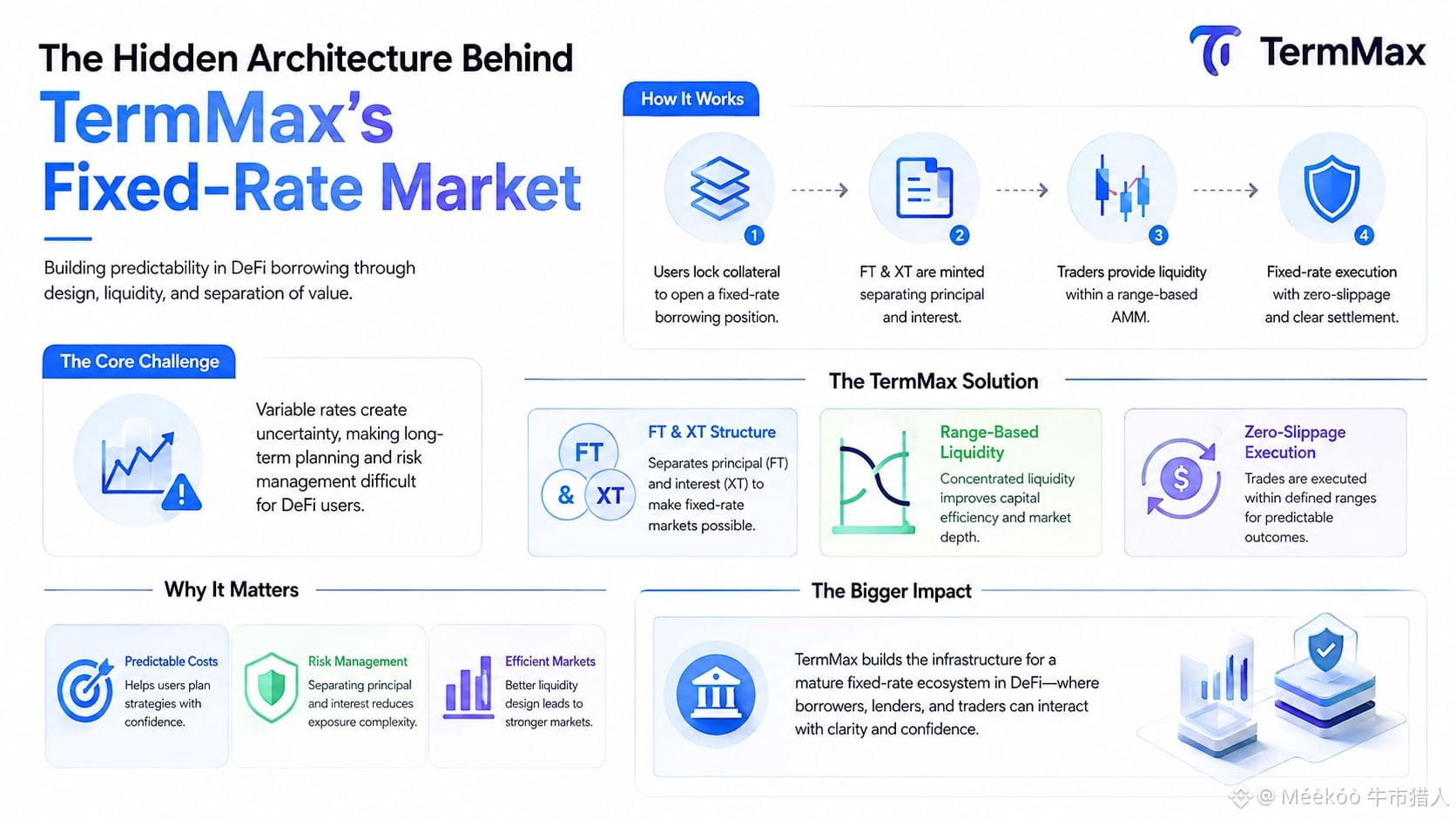
I keep coming back to @TermMax and one question keeps bothering me. Why does DeFi still make borrowing costs so difficult to predict?
For users planning capital over time, constantly changing rates can make even a simple strategy harder to manage.
That problem is not new.
Most DeFi lending markets depend on variable rates, while traditional fixed-rate structures can be harder to implement efficiently on-chain. The challenge is not simply setting a fixed rate; it is creating enough liquidity and a workable market around it.
TermMax takes a different approach.
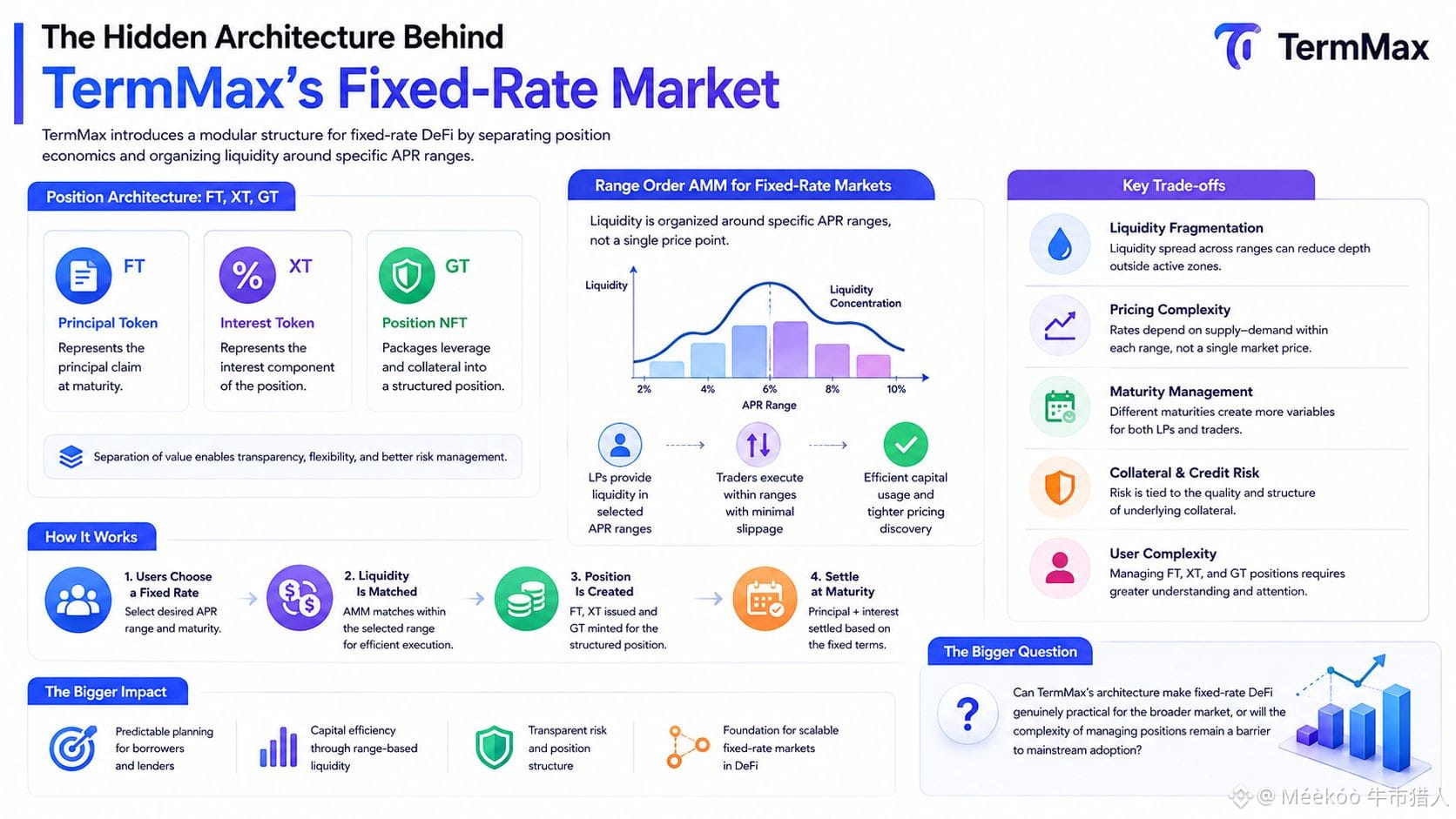
By separating the economics of a position through FT, XT, and GT. FT represents the principal claim, XT represents the interest component, while GT packages leverage and collateral into a structured position.
This is where the design gets interesting.
TermMax also uses a Range Order AMM for its fixed-rate markets, allowing liquidity to be organized around specific APR ranges rather than treating every trade like a conventional spot swap. But this approach still faces trade-offs around liquidity, pricing, maturity, collateral risk, and user complexity.
The bigger question for me is whether this architecture can make fixed-rate DeFi genuinely practical beyond sophisticated users, or whether the complexity of managing these positions could limit its wider adoption? #termmax @TermMax
$HEMI
$ENA
$RE
For users planning capital over time, constantly changing rates can make even a simple strategy harder to manage.
That problem is not new.
Most DeFi lending markets depend on variable rates, while traditional fixed-rate structures can be harder to implement efficiently on-chain. The challenge is not simply setting a fixed rate; it is creating enough liquidity and a workable market around it.
TermMax takes a different approach.
By separating the economics of a position through FT, XT, and GT. FT represents the principal claim, XT represents the interest component, while GT packages leverage and collateral into a structured position.
This is where the design gets interesting.
TermMax also uses a Range Order AMM for its fixed-rate markets, allowing liquidity to be organized around specific APR ranges rather than treating every trade like a conventional spot swap. But this approach still faces trade-offs around liquidity, pricing, maturity, collateral risk, and user complexity.
The bigger question for me is whether this architecture can make fixed-rate DeFi genuinely practical beyond sophisticated users, or whether the complexity of managing these positions could limit its wider adoption? #termmax @TermMax
$HEMI
$ENA
$RE