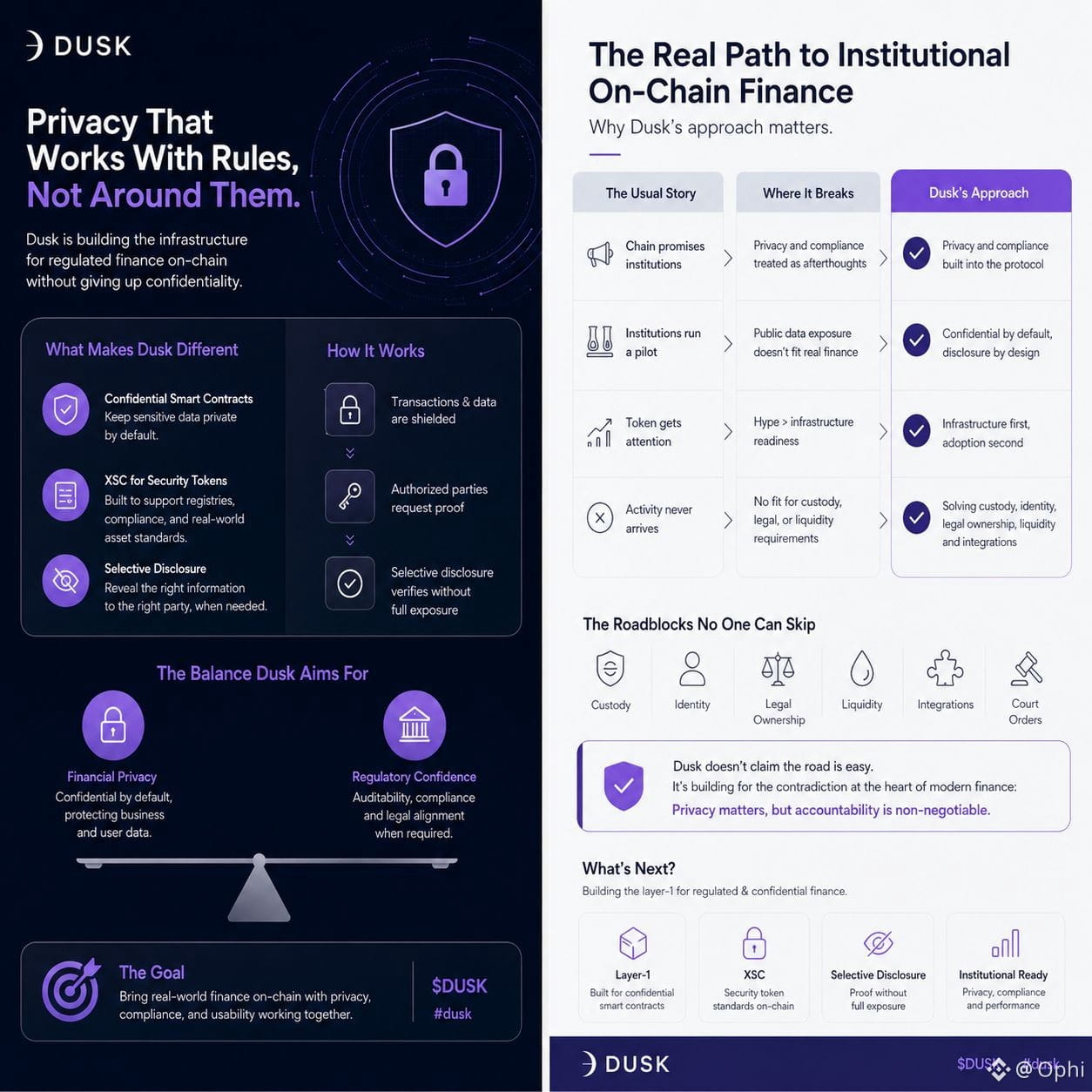
I'm noticing Dusk for an unexpected reason: it talks about privacy without pretending finance can live outside rules. I've watched enough cycles to know how this ends. A chain promises institutions, institutions run a pilot, the token gets attention, and activity never arrives.
Dusk takes a narrower path. Its layer-1 supports confidential smart contracts, while XSC is meant to carry security-token rules without placing every balance, position, or counterparty in public view. That makes more sense than asking a fund to broadcast its books on a blockchain. Transfers can stay shielded while selective disclosure gives an authorized party the proof it needs.
But I keep noticing the friction underneath. Privacy makes verification harder to explain, zero-knowledge systems raise the technical burden, and compliance logic can turn “permissionless finance” into a gated market with better plumbing. Then come the obstacles crypto avoids: custody, identity, legal ownership, liquidity, integrations, and what happens when code meets a court order.
I've seen this before—good engineering mistaken for inevitable adoption. I don't fully trust it, and I’m not sure yet whether XSC becomes infrastructure or another standard waiting for users. Still, something about this feels different. Dusk is at least staring at the contradiction most chains dodge: financial privacy matters, but a system that cannot reveal the right facts to the right people will never get close to serious money.
#dusk $DUSK
@Dusk
Dusk takes a narrower path. Its layer-1 supports confidential smart contracts, while XSC is meant to carry security-token rules without placing every balance, position, or counterparty in public view. That makes more sense than asking a fund to broadcast its books on a blockchain. Transfers can stay shielded while selective disclosure gives an authorized party the proof it needs.
But I keep noticing the friction underneath. Privacy makes verification harder to explain, zero-knowledge systems raise the technical burden, and compliance logic can turn “permissionless finance” into a gated market with better plumbing. Then come the obstacles crypto avoids: custody, identity, legal ownership, liquidity, integrations, and what happens when code meets a court order.
I've seen this before—good engineering mistaken for inevitable adoption. I don't fully trust it, and I’m not sure yet whether XSC becomes infrastructure or another standard waiting for users. Still, something about this feels different. Dusk is at least staring at the contradiction most chains dodge: financial privacy matters, but a system that cannot reveal the right facts to the right people will never get close to serious money.
#dusk $DUSK
@Dusk